


 Downloader
 Free FTP
Sequence Diagram Generator - Instantly Create Clear UML Interaction Diagrams
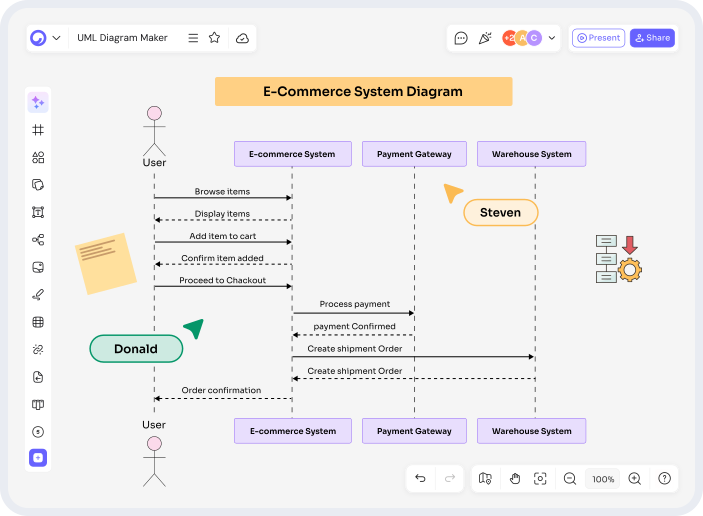
Designing complex systems without a clear visual structure can feel like trying to solve a puzzle in the dark. Developers, engineers, and project managers often deal with complicated workflows and interactions between multiple system components. This is where a sequence diagram generator becomes incredibly useful.
A sequence diagram generator allows you to visually represent how different parts of a system communicate with each other over time. Instead of manually sketching diagrams, these tools automatically create structured UML interaction diagrams that are easy to understand and share.
Think of it like creating a roadmap for a conversation between system components. Every step, every message, and every interaction becomes visible. That clarity helps teams build better software, avoid misunderstandings, and streamline system design.
Introduction to Sequence Diagrams
What is a Sequence Diagram?
A sequence diagram is a type of UML (Unified Modeling Language) diagram that shows how objects or components interact in a particular order. It visually displays the sequence of messages exchanged between different parts of a system.
Imagine a conversation between two people. One person speaks, the other responds, and the conversation continues. A sequence diagram represents that interaction, but instead of people, it shows system components.
Each component sends and receives messages over time, creating a clear timeline of interactions.
Why Sequence Diagrams Are Important in System Design
Sequence diagrams play a critical role in software development and system architecture. They help teams understand how processes work behind the scenes.
Without sequence diagrams, system interactions can become confusing. But with a clear visual structure, developers can easily identify system behaviors, dependencies, and communication flows.
Understanding a Sequence Diagram Generator
What is a Sequence Diagram Generator?
A sequence diagram generator is a tool that automatically creates sequence diagrams based on system interactions or inputs provided by the user.
Instead of drawing every element manually, users simply define the actors, messages, and processes. The generator then converts that information into a structured UML diagram.
How Automated Diagram Tools Simplify Complex Systems
Modern systems can involve dozens of services, APIs, and users interacting at once. Manually drawing these interactions can take hours.
Key Elements of a Sequence Diagram
Participants or Actors
Participants represent the entities involved in the interaction. These can include users, applications, databases, or services.
Each participant is represented by a vertical line called a lifeline.
Lifelines and Activation Bars
A lifeline represents the existence of a participant during the interaction.
Activation bars show when a participant is actively processing a task. These elements help illustrate when components are performing operations.
Messages and Interactions
Messages represent communication between participants. These messages show how data flows between system components.
Benefits of Using a Sequence Diagram Generator
Saves Time in Diagram Creation
Creating diagrams manually can be time-consuming. A sequence diagram generator speeds up the process by automating diagram creation.
What once took hours can now be completed in minutes.
Improves Communication Between Teams
Visual diagrams make it easier for developers, designers, and stakeholders to understand system interactions.
Instead of explaining complicated workflows verbally, teams can simply show the diagram.
Simplifies Complex Processes
Systems often involve multiple steps and interactions. Sequence diagrams break these processes into simple visual flows.
This makes complex systems easier to understand and analyze.
Conclusion
A sequence diagram generator is an essential tool for visualizing system interactions and simplifying complex workflows. Whether you're designing software, planning system architecture, or documenting processes, sequence diagrams provide a clear and structured view of how components communicate.
By automating diagram creation, modern tools save time, improve collaboration, and help teams build better systems. As technology continues to evolve, AI-powered diagram generators will make it even easier to transform ideas and system logic into clear, interactive visual diagrams.
FAQs
1. What is the main purpose of a sequence diagram generator?
A sequence diagram generator helps automatically create UML sequence diagrams that show how different system components interact over time.
2. Who uses sequence diagram generators?
Software developers, system architects, engineers, and project managers commonly use sequence diagram generators to design and document system interactions.
3. Are sequence diagrams only used in software development?
No. Sequence diagrams can also be used for business process modeling, workflow analysis, and system planning.
4. Can AI generate sequence diagrams automatically?
Yes. Many modern tools use artificial intelligence to generate sequence diagrams from text descriptions, code, or system workflows.
5. Why are sequence diagrams important in system architecture?
They help visualize how components communicate, making it easier to understand system behavior, identify issues, and improve design.

 English
 Arabic
 French
 Spanish
 Portuguese
 Deutsch
 Turkish
 Italiano
 Russian
 Romaian
 Portuguese (Brazil)
 Greek
Greek
