


 Downloader
 Free FTP
BIS Certification in India: Complete Guide 2026
INTRODUCTION
BIS Certification is one of the most important regulatory requirements for manufacturers and importers in India. It ensures that products meet quality, safety, and performance standards defined by the Bureau of Indian Standards (BIS). Whether you are a domestic manufacturer or an importer, understanding the BIS certification process in India is crucial to avoid legal issues and ensure smooth market entry.
In this detailed guide, we will explain everything about BIS Certification, including the process, types of licenses, requirements for importers, and how to get BIS certification in India.
What is BIS Certification?
BIS Certification is a conformity assessment issued by the Bureau of Indian Standards. It ensures that a product complies with Indian quality standards and is safe for consumers. Once certified, manufacturers can use the BIS Certification Mark on their products, which builds trust among customers and regulators.
The certification is mandatory for certain products like electronics, steel, cement, toys, and more. Selling non-certified products in such categories can lead to penalties and product bans.
Importance of BIS Certification in India
Getting a BIS License offers multiple benefits:
-
Ensures product quality and safety
-
Enhances brand credibility
-
Mandatory for regulated products
-
Helps in smooth import and export
-
Builds consumer trust
For importers, obtaining a BIS Import Certificate is essential before selling products in the Indian market.
Types of BIS Certification Schemes
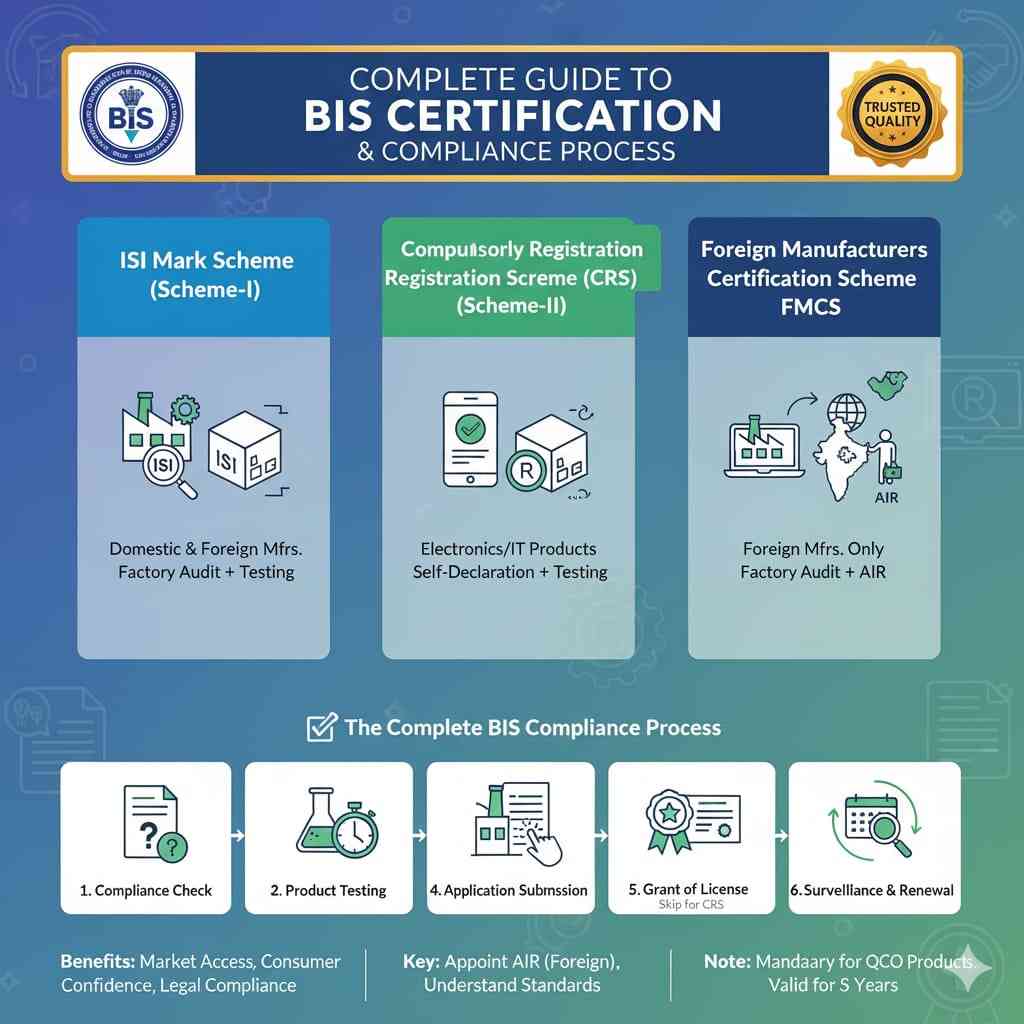
There are mainly three types of BIS certification schemes:
1. ISI Mark Scheme
This is the most common scheme for domestic manufacturers. Products like cement, electrical appliances, and food items require the ISI mark.
2. Compulsory Registration Scheme (CRS)
This scheme is mainly for electronics and IT products such as mobile phones, LED lights, and laptops.
3. Foreign Manufacturers Certification Scheme (FMCS)
Foreign manufacturers must obtain certification under this scheme to sell products in India. It acts as a BIS Certification for Imports
BIS Certification Process in India
Understanding the BIS certification process India is essential for a smooth application. Below is a step-by-step explanation:
Step 1: Identify Applicable Standard
Determine the Indian Standard (IS) applicable to your product.
Step 2: Product Testing
The product must be tested in a BIS-recognized laboratory to ensure compliance with quality standards.
Step 3: Documentation
Prepare all required documents, including:
-
Business license
-
Product details
-
Test reports
-
Manufacturing process details
Step 4: Application Submission
Submit the application online through the BIS portal.
Step 5: Factory Inspection
BIS officials may inspect the manufacturing unit to verify production capabilities.
Step 6: Grant of BIS License
After successful verification, the BIS License is issued.
How to Get BIS Certification in India
If you are wondering how to get BIS certification in India, follow these key steps:
-
Identify whether your product requires mandatory certification
-
Choose the correct BIS scheme
-
Get product testing done
-
Submit the application with documents
-
Coordinate for inspection (if required)
-
Receive certification and start using the BIS mark
The process may take a few weeks to a few months depending on the product category and compliance level.
BIS Certification for Import
Importers must comply with BIS regulations before selling products in India. The BIS Certification for Import ensures that imported goods meet Indian standards.
Key Requirements for Importers:
-
Foreign manufacturer must obtain BIS certification
-
Authorized Indian Representative (AIR) is required
-
Product testing must be done in BIS-approved labs
-
Proper labeling with BIS Certification Mark
Without a valid BIS Import License, imported goods can be rejected at customs.
BIS Import Certificate and License
The BIS Import Certificate is mandatory for certain regulated products. It confirms that the imported goods comply with Indian safety standards.
Benefits of BIS Import License:
-
Easy customs clearance
-
Legal compliance
-
Increased market acceptance
-
Reduced risk of penalties
Importers must ensure that their suppliers are BIS certified before shipping products to India.
Documents Required for BIS Certification
Here are the common documents needed:
-
कंपनी रजिस्ट्रेशन सर्टिफिकेट
-
Manufacturing license
-
Product test reports
-
Quality control details
-
Authorized signatory ID proof
-
Factory layout and process flow
Proper documentation is critical to avoid delays in the certification process.
Cost of BIS Certification
The cost of BIS certification depends on several factors:
-
Product category
-
Testing charges
-
Application fees
-
Inspection charges
For importers, additional costs may include AIR fees and international coordination expenses.
Common Challenges in BIS Certification
Many businesses face difficulties during the process, such as:
-
Incorrect documentation
-
Delay in product testing
-
Lack of knowledge about standards
-
Compliance issues during inspection
To avoid these issues, proper planning and expert guidance are essential.
Conclusion
BIS Certification is a crucial requirement for ensuring product quality and regulatory compliance in India. Whether you are a manufacturer or importer, understanding the certification process, documentation, and legal requirements can save time and avoid penalties.
From obtaining a BIS License to securing a BIS Import Certificate, every step plays a vital role in entering and succeeding in the Indian market. If you follow the correct process and ensure compliance with standards, getting BIS certification becomes much easier.
For professional assistance and hassle-free certification services, you can rely on expert consultants like sunconsultants.co.in.

 English
 Arabic
 French
 Spanish
 Deutsch
 Turkish
 Dutch
Dutch
 Italiano
 Russian
 Romaian
 Portuguese (Brazil)
 Greek
Greek
