


 Downloader
 Free FTP
Where Black Box Testing Fits in the Software Testing Lifecycle?
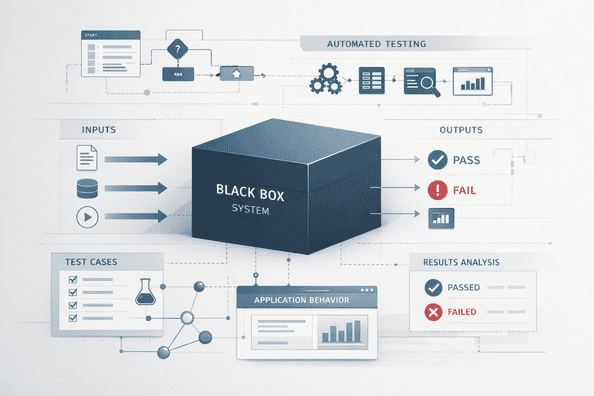
Modern software development relies on structured processes to ensure that applications function correctly before they reach users. The software testing lifecycle includes multiple stages that help identify defects, validate functionality, and confirm that the application meets its intended requirements. Within this lifecycle, black box testing plays a significant role in verifying how software behaves from an external perspective.
Black box testing focuses on evaluating system functionality without examining the internal code structure. Testers interact with the application by providing inputs and analyzing outputs, ensuring that the software behaves according to its specifications. Because this approach reflects how real users interact with the system, it becomes an important component of several stages in the software testing lifecycle.
Understanding the Software Testing Lifecycle
The software testing lifecycle consists of a series of phases designed to ensure that testing activities are organized and effective. These phases typically include requirement analysis, test planning, test design, test execution, and test closure.
Each phase contributes to improving software quality by identifying potential issues and validating application behavior. Black box testing fits naturally into this lifecycle because it focuses on validating the functionality described in system requirements and user stories.
By aligning testing activities with development stages, teams can ensure that software quality is maintained throughout the entire project.
Role During Requirement Analysis
The testing lifecycle begins with requirement analysis, where testers review project documentation, system specifications, and user requirements. During this stage, testers identify what aspects of the application need validation.
Black box testing is closely tied to requirement analysis because test cases are typically derived from functional requirements rather than internal code structures. Testers use these requirements to understand expected system behavior and prepare for designing functional test scenarios.
This early understanding ensures that testing activities remain aligned with user expectations and business objectives.
Contribution to Test Case Design
Once requirements are understood, the next stage involves designing test cases that will be used during test execution. This phase is where black box testing becomes particularly important.
Testers design test cases based on system inputs, expected outputs, and user workflows. Techniques such as boundary value analysis, equivalence partitioning, and decision table testing are commonly used to create structured functional tests.
By focusing on system behavior rather than internal logic, these tests help validate whether the application performs correctly in real-world scenarios.
Role in Functional Testing
Functional testing is one of the most common stages where black box testing is applied. During this stage, testers verify that different features of the application operate according to the defined requirements.
For example, testers may validate features such as user authentication, form submissions, data processing, and navigation workflows. These tests confirm that each function of the application produces the expected results when provided with specific inputs.
Functional validation ensures that the application behaves correctly from the perspective of end users.
Supporting System and Acceptance Testing
As development progresses, testing expands to system-level and acceptance testing stages. Black box testing is widely used in these phases to validate the complete behavior of the application.
During system testing, testers evaluate the application as a whole to confirm that different components work together properly. Acceptance testing focuses on verifying whether the system meets the expectations of stakeholders or end users.
Because black box testing simulates real user interactions, it provides valuable insights into whether the system performs as intended in practical usage scenarios.
Relationship with Other Testing Methods
Modern quality assurance strategies typically combine multiple testing approaches to achieve better coverage. While black box testing evaluates external behavior, other techniques analyze internal system logic.
For instance, teams often apply both black box testing and white box testing during the testing lifecycle. The first focuses on validating system outputs based on inputs, while the second examines the internal structure of the code to ensure that logical paths and conditions function correctly.
Combining these methods helps teams verify both the functional behavior and internal reliability of the application.
Integration with Automated Testing
As development teams adopt faster release cycles and continuous integration practices, testing processes must become more efficient. Black box testing can be integrated with automated testing frameworks to validate application functionality more quickly.
Automated functional tests can simulate user interactions such as form submissions, login processes, and navigation flows. These tests can run automatically whenever code changes are introduced, helping teams detect problems early in the development process.
Automation allows teams to execute functional tests repeatedly without increasing manual effort.
Conclusion
Ensuring software quality requires testing strategies that validate both internal logic and real-world functionality. Black box testing plays a key role in the software testing lifecycle by verifying that applications behave correctly according to their requirements.
From requirement analysis and test design to functional, system, and acceptance testing, black box testing helps confirm that software delivers the expected outcomes for users. When combined with other testing approaches and automation practices, it becomes an essential method for building reliable and high-quality software systems.

 English
 Arabic
 French
 Spanish
 Portuguese
 Deutsch
 Turkish
 Italiano
 Russian
 Romaian
 Portuguese (Brazil)
 Greek
Greek
