


 Downloader
 Free FTP
Promote Your Product
Got a product, service, or story to share? Promote it directly to our active community and boost your brand today.
Create an Ad
Publish Bulk Blog Posts
Boost Your Reach! 📝
Have articles, guest posts, or bulk stories to publish? Send your content directly to our editorial team and feature on our platform.
Email Us Your PostsChatGPT Deep Reasoning: A Practical Look at How AI Reasoning Models Actually Work
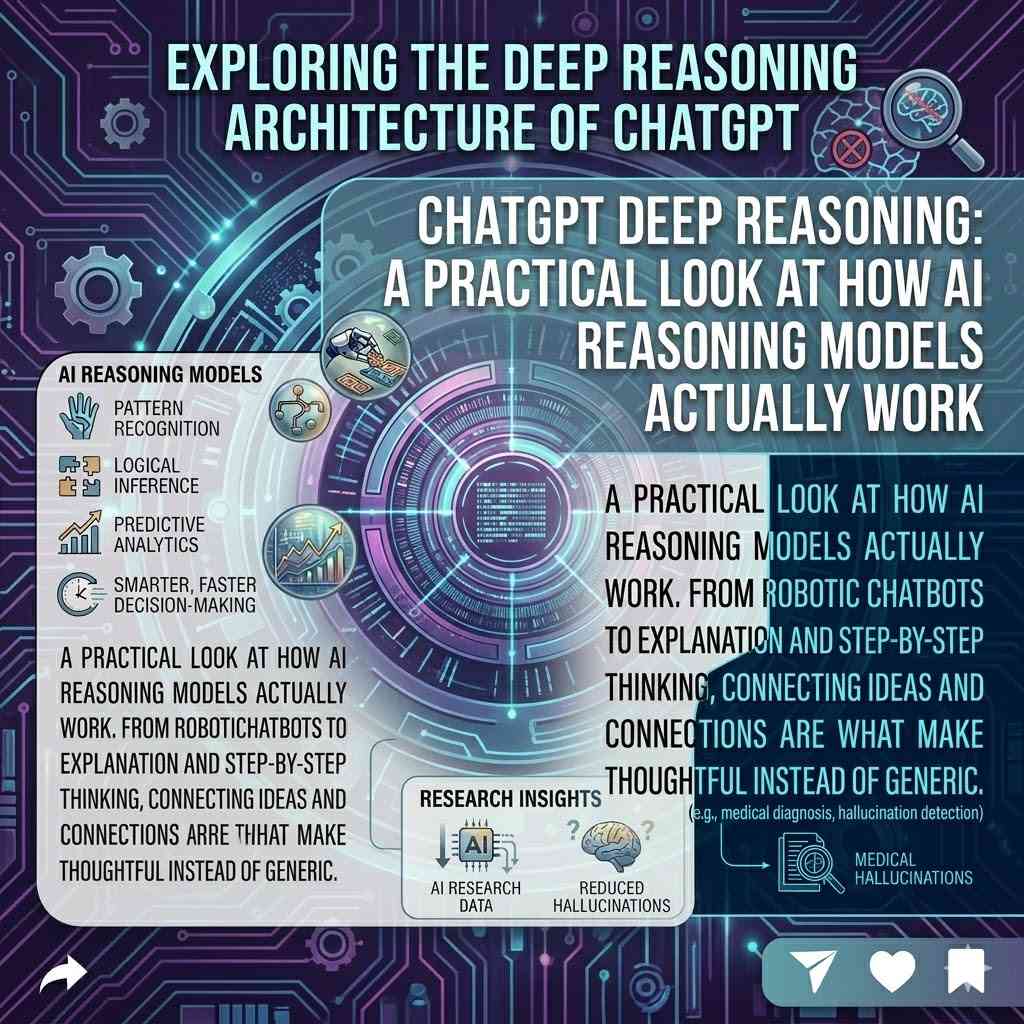
ChatGPT Deep Reasoning: A Practical Look at How AI Reasoning Models Actually Work
A few years ago, most AI chatbots felt… well, robotic. You could ask a question, and you’d usually get a predictable answer. Helpful sometimes, but rarely insightful.
That started changing when models began developing what many people now call ChatGPT deep reasoning. Suddenly the responses weren’t just answers, they were explanations, step-by-step thinking, comparisons, and sometimes even creative suggestions.
If you’ve used modern AI tools recently, you’ve probably noticed this shift. Ask a complicated question and instead of a short reply, the AI walks through the problem, weighs options, and gives a structured explanation.
So what’s actually happening behind the scenes? And why are people talking so much about AI reasoning models explained lately?
Let’s break it down in simple, practical terms.
The Moment AI Started Feeling “Smarter”
The first time I noticed deep reasoning in AI was during a product planning session.
A colleague asked an AI tool something like:
"We’re launching a SaaS product for small retailers. What marketing strategy should we prioritize with a limited budget?"
In the past, a chatbot might respond with a generic list:
-
Use social media
-
Run ads
-
Write blogs
But this time the AI responded differently.
It analyzed the situation, mentioned the budget constraint, suggested content marketing and partnerships with local business communities, and even explained why paid ads might not work initially.
That’s the difference deep reasoning brings. Instead of just retrieving information, the model starts connecting ideas.
What ChatGPT Deep Reasoning Really Means
Despite the name, AI doesn’t “think” the way humans do.
But ChatGPT deep reasoning refers to the model’s ability to:
-
analyze multiple parts of a problem
-
maintain context through longer conversations
-
break complex topics into logical steps
-
compare possible solutions
It’s less about intelligence and more about structured pattern analysis at scale.
Think of it like this:
A basic chatbot answers questions.
A reasoning model walks through problems with you.
That small difference is why the experience feels dramatically more helpful.
AI Reasoning Models Explained (Without the Technical Jargon)
When people hear the phrase AI reasoning models explained, they often expect complicated machine learning terms.
But the core idea is surprisingly simple.
Here’s roughly what happens when you ask a question.
1. The Model Interprets the Intent
First, the AI tries to understand what you're really asking.
Not just the words but the context.
For example:
“Should I invest in SEO or paid ads?”
The model interprets this as a business decision problem, not just a definition question.
2. It Breaks the Question Into Pieces
Reasoning models tend to split complex questions internally.
For example:
-
What is the goal?
-
What resources are available?
-
What outcomes are possible?
This is why answers often come back structured or step-based.
3. It Predicts Logical Connections
The AI then looks for patterns it learned during training.
For instance:
If small businesses have limited budgets → SEO often produces long-term value.
If a product launch needs immediate traction → ads may help faster.
These connections are what make responses feel thoughtful instead of generic.
4. It Generates a Coherent Response
Finally, everything gets assembled into a readable answer.
And ideally, one that actually helps.
That’s the simplified version of AI reasoning models explained without diving into transformer architectures or neural network math.
Why Deep Reasoning Matters More Than Most People Realize
At first glance, deep reasoning might seem like just a better chatbot feature.
But in reality, it changes how people use AI entirely.
Instead of asking simple questions like:
"What is cloud computing?"
Users now ask:
"Should a startup choose AWS or build on open-source infrastructure?"
That’s a decision, not a definition.
And that’s exactly where reasoning models shine.
Real-World Use Cases (Where It’s Already Making a Difference)
You’ll find ChatGPT deep reasoning showing up in more industries than people realize.
Education
Students now use AI to understand difficult topics step by step.
Instead of copying answers, they ask things like:
"Explain this physics problem like I'm a beginner."
That kind of guided explanation was almost impossible with earlier chatbots.
Software Development
Developers often use reasoning models to debug problems.
For example:
"Why does this API fail only when the server load increases?"
The AI can walk through possible causes instead of just defining terms.
Business Strategy
Founders increasingly use AI as a brainstorming partner.
Not to replace decisions, but to explore possibilities:
-
pricing strategies
-
market positioning
-
product ideas
Sometimes the AI suggestion sparks an idea the team hadn’t considered.
Customer Support
Companies are also experimenting with reasoning models to handle complex customer questions, not just simple FAQs.
For example:
Instead of responding with canned answers, AI can analyze a customer issue and guide them through possible fixes.
The Real Limitation People Should Know
Despite all the excitement around ChatGPT deep reasoning, it’s important to stay realistic.
AI reasoning models are impressive, but they still have limits.
They can:
✔ analyze patterns
✔ summarize information
✔ explain complex ideas
But they can also:
✖ misunderstand context
✖ generate confident but incorrect answers
✖ struggle with highly specialized knowledge
That’s why the best way to use AI today is as a thinking assistant, not a decision maker.
The Bigger Shift Happening Right Now
What’s interesting is that reasoning models are quietly changing how humans interact with technology.
Before AI:
We searched Google → read articles → formed conclusions.
Now:
We ask a question → the AI explains possibilities → we refine the idea.
It’s a more conversational way of solving problems.
And honestly, we’re only at the beginning.
Conclusion
The conversation around ChatGPT deep reasoning isn’t just hype.
There really is a meaningful shift happening in AI capabilities.
As we continue to see AI reasoning models explained and improved, these systems will become better collaborators for research, learning, and decision-making.
They won’t replace human thinking.
But they might become one of the most useful thinking tools we’ve ever had.
And if the progress over the last few years is any indication, the next generation of reasoning models will probably surprise us even more.

 English
 Arabic
 French
 Spanish
 Portuguese
 Turkish
 Dutch
Dutch
 Italiano
 Russian
 Romaian
 Portuguese (Brazil)
 Greek
Greek
