


 Downloader
 Free FTP
How to File for Trademark Rectification in India: Process and Legal Grounds
Trademark Rectification in India: Process, Grounds, and Filing Guide
If a registered trademark is wrongly accepted or is affecting your brand, you can take legal action through trademark rectification in India. Through this procedure, you can rectify or delete an incorrect entry in the trademark register. To start the process in a hassle-free manner, you can submit an application on our trademark correction application page, and our team will guide you step by step.
In this article, we detail the legal basis, official procedure, and how expert help can facilitate the process.
What is Rectification of Trademark?
The rectification of the Trademark means the correction of an error in the Register of Trade Marks or removal of a mark from the Register which may have been entered therein by mistake. It can be filed by:
-
The proprietors or owners of the registered trade mark
-
Any aggrieved person (someone whose rights are affected)
The application is submitted before the Trademark Registry under the Trade Marks Act.
Grounds for Rectification of Trademark
You must have valid legal grounds before filing a rectification. Common grounds include:
1. Wrongful Registration
If the trademark was registered in violation of legal provisions.
2. Similar or Identical Trademark
If the mark is confusingly similar to an earlier registered trademark.
3. Non-Use of Trademark
When five years and three months of non-use of the mark have elapsed.
4. Incorrect Details on Record
If there are errors in name, address, ownership, or description.
5. Registration Obtained by Misrepresentation
If false or misleading information was provided during registration.
Proper documents and legal reasoning are required to support these grounds.
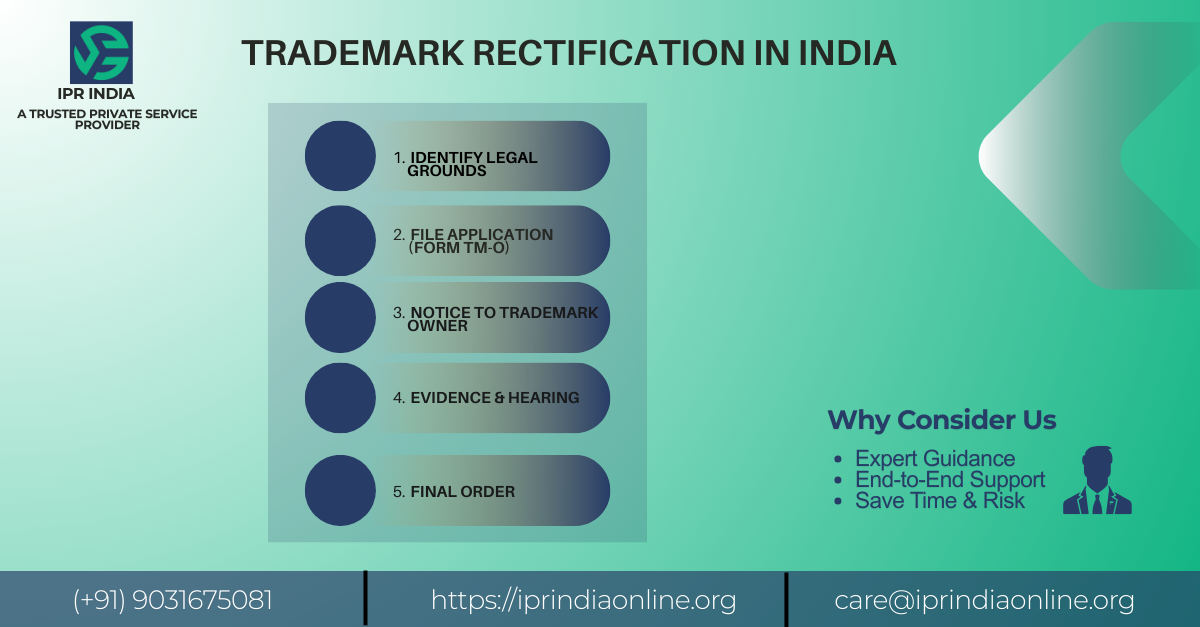
Official Trademark Rectification Process in India
The following is the general procedure for the government.
Step 1: Choose the right legal basis
Determine the valid cause of action for rectification carefully.
Step 2: Submit Application (Form TM-O)
Submit the rectification application with supporting documents.
Step 3: Review by Trademark Registry
The Registry examines the application.
Step 4: Notice to Trademark Owner
If approved, a notice is sent to the registered holder.
Step 5: Counter Statement
The respondent may also file a response in defense of the registration.
Step 6: Evidence and Hearing
Both sides can introduce evidence at a hearing, if necessary.
Step 7: Final Order
The authority may remove, correct, or maintain the trademark registration.
Since this process involves legal drafting and timely responses, proper guidance is important.
How Our Experts Help You with Trademark Rectification
Rectification requires proper legal understanding. Small mistakes in drafting or documentation may lead to rejection. As a private service provider, we simplify the process for you.
Here’s how we assist:
-
Submit Basic Details Online
Fill out our simple online form with the required information. -
Case Evaluation by Experts
Our team reviews your case and checks valid legal grounds. -
Preparation of Application
We drafted the rectification petition with proper legal arguments. -
Filing Before the Registry
The application is filed in the correct format. -
Handling Replies and Notices
If the other party responds, we guide you in preparing further steps. -
Support Until Final Order
We assist until the rectification process is completed and the final order is issued.
This makes the procedure easier and more structured for applicants.
Avoid Future Trademark Issues
Many rectification cases arise due to mistakes made during the original registration. If you are planning to apply for a new trademark, it is important to understand how to register trademark online in India properly. As a private service provider offering expert assistance, we help applicants complete the registration process correctly so that future objections or rectification issues can be minimized.
Conclusion
Trademark rectification in India is a legal remedy to correct or remove an incorrectly registered trademark. It requires valid grounds, supporting documents, and proper legal drafting.
If a registered trademark is causing issues for your business, end those issues promptly to safeguard your brand rights. The process is simplified and more effective when you have the right professional guidance.

 Arabic
 French
 Spanish
 Portuguese
 Deutsch
 Turkish
 Dutch
Dutch
 Italiano
 Russian
 Romaian
 Portuguese (Brazil)
 Greek
Greek
