


 Downloader
 Free FTP
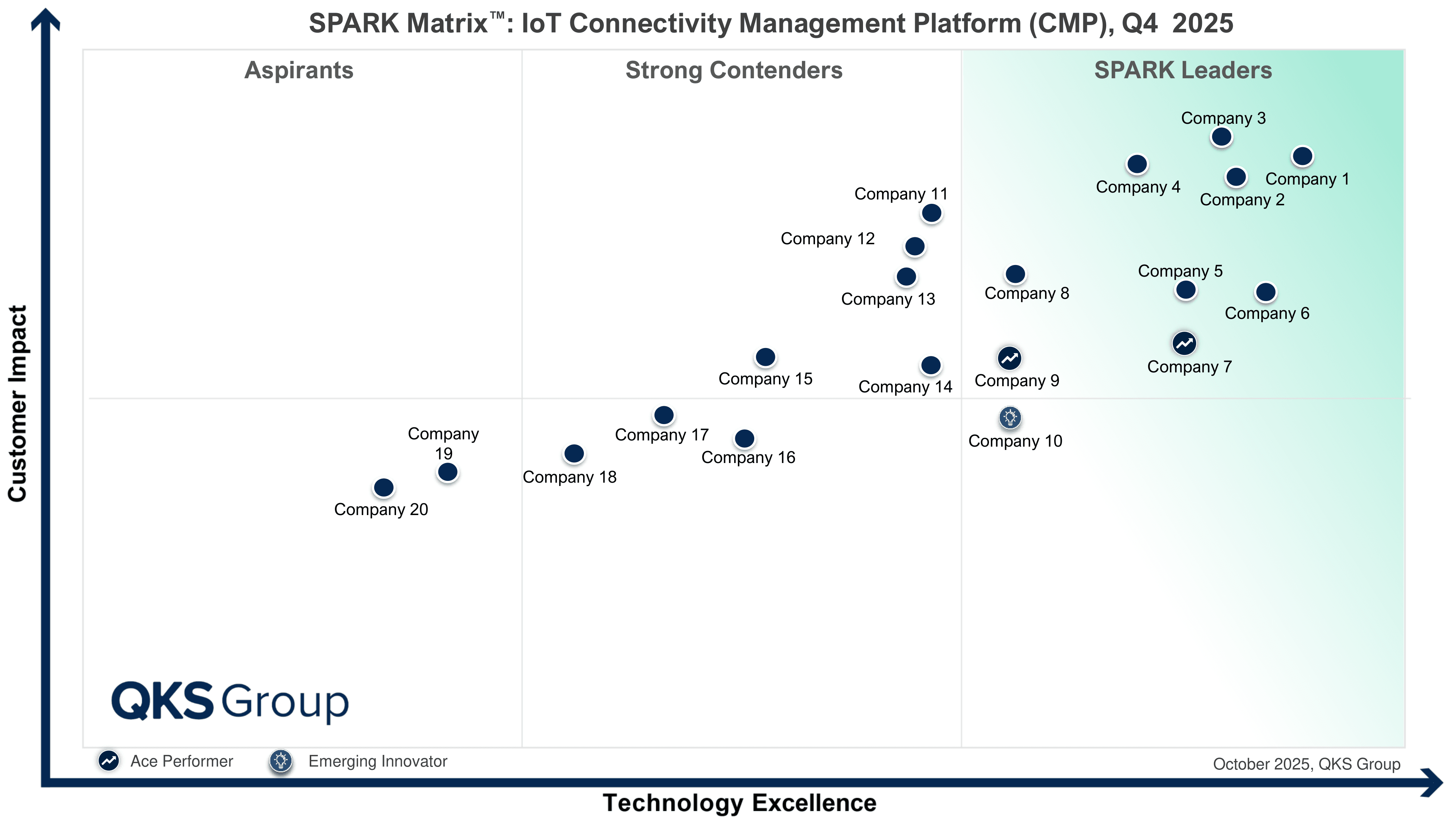
SPARK Matrix IoT CMP Q4 2025 Strategic Evaluation for Enterprise Buyers
Introduction
The IoT Connectivity Management Platform (CMP) market has undergone a fundamental transformation. What once revolved around activating, suspending, and monitoring SIM cards has evolved into something far more strategic. In 2025, CMPs are no longer backend utilities. They have become the control plane of the connected economy, orchestrating connectivity across billions of devices, multiple networks, and increasingly complex regulatory environments.
As enterprises scale IoT deployments across industries such as automotive, utilities, manufacturing, healthcare, logistics, and smart cities, connectivity is no longer a “set-and-forget” function. It is a dynamic, intelligent layer that directly impacts uptime, security, cost efficiency, and compliance. Modern IoT CMPs now sit at the intersection of cloud-native software intelligence and deep hardware integration, where AI-driven automation meets innovations like eSIM and iSIM.
For technology buyers and decision-makers, selecting the right IoT Connectivity Management Platform is not just about managing connections. It is about future-proofing IoT strategies for a decade of hybrid networks, regulatory scrutiny, and autonomous optimization.
What Is an IoT Connectivity Management Platform?
An IoT Connectivity Management Platform is a centralized software platform that enables enterprises and service providers to provision, manage, monitor, and optimize connectivity across large fleets of IoT devices.
Core capabilities typically include:
- SIM, eSIM, and iSIM lifecycle management
- Device provisioning and activation
- Usage monitoring and cost control
- Policy enforcement and automation
- Network selection and failover management
- Security and compliance controls
- Integration with IoT platforms, clouds, and enterprise systems
Modern CMPs are cloud-native, API-driven, and designed to operate across cellular, LPWAN, satellite, and emerging 5G networks.
Why IoT CMPs Matter More Than Ever in 2025
The rapid expansion of IoT has exposed the limitations of traditional connectivity management approaches. Enterprises now face challenges such as global scale, regulatory fragmentation, network heterogeneity, and cost volatility.
Key forces driving CMP evolution include:
- Massive IoT scale: Millions of devices per enterprise across regions and use cases
- Hybrid connectivity: Coexistence of 4G, 5G, LPWAN, private networks, and satellite
- Regulatory pressure: Data sovereignty, roaming restrictions, and security mandates
- Operational complexity: Need for automation over manual workflows
In response, IoT CMPs have evolved into intelligent platforms that enable real-time decision-making, resilience, and governance across the connectivity layer.
Core Capabilities Defining Next-Generation IoT CMPs
1. Cloud-Native Orchestration and Automation
Modern CMPs leverage cloud-native architectures to automate connectivity operations at scale. Policies replace manual intervention, enabling dynamic actions such as throttling, suspension, or network switching based on real-time conditions.
This automation reduces operational overhead and improves service reliability for large IoT deployments.
2. Multi-Network and Multi-Operator Support
Enterprises increasingly demand flexibility across mobile network operators (MNOs), MVNOs, and roaming partners. Leading CMPs support:
- Multi-IMSI and multi-profile connectivity
- Seamless roaming and local breakout
- Network failover and redundancy
This capability is critical for global deployments where uptime and coverage consistency are non-negotiable.
3. eSIM and iSIM Enablement
The shift from physical SIMs to eSIM and iSIM is redefining device design and connectivity control. CMPs now play a central role in:
- Remote profile provisioning
- Secure credential management
- Lifecycle control at the chip level
Vendors that integrate deeply with chipset ecosystems and device manufacturers gain a significant competitive advantage.
4. AI-Driven Optimization and Analytics
AI and machine learning are increasingly embedded within CMPs to analyze usage patterns, predict anomalies, and optimize costs.
Examples include:
- Detecting abnormal data usage or security threats
- Recommending optimal network profiles
- Forecasting connectivity spend
This intelligence transforms CMPs from monitoring tools into proactive optimization engines.
CMP as a Strategic Asset, Not an Operational Tool
Historically, connectivity management was viewed as a cost center. Today, it is a strategic enabler for digital business models.
A mature IoT CMP helps enterprises:
- Accelerate time-to-market for connected products
- Improve customer experience through higher uptime
- Reduce total cost of ownership (TCO)
- Maintain regulatory compliance across regions
- Scale securely without operational complexity
For industries like automotive, utilities, and healthcare, connectivity downtime or compliance failure can directly impact revenue and safety.
Regulatory Agility and Compliance-First Architectures
Regulatory requirements around IoT connectivity are tightening globally. Countries are enforcing local data routing, permanent roaming restrictions, and security certifications.
Advanced CMPs address this through:
- Policy-based compliance enforcement
- Localized connectivity options
- Audit trails and reporting
- Integration with regional operator ecosystems
Vendors that prioritize regulatory agility are better positioned to support long-term, global IoT rollouts.
Key Industry Use Cases for IoT CMPs
IoT Connectivity Management Platforms support diverse enterprise use cases, including:
- Automotive: Connected vehicles, telematics, OTA updates
- Utilities: Smart meters, grid monitoring, outage management
- Manufacturing: Asset tracking, remote monitoring, predictive maintenance
- Healthcare: Medical devices, patient monitoring, compliance-driven connectivity
- Logistics: Fleet management, cold chain monitoring, global tracking
In each case, reliable and intelligent connectivity is foundational to business success.
Competitive Landscape and Vendor Differentiation
The CMP market includes mobile operators, MVNOs, hyperscalers, and specialized IoT platform providers. Differentiation increasingly depends on:
- Depth of automation and AI capabilities
- eSIM/iSIM ecosystem integration
- API maturity and developer support
- Security and compliance frameworks
- Global partner coverage
Vendors that align CMP capabilities with enterprise digital transformation goals are emerging as long-term strategic partners rather than service providers.
The Future of IoT Connectivity Management Platforms
Looking ahead, IoT CMPs will continue to evolve as foundational infrastructure for connected ecosystems.
Key trends shaping the future include:
- Deeper integration with IoT application platforms
- AI-driven autonomous connectivity management
- Convergence of public and private networks
- Expansion of satellite IoT support
- Greater focus on sustainability and energy-efficient connectivity
CMPs will increasingly act as intelligent brokers between devices, networks, clouds, and regulations.
Conclusion
The IoT Connectivity Management Platform market has moved far beyond SIM management. In 2025, CMPs represent the intelligent control plane of a hyper-connected world, where software orchestration, hardware innovation, and regulatory agility converge.
For enterprises, choosing the right CMP is a strategic decision that impacts scalability, resilience, and long-term competitiveness. Vendors that successfully blend real-time automation, multi-network intelligence, and compliance-first design are redefining connectivity as a business enabler rather than a technical constraint.
As IoT deployments scale toward billions of connections, IoT CMPs will remain central to enabling secure, intelligent, and future-ready connected ecosystems.

 English
 Arabic
 French
 Spanish
 Portuguese
 Turkish
 Dutch
Dutch
 Italiano
 Russian
 Romaian
 Portuguese (Brazil)
 Greek
Greek
