


 Downloader
 Free FTP
Types of Sub-Entry Shrouds You Should Know in Continuous Casting
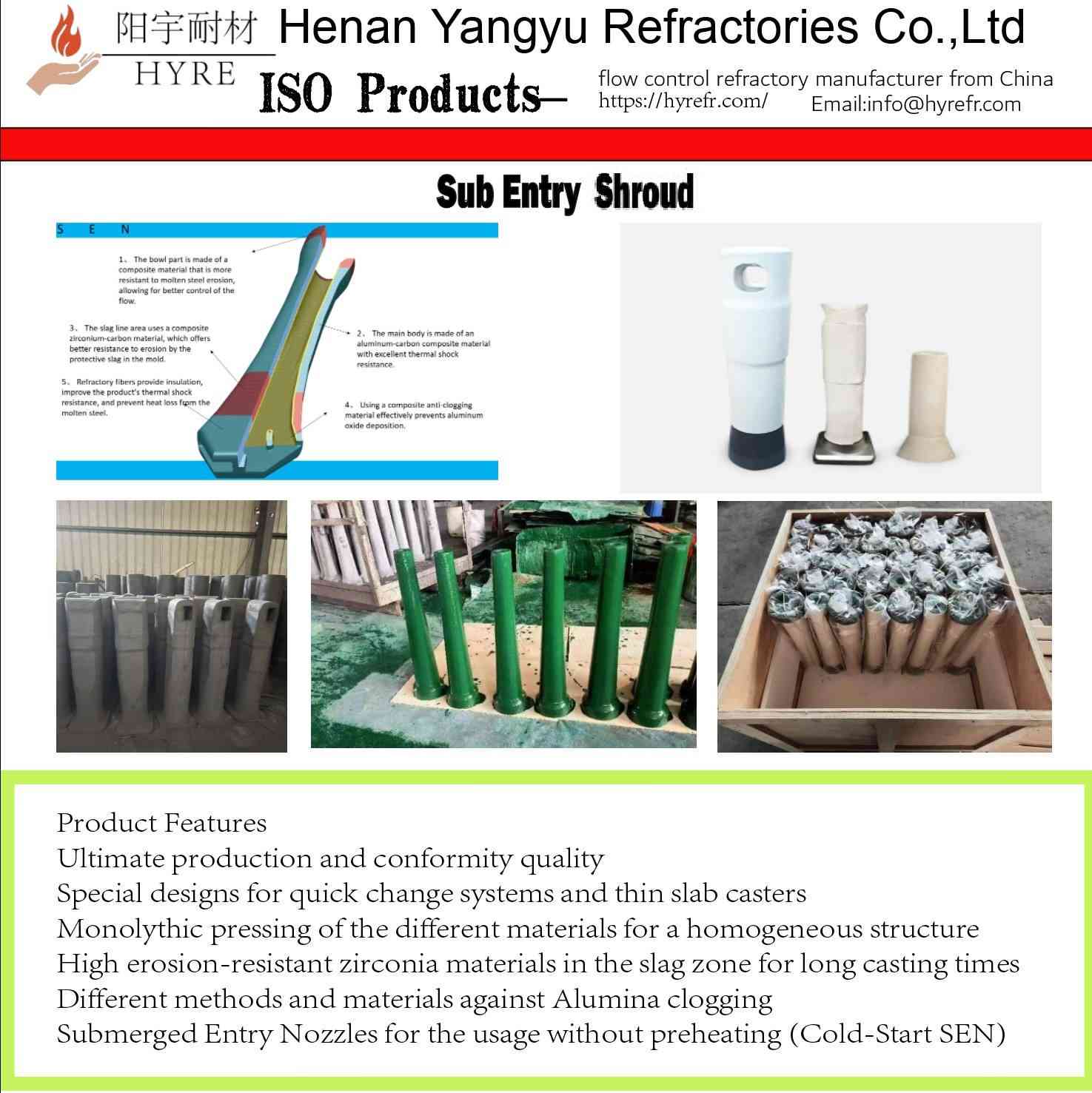
1. Introduction
In continuous casting, maintaining the cleanliness and stability of molten steel as it flows from the ladle to the tundish is a critical requirement. One of the most important components responsible for protecting the steel stream during this transfer is the Sub-Entry Shroud (SES), sometimes also referred to as a ladle-to-tundish shroud or ladle shroud.
The sub-entry shroud is a tubular refractory component installed between the ladle nozzle and the tundish entry zone. Its primary function is to prevent contact between molten steel and atmospheric air, thereby minimizing reoxidation, nitrogen pickup, and inclusion formation. As steel grades become cleaner and casting sequences longer, the design and selection of the appropriate type of sub-entry shroud have become increasingly important.
This article provides a detailed overview of the main types of sub-entry shrouds you should know, including their structures, materials, operating principles, advantages, limitations, and typical applications.

- flow control refractory
2. Basic Function of a Sub-Entry Shroud
Before discussing the types, it is essential to understand the fundamental role of a sub-entry shroud in the casting process.
The sub-entry shroud performs the following key functions:
- Protects molten steel from air aspiration and secondary oxidation
- Reduces nitrogen and hydrogen pickup
- Stabilizes the steel stream entering the tundish
- Minimizes slag entrainment during ladle change
- Improves steel cleanliness and casting stability
Without a properly designed and installed shroud, the benefits of ladle refining and tundish metallurgy can be significantly reduced.
3. Classification of Sub-Entry Shrouds
Sub-entry shrouds can be classified based on several criteria:
- Material composition
- Structural design
- Functional features
- Casting application
In industrial practice, the most common classification is based on material and functional design, which directly influence performance and service life.
4. Conventional Alumina-Based Sub-Entry Shrouds
4.1 Description and Structure
Conventional alumina-based sub-entry shrouds are among the earliest and most widely used designs. They are typically manufactured from:
- High-alumina refractories (Al₂O₃ ≥ 70–90%)
- Low-carbon or carbon-free matrices
The shroud consists of a straight or slightly tapered tubular body with coupling ends designed to connect to the ladle nozzle and the tundish cover or well.
4.2 Advantages
- Good refractoriness and thermal stability
- Relatively low manufacturing cost
- Adequate performance for conventional carbon steels
4.3 Limitations
- Higher wettability by molten steel
- Susceptibility to chemical corrosion
- Limited resistance to thermal shock
- Higher tendency for steel adhesion and clogging
As a result, conventional alumina shrouds are increasingly being replaced in demanding applications.
5. Alumina-Carbon Sub-Entry Shrouds
5.1 Description and Material System
Alumina-carbon (Al₂O₃–C) sub-entry shrouds are currently the most widely used type in modern steel plants. They incorporate controlled amounts of carbon into the alumina matrix.
Carbon provides:
- Improved thermal shock resistance
- Reduced steel wettability
- Enhanced resistance to erosion
Antioxidants such as aluminum, silicon, or boron carbide are added to reduce carbon oxidation.

- flow control refractory
5.2 Structural Characteristics
Typical features include:
- Dense inner bore with low surface roughness
- Multi-layer structure with wear-resistant inner zones
- Reinforced ends for mechanical stability
5.3 Advantages
- Excellent resistance to thermal shock
- Reduced steel adhesion and clogging
- Stable performance during long casting sequences
- Suitable for aluminum-killed steels
5.4 Limitations
- Carbon oxidation if improperly protected
- Requires controlled preheating and storage
- Slightly higher cost than alumina-only shrouds
6. Zirconia-Based Sub-Entry Shrouds
6.1 Description and Composition
Zirconia-based sub-entry shrouds utilize zirconium dioxide (ZrO₂), either as:
- Full zirconia shrouds
- Zirconia inserts in the bore region
Zirconia is selected for its exceptional chemical stability and low wettability.
6.2 Key Properties
- Extremely low steel wettability
- Outstanding resistance to chemical corrosion
- High density and smooth bore surface
6.3 Advantages
- Superior anti-clogging performance
- Excellent steel cleanliness control
- Long service life for clean steel grades
6.4 Limitations
- Higher material and manufacturing cost
- Higher thermal expansion, requiring careful design
- More sensitive to thermal shock if not engineered properly
Zirconia shrouds are commonly used in high-end applications such as automotive or bearing steels.
7. Insulated Sub-Entry Shrouds
7.1 Design Concept
Insulated sub-entry shrouds incorporate an insulating layer between the working lining and the outer shell. This design aims to:
- Reduce heat loss from molten steel
- Maintain stable steel temperature
- Minimize thermal gradients
7.2 Applications
These shrouds are particularly useful in:
- Long transfer times
- Small tundishes
- Low superheat casting conditions
7.3 Advantages and Challenges
While insulation improves thermal performance, it may reduce mechanical strength. Therefore, a careful balance between insulation and structural integrity is required.
8. Argon-Protected Sub-Entry Shrouds
8.1 Functional Principle
Argon-protected sub-entry shrouds are designed with gas injection channels or porous zones that allow argon gas to flow along the inner bore or coupling area.
Argon serves to:
- Displace air from the steel stream
- Reduce oxygen partial pressure
- Prevent reoxidation and inclusion formation
8.2 Structural Features
- Integrated argon inlet ports
- Controlled pore size or slit geometry
- Gas-tight sealing at connection points
8.3 Advantages
- Enhanced steel cleanliness
- Reduced nitrogen pickup
- Improved performance during ladle changes
8.4 Limitations
- Requires stable and controlled argon supply
- Risk of flow disturbance if gas rate is excessive
- Higher system complexity
9. Split-Type and Quick-Change Sub-Entry Shrouds
9.1 Design Purpose
Split-type or quick-change sub-entry shrouds are designed to:
- Reduce ladle turnaround time
- Improve operational flexibility
- Facilitate rapid replacement during casting
9.2 Structural Characteristics
- Two-piece or modular design
- Quick-lock or clamp systems
- Pre-assembled coupling ends
9.3 Advantages and Trade-Offs
These designs improve productivity but require precise alignment and sealing to avoid air ingress.
10. Sub-Entry Shrouds with Anti-Splash and Anti-Turbulence Design
10.1 Flow Control Features
Advanced sub-entry shrouds may include:
- Internal flow straighteners
- Optimized bore profiles
- Anti-splash collars
These features help stabilize the steel stream entering the tundish.
10.2 Benefits
- Reduced tundish surface turbulence
- Lower slag entrainment risk
- Improved inclusion flotation
11. Selection Criteria for Sub-Entry Shroud Types
Choosing the correct type of sub-entry shroud depends on:
- Steel grade and cleanliness requirements
- Casting speed and sequence length
- Ladle change practice
- Argon protection strategy
- Cost and service life expectations
No single shroud type is optimal for all conditions.
12. Common Failure Modes Across Shroud Types
Regardless of type, sub-entry shrouds may suffer from:
- Thermal shock cracking
- Chemical corrosion
- Mechanical breakage at joints
- Carbon oxidation
Understanding these risks is essential for proper selection and operation.
13. Future Trends in Sub-Entry Shroud Technology
Current development focuses on:
- Functionally graded materials
- Improved zirconia composites
- Better integration with argon systems
- Enhanced dimensional precision
These advances aim to support higher casting speeds and cleaner steels.

14. Conclusion
The sub-entry shroud is a critical protective refractory component in continuous casting. A clear understanding of the different types of sub-entry shrouds—from conventional alumina designs to advanced zirconia and argon-protected systems—is essential for selecting the right solution for each casting condition.
As steelmaking technology evolves toward higher cleanliness, longer sequences, and stricter quality standards, the importance of choosing the appropriate type of sub-entry shroud will continue to increase.
Conifer | henan Yangyu Refractories Co.,Ltd's Collections
Functional Refractory Items In The Tundish
How To Protect The Liquid Steel From Oxidation
5 Key Factors Behind Ladle Shroud Cracking | adam112211のブログ - 楽天ブログ
Existing Problems of Tundish Metering Nozzles in Continuous Casting | adam112211のブログ - 楽天ブログ
Tips You Shuold Know About The Tundish Metering Nozzle
Introduction To The Fast Change Mechanism Of Tundish Metering Nozzle
. Tundish Metering Nozzle&Zirconia Inserts
What Is The Composition Of Sub Entry Nozzle(SEN)
Ladle Shroud Gasket – Material, Function, Shape & Installation Guide

 English
 French
 Spanish
 Portuguese
 Deutsch
 Turkish
 Dutch
Dutch
 Italiano
 Russian
 Romaian
 Portuguese (Brazil)
 Greek
Greek
