


 Downloader
 Free FTP
Nante Industrial surface mounted socket Selection Checklist
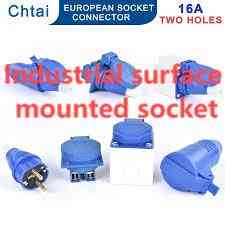
When planning reliable power distribution in factories and workshops, engineers often specify an Industrial surface mounted socket placed at accessible heights to simplify maintenance and reduce downtime. For heavy-duty applications, selecting the right Industrial surface mounted socket during the design phase reduces installation errors and ensures long-term safety for personnel and equipment.
Why surface-mounted sockets matter in industrial settings
Surface-mounted sockets are engineered to survive vibration, dust, and accidental impact while delivering continuous power to tools, machinery, and auxiliary systems. Their raised profile eliminates the need to recess enclosures into walls — a major advantage in retrofit projects or where walls contain insulation or other utilities. Durable construction and robust mounting mean fewer service calls and better uptime.
Materials, sealing, and ingress protection
Choose housings manufactured from impact-resistant thermoplastics, die-cast aluminum, or stainless steel, depending on corrosive exposure and mechanical demands. Verify the IP rating (for dust and water ingress) and IK rating (for impact resistance) to match the environment: washdown lines, outdoor yards, and dusty processing floors each demand different protection levels. Proper gaskets, sealed cable entries, and stainless fasteners help maintain ratings over years of service.
Mounting, wiring practice, and safety considerations (Nante)
Proper installation prevents premature failure. Use gasketed back boxes and torque-rated fasteners to preserve seals, and route cables through appropriate glands to maintain IP performance. Provide adequate strain relief so vibrations cannot loosen terminations. Label circuits clearly, add mechanical guards where cords may be snagged, and ensure that emergency-stop circuits are segregated and protected. Where possible, choose units with integrated lockable covers to prevent unauthorized access.
Compatibility, accessories, and customization options
Modern industrial sockets often include options for interlocks, dust caps, inbuilt RCDs (residual current devices), and surge suppression. Select units that accept standard plug profiles or that can be fitted with adapter plates to match existing tool fleets. Consider modular frames that allow quick replacement of worn modules without removing the entire assembly — a cost-effective choice for high-turnover production cells.
Thermal, electrical load, and derating guidance
Confirm the socket’s amperage rating and how it performs under continuous loads. Continuous duty heating and elevated ambient temperatures reduce current-carrying capacity; consult manufacturer derating curves for conductor sizing and connector selection. For high-current feeds or motors, provide separate feeder runs and avoid daisy-chaining loads that can overheat sockets or plugs.
Maintenance schedules and lifecycle planning
A simple preventative maintenance routine prevents incidents: inspect covers and seals monthly in harsh environments and quarterly in cleaner facilities; check torque on terminals during annual service; replace cracked or pitted sockets promptly. Keep spare modules and seals on hand to expedite repairs and avoid extended downtime. Maintain a log of part numbers and installation photos for quick matching when replacements are required.
Selecting a supplier and procurement tips
When comparing manufacturers, look beyond list price. Compare warranty terms, availability of spare parts, lead times, and the ability to supply certified test reports for IP, IK, and electrical performance. Ask for samples when ordering at scale and test them under real-world conditions before committing to a large purchase. For complex or custom assemblies, request CAD models and dimensional drawings to confirm fit.
Installation best practices from field technicians
Place sockets at ergonomic heights for frequent use and within reach of fixed tool mounts when appropriate. Avoid mounting over conveyors where impact risk is high, and protect cords from sharp edges using conduit or abrasion-resistant sleeves. Train staff to unplug equipment before cleaning, and incorporate routine visual checks into shift handover procedures.
In sum, choosing the correct industrial socket assembly — with attention to materials, protection ratings, thermal behavior, and maintainability — significantly reduces operational interruptions and increases worker safety. Thoughtful procurement, combined with regular maintenance and careful installation, ensures these surface-mounted power points remain reliable for many years. For specifications, model options, and to find the right configuration for your installation, visit https://www.nante.com/product/

 Arabic
 French
 Spanish
 Portuguese
 Deutsch
 Turkish
 Dutch
Dutch
 Italiano
 Russian
 Romaian
 Portuguese (Brazil)
 Greek
Greek
