


 Downloader
 Free FTP
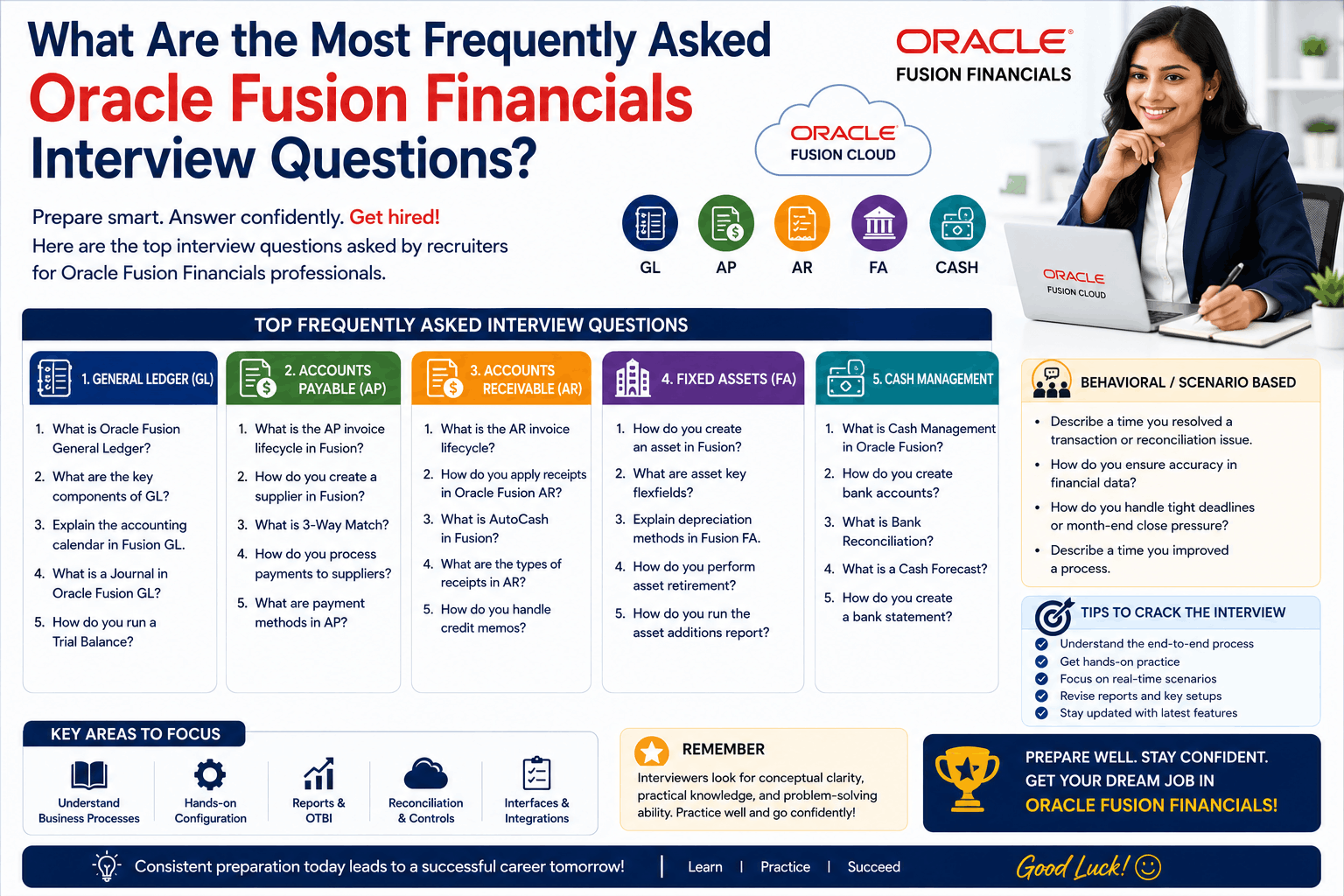
What Are the Most Frequently Asked Oracle Fusion Financials Interview Questions?
Introduction
Oracle Fusion Financials has quietly turned into one of the hottest Cloud ERP skills out there, and that's opened up genuinely exciting doors for both freshers and folks already deep into their careers. But here's the catch nobody tells you upfront: finishing a course is only half the battle. The other half is walking into an interview room, or a Zoom call these days, and actually proving you know what you're talking about.
Tech Leads IT built its Oracle Fusion Financials Training with exactly that gap in mind, real projects, practical learning, and interview prep that's actually relevant to what's being asked right now, not a recycled list from years ago.
So whether this is your very first Oracle Fusion Financials interview or you're aiming to level up your career, knowing the questions that actually come up, and more importantly, why they're asked, makes a real difference in how confident you'll feel walking in.
Why Do Interviewers Even Ask These Questions?
Here's something worth understanding upfront: recruiters aren't just checking whether you memorized a manual. They're trying to figure out if you actually get how financial processes work, whether you understand the modules on a practical level, and whether you can think through a real business problem instead of just reciting a definition.
Most interviews, whether they realize it or not, are quietly testing you on:
-
Your functional knowledge
-
How solid your accounting fundamentals are
-
Your grasp of Oracle Fusion Financials modules
-
Whether you understand actual business processes
-
How you approach problem-solving
-
How clearly you communicate
-
Any real, hands-on implementation experience you bring
Candidates who blend technical knowledge with genuine business understanding tend to walk away from these interviews looking a lot stronger than those who only memorized definitions.
The Basic Questions You Should Expect
These come up constantly, especially for freshers and entry-level candidates.
1. "What is Oracle Fusion Financials?"
Keep it simple and clear: it's Oracle's cloud-based ERP application for managing financial operations, things like General Ledger, Accounts Payable, Accounts Receivable, Fixed Assets, Cash Management, and Financial Reporting, all living under one platform.
2. "What are the main modules in Oracle Fusion Financials?"
A solid answer should hit:
-
General Ledger (GL)
-
Accounts Payable (AP)
-
Accounts Receivable (AR)
-
Cash Management (CM)
-
Fixed Assets (FA)
-
Expense Management
-
Tax Management
-
Financial Reporting
And don't be surprised if the follow-up question is about how these modules actually talk to each other.
3. "Why is Oracle Fusion Financials preferred over traditional ERP systems?"
This one's a good chance to show you understand the bigger picture, not just the software. Talk about things like:
-
Its cloud-native architecture
-
Real-time reporting instead of waiting for month-end
-
Better scalability as businesses grow
-
Automatic updates instead of painful upgrade cycles
-
Stronger security
-
Automation reducing manual work
-
Easy access from anywhere in the world
4. "What is the General Ledger module?"
Be ready to walk through:
-
Chart of Accounts
-
Journals
-
The posting process
-
Accounting periods
-
Financial statements
-
Trial Balance
-
Basic reporting
GL is the foundation everything else in Oracle Fusion Financials sits on, so this question tends to come up in almost every interview.
Questions Focused on Accounts Payable
Since supplier transactions are such a big part of daily operations, expect a good chunk of questions here.
-
What is Accounts Payable?
-
Can you walk me through the invoice lifecycle?
-
How are supplier invoices actually processed?
-
What are payment terms?
-
What does invoice validation involve?
-
How does the approval process work?
-
What's three-way matching, and why does it matter?
If you genuinely understand the Procure-to-Pay (P2P) process end to end, this whole section becomes a lot less intimidating.
Questions Focused on Accounts Receivable
This time the focus shifts to customer-side transactions.
-
What is Accounts Receivable?
-
How do customer invoices work?
-
What exactly is a receipt?
-
What's a credit memo?
-
Can you explain the Order-to-Cash (O2C) process?
-
How does a customer payment actually get recorded?
Don't be surprised if revenue recognition and customer account management come up here too.
Questions on Cash Management
This module tends to get overlooked in prep, but it comes up more than people expect.
-
What is bank reconciliation?
-
Why does Cash Management matter so much?
-
How are bank statements processed?
-
What is cash positioning?
-
Can you explain payment reconciliation?
It genuinely helps to understand how tightly Cash Management ties into both AP and AR.
Questions on Fixed Assets
Expect something along these lines:
-
What is the Fixed Assets module?
-
How do you actually create an asset in the system?
-
What is asset depreciation?
-
Can you explain asset retirement?
-
What are asset categories?
These questions are really testing whether you understand how companies manage long-term investments, not just how to click through a screen.
Scenario-Based Questions, Where Things Get Real
This is usually where interviews shift from "textbook" to "show me you can actually do this job."
-
How would you go about configuring a new ledger?
-
What would you do if you found duplicate supplier invoices?
-
Walk me through what you'd do during period closing.
-
How would you troubleshoot a posting error?
-
A client wants additional financial reports, what's your approach?
-
How do you actually go about gathering requirements from business users?
These questions aren't about having a perfect answer memorized. They're testing how you think.
Don't Forget the Accounting Basics
Even in a technical-sounding interview, accounting fundamentals sneak in constantly. Make sure you're solid on:
-
Debits and credits
-
Journal entries
-
Trial balance
-
Chart of Accounts
-
Financial statements
-
Accounting periods
-
Asset depreciation
-
Revenue recognition
-
Expense recognition
A shaky accounting foundation tends to show up in your functional answers, even when the question sounds purely technical.
Practical Ways to Actually Prepare
Finishing an Oracle Fusion Financials Course is a great start, but it's really just step one. What separates candidates who feel confident from those who freeze up is consistent, hands-on practice.
Some things worth actually doing:
-
Practicing Oracle Cloud navigation until it feels natural
-
Reviewing business process flows repeatedly
-
Working through real practical assignments
-
Brushing up on accounting basics regularly
-
Solving implementation scenarios, not just reading about them
-
Practicing how you'd explain module integration out loud
-
Sitting through mock interviews
-
Working on communication skills, not just technical knowledge
Honestly, practical experience tends to leave a much stronger impression than a memorized script ever will.
Mistakes That Quietly Cost People the Job
A lot of candidates don't lose out because they lack knowledge, they lose out because of small, avoidable mistakes. Watch out for:
-
Memorizing answers without actually understanding the concept behind them
-
Skipping over accounting fundamentals
-
Overstating experience you don't actually have
-
Giving vague, half-finished explanations
-
Weak or unclear communication
-
Skipping hands-on practice entirely
-
Not understanding how business processes actually flow
Recruiters genuinely respond better to honest, well-structured answers backed by real practical knowledge, even if it means admitting you're still learning something.
How Real Training Actually Helps Here
A solid Oracle Fusion Financials Training program does more than just teach you the theory, it combines that with real, hands-on implementation practice. That combination is what actually helps you:
-
Understand the Oracle Financials modules properly
-
Learn how real business processes actually work
-
Practice genuine implementation scenarios
-
Get comfortable navigating Oracle Cloud
-
Build stronger functional knowledge
-
Walk into interviews with real confidence
-
Sharpen your problem-solving instincts
This kind of practical grounding is exactly what tends to show up in how you answer both technical and functional interview questions.
Why Learners Keep Choosing Tech Leads IT
Picking the right training partner matters just as much as the prep itself. Tech Leads IT is built around one core idea: practical, industry-focused learning beats theory-only courses every time.
Here's what that actually looks like for learners:
-
Live, instructor-led online classes
-
Trainers with real, hands-on Oracle project experience
-
Real-time implementation scenarios instead of made-up examples
-
Practical, hands-on assignments
-
Genuine Oracle Cloud practice
-
Mock interview sessions
-
Resume-building help
-
Career guidance
-
Placement support
The whole point is to help learners walk in ready to actually contribute from day one, not just pass an interview and hope for the best afterward.
Conclusion
Getting ready for an Oracle Fusion Financials interview takes more than skimming through a list of common questions. Recruiters want to see genuine accounting knowledge, real understanding of the modules, familiarity with how business processes actually flow, and the ability to think through real-world problems rather than recite memorized answers.
Enrolling in Oracle Fusion Financials Training builds exactly the kind of practical skills employers actually value, while a comprehensive Oracle Fusion Financials Course gives you structured learning, hands-on experience, and interview-focused preparation all in one place. With real guidance, implementation-based projects, and genuine career support from Tech Leads IT, you can walk into your next Oracle Fusion Financials interview genuinely prepared, and take a real step toward building a lasting career in Cloud ERP consulting and implementation.

 English
 Arabic
 French
 Spanish
 Portuguese
 Deutsch
 Turkish
 Dutch
Dutch
 Italiano
 Russian
 Romaian
 Portuguese (Brazil)
