


 Downloader
 Free FTP
Data Center Power Storage Market Forecast Reaches USD 129.0 Billion by 2032
Market Overview and Growth Outlook
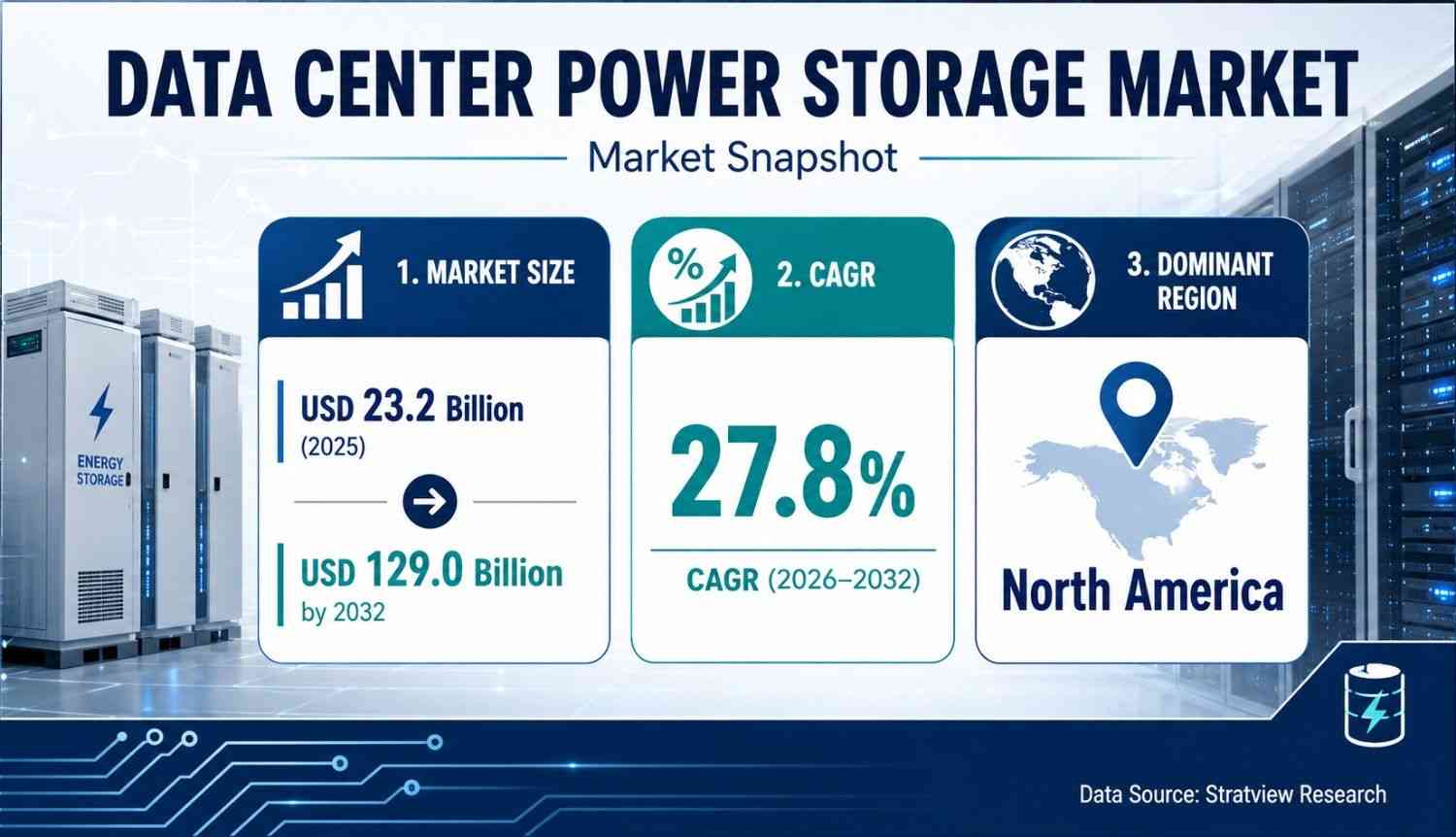
The Data Center Power Storage Market generated annual demand of USD 23.2 billion in 2025. Demand is expected to reach USD 29.6 billion in 2026, representing 27.3% year-over-year growth. The market is forecast to expand to USD 129.0 billion by 2032 and create USD 483.5 billion in cumulative sales opportunities.
“The Data Center Power Storage Market is expected to grow at a CAGR of 27.8% during 2026–2032.” By the end of the forecast period, annual demand is projected to exceed 5.5 times the 2025 market size. This expansion is tied to the rising power requirements of data-intensive computing infrastructure.
AI training, inference, machine learning, cloud platforms, and real-time analytics are creating dense computing environments. GPU clusters raise per-rack power loads and increase exposure to grid interruptions. Consequently, data center operators are strengthening backup capacity through BESS, UPS systems, intelligent battery management, and modular power architecture.
The Data Center Power Storage Market forecast reflects growing demand for power continuity, renewable-energy integration, and operational reliability. Storage systems are increasingly required to balance intermittent energy, manage peak demand, support grid resilience, and protect critical applications from power-quality disruptions.
Request a free sample report:
https://www.stratviewresearch.com/Request-Sample/data-center-power-storage-market#form
Market Segmentation Analysis
Based on the storage type, the data center power storage market is segmented into battery energy storage systems (BESS) and uninterruptible power supply (UPS) systems. BESS is expected to remain the dominant storage type, while UPS systems are projected to witness the fastest growth throughout the forecast period.
Battery energy storage systems support longer-duration backup, rapid response, renewable-energy integration, and peak shaving. Their position is reinforced by declining lithium-ion battery costs, superior energy density, and improving cycle life. BESS deployments also offer operators an alternative to diesel generation for backup and resilience.
UPS systems continue supporting immediate power continuity during electrical disruption. Modular UPS architectures are creating opportunities by allowing data centers to adapt protection capacity to changing computing requirements. This development is particularly relevant as AI infrastructure causes power loads to rise rapidly within existing and newly constructed facilities.
Based on the data center type, the market is segmented into enterprise, hyperscale, colocation, and edge. Hyperscale data centers are expected to remain the dominant segment during the forecast period and represent the largest and fastest-growing demand segment for advanced power storage solutions.
Hyperscale operators use large storage installations to improve grid independence, renewable-energy integration, and availability for mission-critical workloads. Colocation operators require robust systems to meet service-level agreements. Edge locations need compact and modular designs that can maintain reliable power in space-constrained environments.
Regional Market Insights
North America is expected to hold the largest share of the global market during the forecast period. The region benefits from a high concentration of hyperscale campuses, extensive colocation investment, an advanced BESS ecosystem, clean-energy infrastructure support, and rapid AI data center construction.
Asia-Pacific is expected to register the fastest growth during 2026–2032. Hyperscale and colocation facilities are expanding in China, Japan, Singapore, India, South Korea, and Australia. Domestic battery capabilities in China and growing cloud-provider investment across the region reinforce demand for storage infrastructure.
Regional demand is concentrated within a limited number of major markets. The top 10 countries represented more than 90% of global market share in 2025, with demand exceeding USD 21.0 billion. Their importance reflects the concentration of hyperscale capacity and BESS implementation.
Emerging Trends Shaping the Data Center Power Storage Market
BESS is assuming a broader role in data center power systems. In addition to backup, batteries can support peak shaving, renewable-energy balancing, and grid interaction. Their growing use as an alternative to diesel generators is changing power-resilience strategies for hyperscale and colocation operators.
Advanced battery chemistries are becoming part of the technology-development agenda. Suppliers are investing in lithium-ion and solid-state systems to improve energy density, cycle life, and ownership economics. Alternative chemistries, including sodium-ion and iron-air, are also relevant to efforts aimed at reducing critical-material dependency.
Intelligent power-storage platforms represent another important industry trend. Software-managed systems can provide real-time optimization, predictive maintenance, and coordinated energy use. Combined with modular UPS architectures, these capabilities help operators respond to changing loads and manage increasingly complex data center energy environments.
Key Growth Drivers of the Market
- Expansion of AI model training increases computing power density, creating greater demand for immediate backup and longer-duration energy storage.
- Hyperscale investment creates large storage requirements, supporting demand for utility-scale batteries, integration services, and intelligent management platforms.
- Colocation development increases the need for dependable power availability, strengthening investment in BESS and UPS infrastructure.
- Renewable-energy adoption requires storage to balance intermittent generation, reduce peak demand, and limit dependence on fossil-fuel backup sources.
- Grid instability increases operational risk, encouraging data center operators to deploy storage systems that protect availability and critical digital workloads.
Competitive Landscape
Top Companies in the Market
ABB Group
Schneider Electric
Vertiv
Eaton (Electrical Sector)
Siemens
Legrand
Exide Technologies
Saft Group (TotalEnergies)
EnerSys
Fluence Energy
Conclusion and Strategic Outlook
The Data Center Power Storage Market is expected to expand at a CAGR of 27.8% from 2026 to 2032, reaching USD 129.0 billion. The USD 483.5 billion cumulative sales opportunity demonstrates the commercial scale associated with power storage for AI, cloud, hyperscale, colocation, enterprise, and edge environments.
BESS dominance, rapid UPS growth, hyperscale investment, North American leadership, and Asia-Pacific expansion define the industry outlook. The market’s long-term development will also depend on material sourcing, deployment costs, battery lifecycle management, thermal safety, and the performance of intelligent power-management technologies.
FAQs – Data Center Power Storage Market
1. What value will the Data Center Power Storage Market reach?
The Data Center Power Storage Market is projected to reach USD 129.0 billion by 2032. Annual demand is expected to increase from USD 29.6 billion in 2026.
2. What is the forecast CAGR?
The market is forecast to grow at a CAGR of 27.8% during 2026–2032. This growth would make the 2032 market more than 5.5 times larger than its 2025 value.
3. What is creating demand for storage systems?
AI computing, cloud services, hyperscale construction, colocation expansion, renewable-energy integration, and power-resilience requirements are creating demand. These forces increase the need for fast, reliable, and intelligently managed backup infrastructure.
4. Which region has the strongest market position?
North America is expected to retain the largest market share. Asia-Pacific is expected to grow fastest due to data center investment across China, Japan, Singapore, India, South Korea, and Australia.
5. Is the investment outlook free from risk?
No. Battery-material volatility, supply constraints, upfront costs, degradation, recycling, and thermal safety can affect returns and operating economics. Market participants must account for these challenges when planning deployments.

 English
 Arabic
 Spanish
 Portuguese
 Deutsch
 Turkish
 Dutch
Dutch
 Italiano
 Russian
 Romaian
 Portuguese (Brazil)
 Greek
Greek
