


 Downloader
 Free FTP
Global Polystyrene Price Index: Chart 2026 and Data | IMARC Group
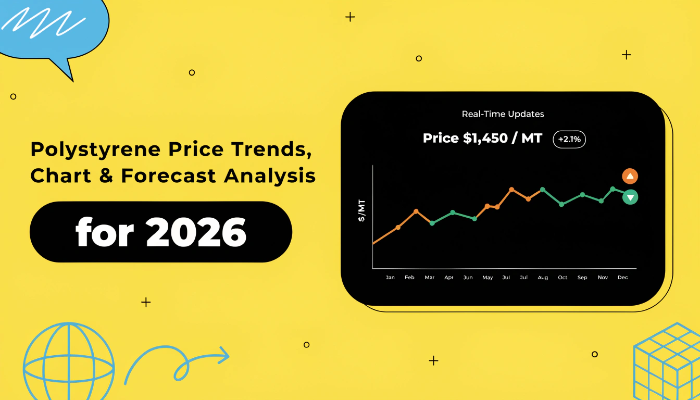
Global Polystyrene Price Outlook – Q2 2026
Global Polystyrene Price Index indicates a clear downtrend of approximately 9–13% across major regions in June 2026, reflecting weakening downstream demand and easing feedstock costs. Early in the quarter, prices showed mild stability, but by mid-to-late June, consistent declines were recorded due to reduced buying activity and oversupply in key markets.
The Polystyrene Price Chart highlights a synchronized global correction, particularly in Europe and South America where the sharpest declines were observed. According to IMARC Group’s June 2026 price-tracking database and methodology, the downward movement was primarily driven by falling styrene monomer costs and subdued packaging and construction demand.
Polystyrene Prices By Region – June 2026 Snapshot
- Northeast Asia: USD 1.41/Kg (↓ -9.0%)
- Europe: USD 1.49/Kg (↓ -12.9%)
- India: USD 1.53/Kg (↓ -6.7%)
- Southeast Asia: USD 1.5/Kg (↓ -5.7%)
- South America: USD 1.26/Kg (↓ -13.1%)
The price spread reflects a broad global decline, with South America and Europe experiencing the steepest corrections due to weak demand and excess supply. Asia showed relatively moderate declines, supported by stable consumption patterns. Overall, the market signals a demand slowdown combined with easing raw material costs.
Polystyrene Prices By Country: Regional Trends And Market Insights
North America (USA)
Polystyrene prices in North America followed a downward trajectory in June 2026, aligning with global trends. Although exact pricing data is not specified, the region experienced moderate declines due to reduced demand from packaging and consumer goods sectors. Supply remained adequate, supported by stable production levels and lower feedstock costs, particularly styrene.
Asia-Pacific (Japan, India, China)
Asia-Pacific markets showed mixed but overall declining trends. India reported prices at USD 1.53/Kg, reflecting a relatively smaller decline compared to other regions due to consistent domestic demand. Northeast Asia recorded USD 1.41/Kg, impacted by weaker export demand and falling feedstock prices. Southeast Asia, at USD 1.5/Kg, maintained relative stability but still experienced downward pressure from regional oversupply.
South America (Brazil)
South America saw the sharpest decline, with prices at USD 1.26/Kg, down by 13.1%. The region faced weak industrial demand and high inventory levels, which pressured suppliers to reduce prices. Import dependency and fluctuating freight rates also contributed to pricing volatility.
Global Polystyrene Supply And Demand Analysis – June 2026
Supply conditions remained relatively comfortable during June 2026, with sufficient production capacity across major regions. Increased output in Asia and stable operations in North America contributed to higher availability in the global market.
Demand, however, showed noticeable weakness. Key sectors such as packaging, construction, and consumer goods reduced procurement volumes due to slower economic activity and inventory adjustments. Export markets also softened, particularly in Europe and South America, where industrial consumption declined. This imbalance between supply and demand played a central role in driving prices downward.
Polystyrene Price Index And Historical Trend Analysis
The Polystyrene Price Index showed consistent monthly declines throughout Q2 2026, marking a reversal from the relatively stable pricing observed in Q1. The index dropped by approximately 8–12% over the quarter, reflecting widespread market correction.
The polystyrene price history chart indicates that current prices are moving toward early-2025 levels, suggesting a cyclical downturn. Unlike sharp fluctuations seen in previous years, the current decline appears gradual and demand-driven. IMARC Group data highlights that price movements are closely linked to styrene monomer trends and downstream consumption patterns.
Polystyrene Price Forecast 2026–2027: Expected Market Direction
The polystyrene price forecast 2026 suggests continued softness in the short term, followed by gradual stabilization as demand recovers.
- Short-term (Q3 2026): continued downward or stable trend
- Mid-term (Q4 2026): potential stabilization as inventories normalize
- Long-term (Q1 2027): gradual recovery depending on industrial demand
Buyers are expected to benefit from favorable procurement conditions in the near term, while suppliers may adjust production to balance the market.
Key Factors Driving Polystyrene Prices Monthly
Several factors influenced price movements during June 2026:
- Feedstock costs: declining styrene prices reduced production costs
- Demand slowdown: weaker consumption in packaging and construction sectors
- Supply levels: adequate production led to excess availability
- Inventory buildup: high stock levels pressured pricing
- Global trade: reduced export demand impacted regional pricing
These factors collectively contributed to the downward pricing trend observed across all major regions.
What Is Polystyrene And Where Is It Used?
Polystyrene is a synthetic aromatic polymer made from styrene monomer. It is widely used in packaging, insulation, disposable products, and consumer goods due to its lightweight and cost-effective properties.
The material is available in both solid and foam forms, making it versatile for various industrial applications. Its demand is closely tied to construction, electronics, and packaging industries, which directly influence its pricing trends.
Recent Developments in the Polystyrene Market – June 2026
- Declining styrene prices influenced global cost structures
- Reduced demand from packaging and construction sectors
- Stable production levels-maintained supply availability
- Export demand weakened in Europe and South America
- Market participants adopted cautious buying strategies
Unlock actionable pricing intelligence—request your free sample report today: https://www.imarcgroup.com/polystyrene-pricing-report/requestsample
FAQs About Polystyrene Prices Analysis & Market Insights:
What is the current Polystyrene Price Index in 2026?
The Polystyrene Price Index shows a consistent downward trend in June 2026, with declines ranging from 8% to 13% across regions. This is mainly due to weak demand and falling feedstock costs.
How does the Polystyrene Price Chart show regional price differences?
The Polystyrene Price Chart highlights that South America and Europe experienced the steepest declines, while Asia saw relatively moderate corrections. These differences are driven by regional demand and supply conditions.
What factors are influencing the polystyrene price forecast 2026?
Key factors include feedstock costs, demand from packaging and construction industries, supply levels, and global trade flows. These elements determine short-term price movements and long-term market trends.
Conclusion
Polystyrene prices in June 2026 reflect a clear downward trend driven by weak demand and sufficient supply. Regional variations highlight differences in consumption patterns and inventory levels. Moving forward, the market is expected to stabilize as demand gradually recovers and supply adjusts accordingly.
Contact Us:
IMARC Group
134 N 4th St. Brooklyn, NY 11249, USA
Email: sales[@]imarcgroup.com
Tel No:(D) +91 120 433 0800
United States: +1-201971-6302

 English
 Arabic
 French
 Portuguese
 Deutsch
 Turkish
 Dutch
Dutch
 Italiano
 Russian
 Romaian
 Portuguese (Brazil)
 Greek
Greek
