


 Downloader
 Free FTP
IMDG Code Requirements for Lithium Battery Ocean Freight Shipping: What Every Shipper Needs to Know in 2026
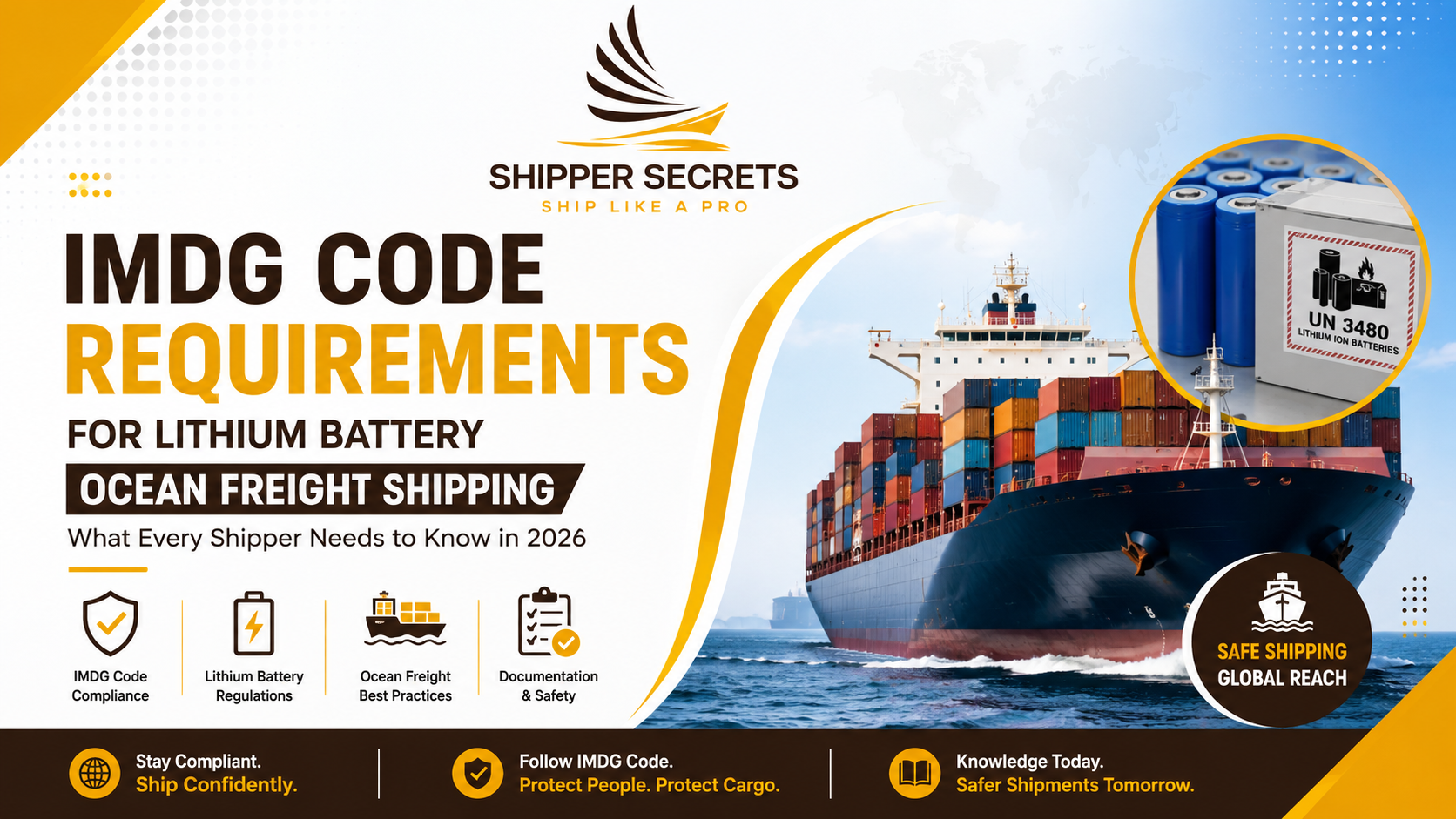
Ocean freight remains the backbone of global lithium battery logistics. There's no state-of-charge cap the way there is for air transport and container capacity makes sea shipping the only realistic option for high-volume battery cargo from consumer electronics to EV components and energy storage systems. But "no SoC limit" doesn't mean "no rules." The International Maritime Dangerous Goods (IMDG) Code, published by the International Maritime Organization (IMO) and given legal force under SOLAS, governs every lithium battery shipment that moves by sea and 2026 has brought some of the most significant changes to that code in years.
If you ship batteries or products containing them by ocean freight, here's what the IMDG Code actually requires and what's changed.
Why the IMDG Code Applies to Nearly Every Battery Shipment
The IMDG Code covers lithium batteries across the board: lithium-metal (UN 3090/3091), lithium-ion (UN 3480/3481), batteries shipped standalone, batteries packed with equipment and batteries installed inside equipment. It applies on container ships, bulk carriers and RoRo vessels alike. Because lithium batteries are classified as Class 9 dangerous goods due to thermal runaway risk, almost no battery shipment escapes some level of DG regulation; the main variable is how much relief a shipment qualifies for.
Amendment 42-24: Mandatory as of January 1, 2026
The single biggest development for ocean shippers this year is IMDG Code Amendment 42-24, which became mandatory on January 1, 2026, after a voluntary transition period in 2025. Carriers are now rejecting bookings that don't comply, so if your documentation or classification still reflects the old 41-22 edition, it's time to update. Key changes shippers need to build into their processes include:
-
New UN numbers for battery-powered vehicles: UN 3556, 3557 and 3558 now specifically cover lithium-ion, lithium-metal and sodium-ion powered vehicles respectively.
-
Sodium-ion batteries are now formally regulated: Many shippers have been treating sodium-ion cells as general cargo, assuming the technology is too new to be captured by DG rules. Under 42-24, sodium-ion batteries (UN 3551, UN 3552) are explicit Class 9 dangerous goods, subject to the Lithium Battery Mark, Class 9 labeling and the same testing expectations as lithium batteries.
-
Stricter documentation for related cargo classes: production date, packaging date and packaging temperature must now be included on transport documents for certain materials shipped alongside batteries, such as carbon products.
-
New exemption certificate requirements: any shipment claiming a DG exemption must now be accompanied by a corresponding certificate under Section 5.4.4.2.
Classification, Packing Instructions and Special Provision 188
Lithium-ion batteries (UN 3480) are classified as Class 9. Packing Instructions P903/LP903 lay out packaging materials, UN-certified performance standards and quantity limits per package. Many small cells and batteries qualify for relief from full dangerous goods requirements under Special Provision 188, provided they fall under defined watt-hour thresholds but this relief has narrowed with recent amendments, so don't assume last year's exemption still applies without checking.
Core packaging expectations that ocean shippers should have in place regardless of exemption status:
-
Each cell or battery fully enclosed in non-metallic material, protected against short circuit
-
Packaging that prevents shifting or movement within the container during transit
-
UN-certified packaging that meets IMDG performance requirements
-
Batteries stowed away from heat sources, in locations accessible for firefighting
-
Emergency response information accompanying the consignment
Documentation: Where Most Rejections Actually Happen
Across nearly every carrier and forwarder reporting on 2026 shipments, one theme repeats: documentation errors not packaging failures cause the majority of port rejections and delays. A compliant ocean lithium battery shipment needs:
-
A complete Dangerous Goods Declaration, accurately stating battery type (lithium-ion vs. lithium-metal), correct UN number, quantity and classification
-
A packing certificate
-
UN 38.3 test summaries, confirming the battery has passed the required altitude, thermal, vibration, impact, short-circuit, crush, overcharge and forced-discharge testing
-
Advance booking confirmation with the carrier - many shipping lines require DG declarations submitted at least 72 hours before loading and some require longer lead times, so confirm this when you book, not after
Misdeclaring battery type or quantity is one of the most common and most costly compliance failures shippers make.
Defective, Damaged or Recalled (DDR) Batteries
DDR batteries face categorically different rules. Under IMDG requirements, these batteries require special permits and must be declared accurately. Treating a DDR battery as a standard shipment is a serious violation. Physical damage, swelling, heat exposure or a manufacturer recall notice all trigger DDR status. If there's any doubt about a battery's condition, the safer assumption is DDR classification until proven otherwise.
Container and Stowage Requirements
Beyond the battery packaging itself, the shipping container must meet IMDG Code specifications for the cargo it's carrying which can mean ventilation requirements and segregation from incompatible cargo depending on battery chemistry and volume. Following incidents involving large lithium battery fires aboard container ships, recent IMDG amendments have specifically tightened stowage requirements for bulk battery shipments, including location on the vessel and distance from ignition sources.
Staying Compliant Through the Next Amendment Cycle
The IMDG Code revises on a two-year cycle based on incident data and emerging battery technologies, which means 42-24 won't be the last update ocean shippers need to absorb. Sodium-ion batteries were a blind spot for many companies this cycle; something else will be the blind spot next cycle. The shippers who stay ahead of it are the ones who build compliance verification into their sourcing and export process rather than reacting amendment by amendment.
That's exactly the gap that proper dangerous goods training closes. Shipper Secrets' Shipping Batteries (IATA, DOT and IMDG) course walks your team through classification, packaging, documentation and the current amendment requirements for lithium battery shipments by ground, air and vessel — so your staff isn't just told what the rules are, but knows how to find the answers themselves the next time the code changes. If lithium batteries move through your supply chain in any volume, getting your team properly trained is the most reliable way to keep shipments moving and avoid the port rejections that are increasingly common under 2026's tighter enforcement.
Frequently Asked Questions
1. Is there a state-of-charge (SoC) limit for lithium batteries shipped by ocean freight?
No. Unlike air freight, where standalone lithium-ion batteries generally can't exceed 30% SoC, the IMDG Code does not impose a state-of-charge cap on ocean shipments. This is one of the main reasons ocean freight remains the preferred mode for high-volume battery cargo. That said, documentation, packaging and stowage requirements are still strict and non-compliance can still get a shipment rejected at port.
2. What is IMDG Amendment 42-24 and do I have to comply with it now?
Amendment 42-24 is the current edition of the IMDG Code, introducing new UN numbers, updated classification rules and stricter documentation requirements. It became mandatory on January 1, 2026, after a voluntary adoption period in 2025. Carriers are now rejecting bookings that rely on the older 41-22 edition, so yes compliance with 42-24 is required for any ocean shipment moving today.
3. Are sodium-ion batteries regulated the same way as lithium batteries?
Yes, as of Amendment 42-24. Sodium-ion batteries (UN 3551 and UN 3552) are now explicitly classified as Class 9 dangerous goods, subject to the Lithium Battery Mark, Class 9 labeling and testing expectations similar to lithium-ion and lithium-metal batteries. Shippers who have been treating sodium-ion cells as general cargo need to update that practice immediately, as doing so now constitutes a dangerous goods violation.
4. What documentation is required for an ocean lithium battery shipment?
At minimum: a complete Dangerous Goods Declaration (battery type, correct UN number, quantity and classification), a packing certificate and UN 38.3 test summaries confirming the battery passed required altitude, thermal, vibration, impact, short-circuit, crush, overcharge and forced-discharge testing. Most carriers also require the DG declaration submitted at least 72 hours before loading to confirm lead times when booking, since some lines require more notice.
5. Can I ship a damaged, defective or recalled (DDR) lithium battery by ocean freight?
Only with a special permit and accurate DDR declaration. DDR batteries including any battery that's physically damaged, swollen, exposed to heat or subject to a manufacturer recall cannot move as a standard shipment. Misdeclaring a DDR battery as standard cargo is a serious compliance violation. When a battery's condition is uncertain, the safer approach is to treat it as DDR until it's confirmed otherwise.
📞 Contact Us
📍 868 Cardiff Road, Naperville, IL 60565
📞 708.275.8418
🌐 Get in touch with our logistics experts for reliable shipping and freight solutions. 🚚✈️📦
Learn More About Lithium Battery Transport

 English
 Arabic
 French
 Portuguese
 Deutsch
 Turkish
 Dutch
Dutch
 Italiano
 Russian
 Romaian
 Portuguese (Brazil)
 Greek
Greek
