Every website and web application is built using two essential components that work together to deliver a complete digital experience: front-end development and back-end development. Whether you're using an e-commerce platform, booking travel tickets, or accessing an online learning portal, both technologies play a crucial role in ensuring everything functions seamlessly. While the front end focuses on what users can see and interact with, the back end handles the processing and data management behind the scenes. Understanding these two areas is important for aspiring developers, business owners, and anyone interested in modern web technologies, as each offers unique career opportunities and technical expertise.
The Purpose of Front-End Development
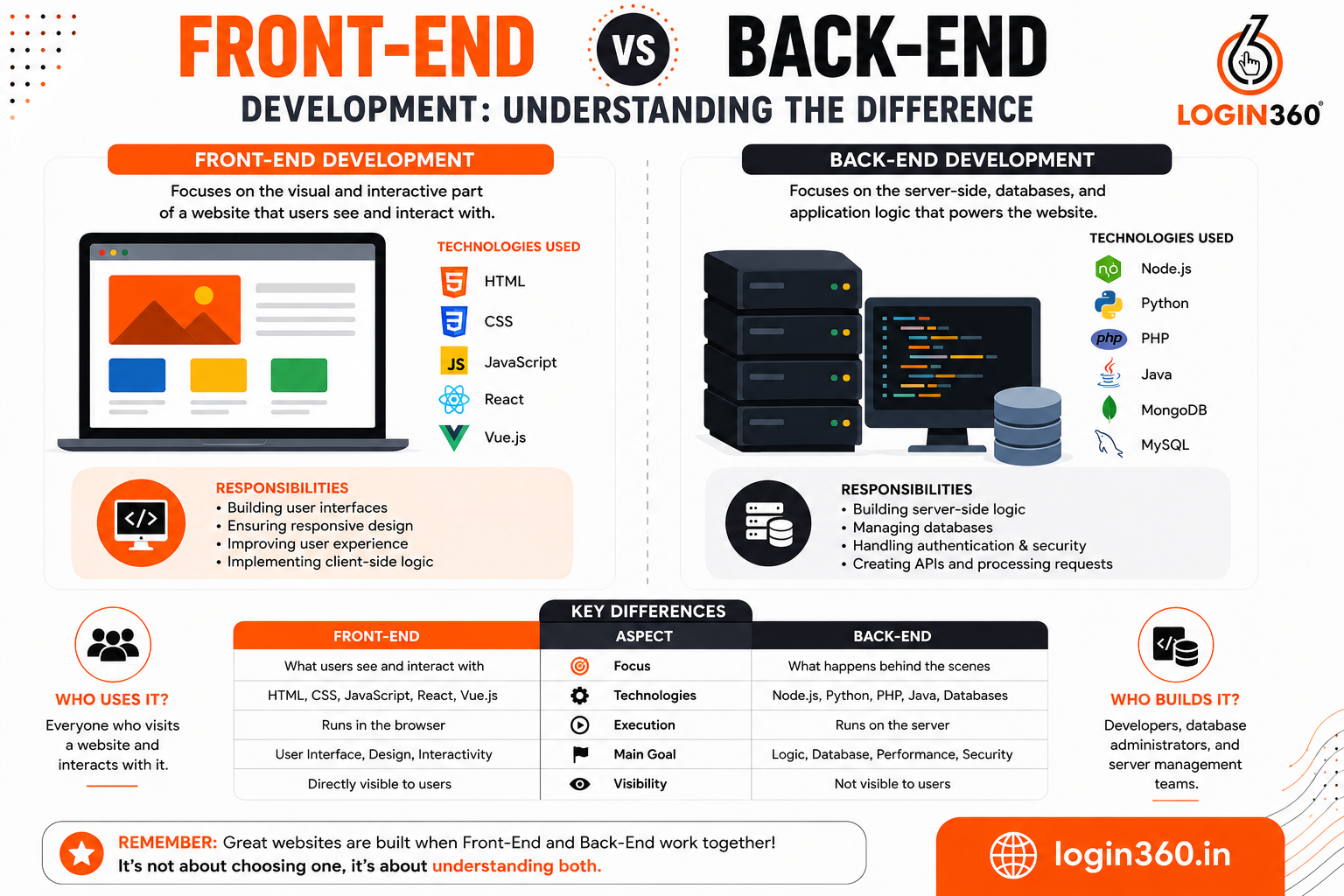
Front-end development is responsible for creating the visual elements of a website that visitors interact with every day. This includes navigation menus, buttons, forms, images, layouts, animations, and overall page responsiveness. The main objective is to deliver an engaging and user-friendly interface that works smoothly across desktops, tablets, and smartphones. Front-end developers use HTML to structure web pages, CSS to style them, and JavaScript to add interactive functionality. Modern libraries and frameworks like React, Vue.js, and Angular further enhance the development process by enabling faster, more dynamic user experiences.
The Role of Back-End Development
Back-end development focuses on the technology that powers websites behind the interface. It manages application logic, handles user requests, processes transactions, communicates with databases, and ensures that data is delivered accurately and securely. Every time a user logs into an account, submits a registration form, or completes an online payment, the back end processes those actions. Developers in this field work with programming languages such as Python, Java, PHP, Node.js, Ruby, and C#, while using databases like MySQL, PostgreSQL, and MongoDB to organize and retrieve information efficiently.
Core Technologies Behind Both Development Types
Although front-end and back-end development have different responsibilities, each relies on specialized technologies to achieve its goals. Front-end developers commonly work with HTML5, CSS3, JavaScript, Bootstrap, Tailwind CSS, React, Angular, and Vue.js to create responsive interfaces. Meanwhile, back-end developers use frameworks like Django, Laravel, Express.js, Spring Boot, and ASP.NET, along with server technologies, RESTful APIs, cloud platforms, and database management systems. Combining these technologies allows businesses to build secure, scalable, and high-performing web applications.
Major Differences Between Front-End and Back-End Development
The primary difference between front-end and back-end development lies in their focus and responsibilities. Front-end developers concentrate on improving the user experience by designing responsive layouts, optimizing website speed, and ensuring accessibility across devices. Back-end developers prioritize server performance, business logic, data storage, security, and application scalability. While front-end tasks often involve creativity and design implementation, back-end development demands analytical thinking and efficient programming. Despite these differences, both disciplines must work together to ensure websites function smoothly from the user's perspective.
Skills Needed to Succeed in Each Field
Success in either front-end or back-end development requires continuous learning and strong technical skills. Front-end developers should understand responsive design principles, browser compatibility, JavaScript frameworks, UI/UX concepts, debugging, and version control systems like Git. Back-end developers need expertise in programming languages, database management, API development, server administration, authentication systems, cloud computing, and cybersecurity. Strong communication, logical thinking, and problem-solving abilities are equally valuable because developers frequently collaborate to solve technical challenges and improve application performance.
How Front-End and Back-End Connect
The interaction between front-end and back-end development is made possible through APIs that allow both sides of an application to communicate effectively. When a user performs an action such as searching for a product or submitting login details, the front end sends a request to the back end. The server processes the request, retrieves or stores the required data in a database, and sends the appropriate response back to the interface. This seamless exchange of information enables websites to deliver fast, reliable, and personalized user experiences while maintaining security and efficiency.
Career Scope and Industry Demand
The demand for both front-end and back-end developers continues to grow as businesses invest in digital transformation and online services. Front-end professionals can pursue roles such as UI Developer, JavaScript Developer, React Developer, or Web Designer with coding expertise. Back-end specialists often work as Software Engineers, API Developers, Database Engineers, Cloud Developers, or System Architects. Professionals who master both disciplines can become Full Stack Developers, one of the most sought-after roles in the technology industry due to their ability to handle complete web application development.
Selecting the Best Career Option
Choosing between front-end and back-end development depends on your interests, strengths, and long-term career goals. Individuals who enjoy designing interfaces, improving user interactions, and working with visual elements may find front-end development more satisfying. Those who prefer writing complex logic, optimizing databases, solving technical challenges, and managing servers may enjoy back-end development more. Exploring projects in both areas allows beginners to gain practical experience before deciding on a specialization, while learning both can open doors to full-stack development opportunities.
Conclusion
Front-end and back-end development are two equally important pillars of web development that work together to create modern digital experiences. The front end ensures users enjoy visually appealing, interactive, and responsive websites, while the back end provides the functionality, security, and data management needed to keep applications running efficiently. Rather than choosing one as more important than the other, understanding how both contribute to successful web development helps aspiring professionals make informed career decisions. With businesses increasingly relying on web technologies, expertise in either front-end or back-end development offers excellent career prospects, continuous learning opportunities, and long-term professional growth.



 Downloader
 Free FTP

 English
 Arabic
 French
 Spanish
 Deutsch
 Turkish
 Dutch
Dutch
 Italiano
 Russian
 Romaian
 Portuguese (Brazil)
 Greek
Greek
