


 Downloader
 Free FTP
How to Start a Career in Data Science with No Experience
Introduction
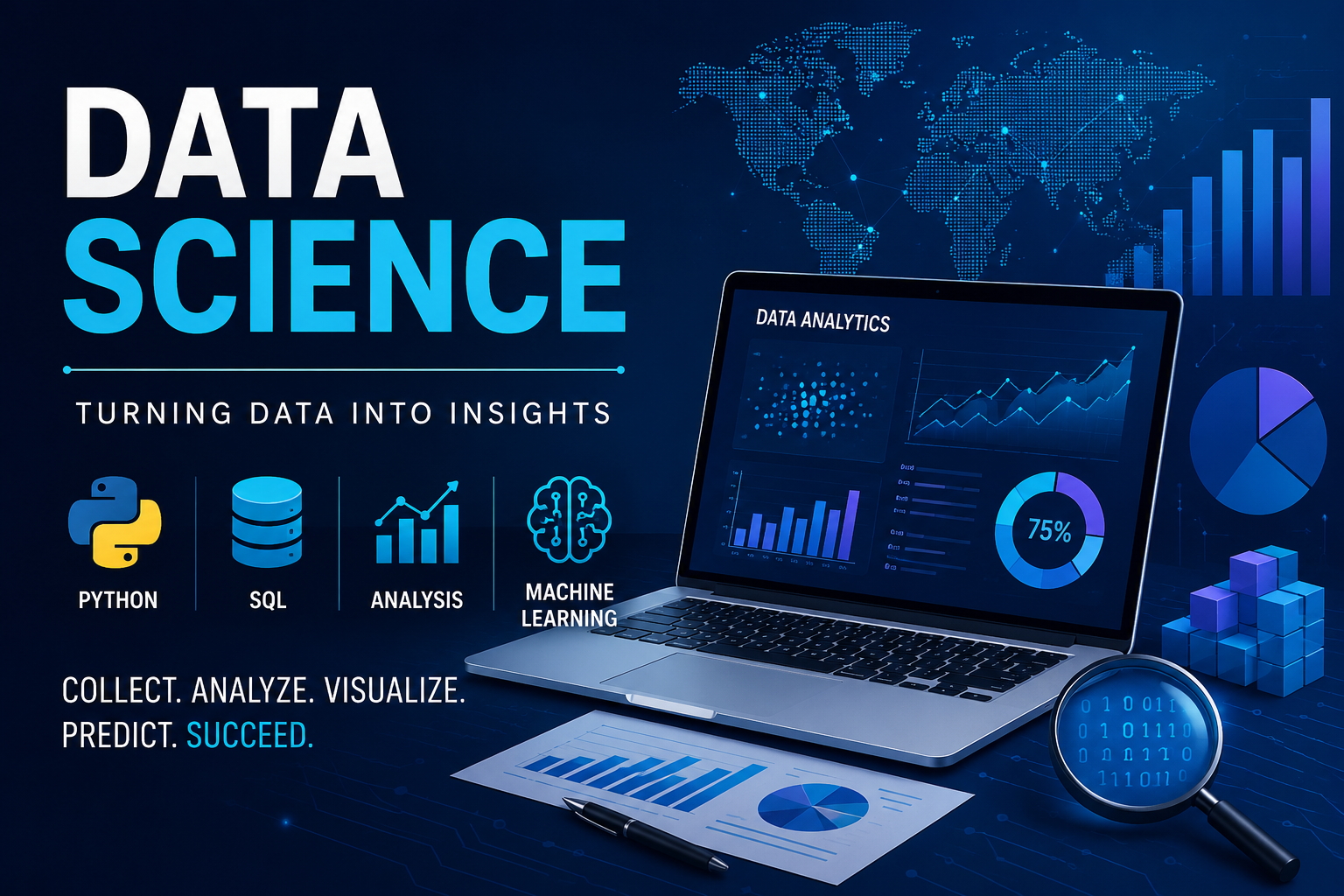
Data science has become one of the most promising career choices in the digital age. As businesses generate increasing amounts of data, the need for professionals who can analyze and interpret that information continues to rise. Organizations across industries such as healthcare, banking, retail, manufacturing, education, and e-commerce use data science to improve business performance, understand customer preferences, and make informed decisions. Although many people believe that entering this field requires professional experience or a technical degree, anyone can build a successful career by following a structured learning path and practicing consistently.
What is Data Science?
Data science is the practice of transforming raw data into meaningful insights that help businesses solve problems and make better decisions. It combines programming, statistics, mathematics, and business knowledge to discover patterns and trends hidden within large datasets.
A data scientist collects data from multiple sources, prepares it for analysis, examines the information, and develops predictive models. These insights help organizations improve efficiency, reduce risks, optimize operations, and enhance customer satisfaction. Because of its growing importance, data science is now widely used in industries including finance, healthcare, logistics, manufacturing, retail, telecommunications, and artificial intelligence.
Step 1: Understand the Data Science Process
The first step toward becoming a data scientist is understanding the complete workflow followed in real-world projects. Every project starts with gathering data from different sources. The collected data is cleaned by removing duplicate records, correcting errors, and handling missing values. After preparing the dataset, it is analyzed to identify useful trends and relationships. Based on the project requirements, machine learning models may be developed to generate predictions, and the final insights are shared through reports or dashboards for business decision-making.
Step 2: Learn Python Programming
Python is the preferred programming language for data science because it is easy to learn and supported by a wide range of powerful libraries. Beginners should begin with programming basics such as variables, loops, functions, conditional statements, and data structures.
After learning the fundamentals, practice using libraries like NumPy, Pandas, Matplotlib, and Scikit-learn. Writing code regularly and solving practical exercises will strengthen your coding skills and improve logical thinking.
Step 3: Learn Statistics
Statistics is one of the core foundations of data science because it helps professionals understand data accurately and draw reliable conclusions. Beginners should first focus on mastering the essential statistical concepts before exploring advanced topics.
Important areas include probability, mean, median, variance, standard deviation, correlation, regression, and hypothesis testing. These concepts are essential for analyzing datasets and building dependable predictive models.
Step 4: Master SQL
SQL is an important skill because most business data is stored in relational databases. Data scientists use SQL to retrieve, organize, filter, and prepare data before analysis.
Start by practicing SQL commands such as SELECT, WHERE, GROUP BY, ORDER BY, JOIN, and subqueries. As your knowledge grows, learn advanced features like Common Table Expressions (CTEs) and window functions to work more efficiently with large datasets.
Step 5: Develop Data Visualization Skills
Presenting insights clearly is an essential responsibility of a data scientist. Data visualization makes complex information easier to understand by displaying it through charts, graphs, and interactive dashboards.
Popular visualization tools include Matplotlib, Seaborn, Plotly, Tableau, and Power BI. Developing visualization skills helps communicate findings effectively to both technical professionals and business leaders.
Step 6: Learn Machine Learning Fundamentals
Machine learning is an important area of data science that enables systems to recognize patterns and make predictions from historical data. After building a strong foundation in Python, SQL, and statistics, begin learning algorithms such as linear regression, logistic regression, decision trees, random forest, and support vector machines. Focus on understanding when and where each algorithm is used rather than memorizing mathematical formulas.
Step 7: Build Real-World Projects
Practical projects provide hands-on experience and demonstrate your abilities to potential employers. Beginners can build projects such as customer segmentation, sales forecasting, house price prediction, movie recommendation systems, and stock market analysis. Clearly explain the project objective, methodology, analysis, and results to showcase your technical and problem-solving skills.
Step 8: Create a Professional Portfolio
A well-organized portfolio is one of the best ways to showcase your skills without prior work experience. Include GitHub repository links, project descriptions, source code, dashboards, visualizations, documentation, and business insights. A regularly updated portfolio reflects your continuous learning and practical expertise.
Step 9: Earn Relevant Certifications
Professional certifications help strengthen your resume and validate your technical knowledge. Select certification programs that include Python, SQL, statistics, machine learning, data visualization, and capstone projects. Combining certifications with practical project experience makes your profile more competitive.
Step 10: Prepare for Interviews
Before applying for data science roles, spend time preparing for technical interviews. Practice Python programming, SQL queries, statistical concepts, machine learning fundamentals, business case studies, and data interpretation questions. Mock interviews are also valuable for improving communication skills and boosting confidence.
Career Opportunities in Data Science
Once you have developed the required technical and analytical skills, you can apply for entry-level positions such as data analyst, junior data scientist, machine learning associate, business intelligence analyst, AI research assistant, data engineer trainee, and analytics consultant. With experience and continuous learning, you can progress into advanced roles, including Senior Data Scientist, Machine Learning Engineer, AI Specialist, Lead Data Scientist, and Analytics Manager.
Conclusion
Building a career in data science without previous experience is achievable with dedication, continuous learning, and practical application. By strengthening your knowledge of Python, SQL, statistics, data visualization, and machine learning while working on real-world projects and maintaining a professional portfolio, you can become ready for entry-level opportunities. Consistent practice and a willingness to learn will help you build a successful career in the ever-growing field of data science.

 English
 Arabic
 Spanish
 Portuguese
 Deutsch
 Turkish
 Dutch
Dutch
 Italiano
 Russian
 Romaian
 Portuguese (Brazil)
 Greek
Greek
