


 Downloader
 Free FTP
Politically Exposed Person Check vs Sanctions Screening: Key Differences Every Business Should Know
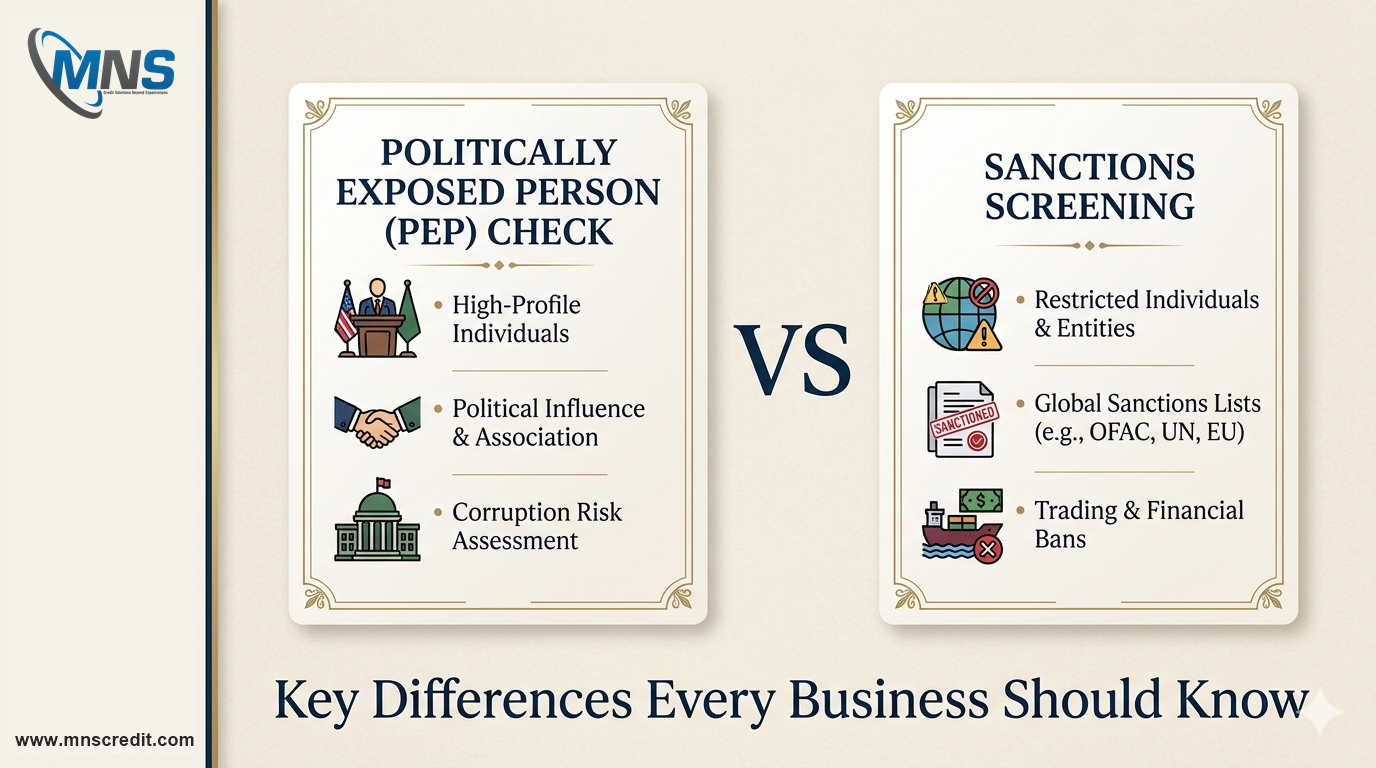
In the compliance world, PEP screening and sanctions screening are often mentioned in the same breath — and for good reason. Both are critical components of AML and KYC frameworks, and both involve matching customer data against risk databases. However, the two disciplines are fundamentally different in purpose, scope, and regulatory consequence. Understanding these distinctions is essential for building an effective compliance programme.
What Is Sanctions Screening?
Sanctions screening is the process of checking whether a customer, counterparty, or transaction involves a party that has been officially designated by a government or international body as subject to economic or financial restrictions. Sanctioned persons and entities are typically listed on authoritative registers such as OFAC's Specially Designated Nationals (SDN) list, the UN Security Council Consolidated List, the EU Consolidated Sanctions List, and the UK HM Treasury Financial Sanctions List.
Being sanctioned is a legal designation. Transacting with a sanctioned party — even unintentionally — can constitute a criminal offence in many jurisdictions. In the United States, OFAC violations can result in multi-million dollar fines and criminal prosecution. In India, sanctions compliance is governed by the Foreign Exchange Management Act (FEMA) and administered through the Reserve Bank of India.
What Is PEP Screening?
PEP screening, by contrast, is not about legal prohibition. A person's PEP status does not make it illegal to do business with them. Rather, PEP screening is a risk management tool — it identifies individuals who, by virtue of their position and access to public resources, represent an elevated risk of corruption, bribery, and money laundering.
The regulatory obligation triggered by PEP identification is Enhanced Due Diligence (EDD) — a deeper level of scrutiny applied before and during the business relationship. This may include verifying the source of wealth, obtaining senior management approval, and applying enhanced transaction monitoring.
Key Differences at a Glance
• Legal Status: Sanctions are legal restrictions; PEP status is a risk indicator, not a prohibition.
• Data Sources: Sanctions data comes from official government lists; PEP data is compiled from governmental registers, political records, and media sources.
• Consequence of Match: A sanctions match may require an immediate transaction block or relationship termination; a PEP match triggers EDD review and heightened monitoring.
• Scope: Sanctions lists are finite and definitive; PEP databases are broader and more interpretive, covering categories, family members, and associates.
• Update Frequency: Sanctions lists are updated frequently, sometimes daily, and require real-time screening; PEP databases require continuous but often less time-critical updates.
Why You Need Both
PEP and sanctions screening are complementary, not interchangeable. A sanctioned individual may not be a PEP, and a PEP may not be sanctioned. Running only one type of check leaves significant gaps in your compliance programme.
Consider a scenario where a customer is a PEP from a high-corruption jurisdiction who is not yet on any sanctions list. A PEP check would identify the elevated risk and trigger EDD; a sanctions check alone would return no result, potentially leaving the risk undetected until enforcement action follows.
Conversely, a sanctions-designated individual may not hold public office and therefore would not appear on PEP lists. Only a sanctions check would identify the prohibition on transacting with this person.
Integrating Both into Your Compliance Programme
Best practice requires both PEP and sanctions screening to be integrated into a unified compliance workflow, ideally supported by a single technology platform that draws from both data pools simultaneously. This approach reduces duplication, ensures comprehensive coverage, and streamlines the analyst review process.
MNS Credit Management Group's compliance screening services encompass both PEP and sanctions checks, delivering unified risk intelligence across Indian and international markets.
Conclusion
PEP checks and sanctions screening serve distinct but complementary roles in financial crime prevention. Every business subject to AML obligations needs both. Understanding the difference — and ensuring your programme addresses both — is foundational to a credible and effective compliance framework.

 English
 Arabic
 Spanish
 Portuguese
 Deutsch
 Turkish
 Dutch
Dutch
 Italiano
 Russian
 Romaian
 Portuguese (Brazil)
 Greek
Greek
