


 Downloader
 Free FTP
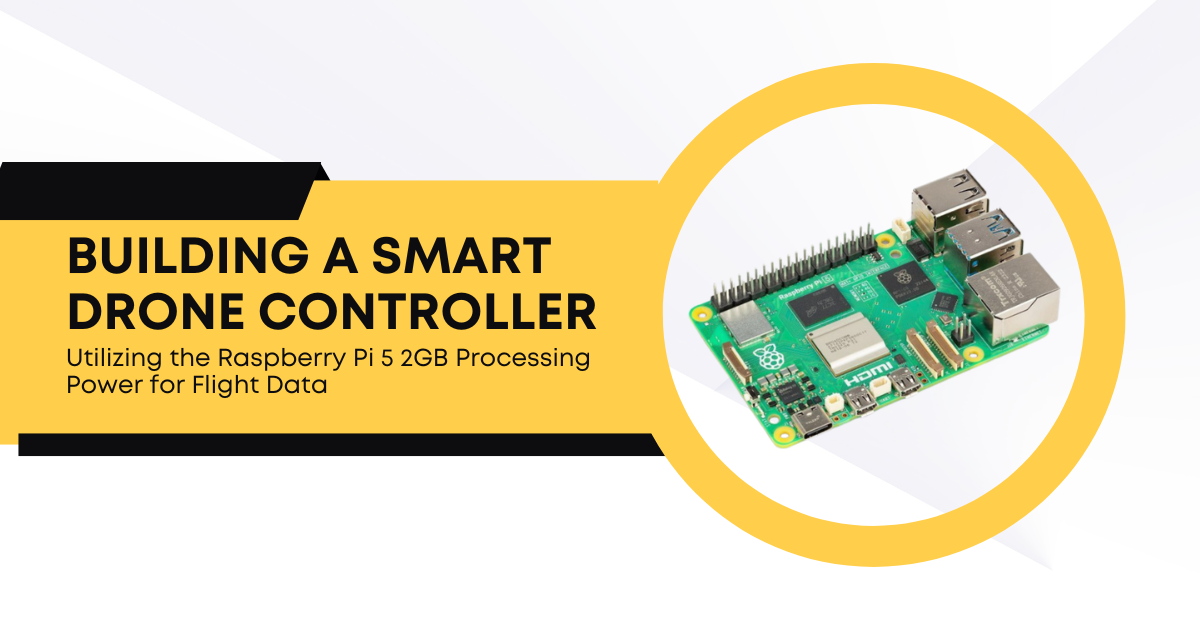
Building a Smart Drone Controller: Utilizing the Raspberry Pi 5 2GB Processing Power for Flight Data
Modern drone design demands high computational power. Traditional flight controllers handle basic stabilization well. However, they lack the speed for real-time edge processing.
Developers now use single-board computers for advanced aerial tasks. The Raspberry Pi 5 provides a capable hardware platform for these applications. It acts as a companion computer alongside the primary flight controller.
This setup splits critical flight duties. The micro-controller manages immediate motor stabilization loops. The Raspberry Pi 5 Model 2GB RAM processes heavy mathematical flight data simultaneously.
Using this dual-processor method creates a capable smart drone system. The system reads sensor arrays, avoids obstacles, and calculates complex navigation routes instantly.
Technical Specifications of the Hardware
The Raspberry Pi 5 changes how engineers build autonomous systems. It features a Broadcom BCM2712 system-on-chip. This chip contains a quad-core ARM Cortex-A76 processor. The CPU operates at a clock speed of 2.4GHz. This architecture delivers a huge performance increase. It runs two to three times faster than previous board versions.
Traditional flight controllers connect to the companion board using serial links. The motor loops run on low-level firmware. Complex data and computer vision tasks run on the Linux board.
Memory bandwidth also improves significantly on this hardware version. The board uses LPDDR4X-4267 memory modules. The hardware design reduces power consumption during idle operation.
1. Processor and Memory Layout
The 2GB version uses a single memory chip. This setup contains fewer transistors than the larger 8GB version. It reduces the base power draw during flight.
The system includes a VideoCore VII graphics unit. The GPU runs at a clock speed of 800MHz. It handles hardware-accelerated video decoding tasks easily.
2. Input and Output Capabilities
The system relies on a custom I/O controller called the RP1. This southbridge chip manages peripheral communication lanes. It delivers double the aggregate USB bandwidth for external devices.
The board features two four-lane MIPI transceivers. These ports accept dual camera connections. A single PCIe 2.0 lane supports high-speed solid-state drives.
Performance Statistics and Benchmarks
Quantifiable data proves the value of the Raspberry Pi 5 Model 2GB RAM in aviation systems. Sysbench CPU tests show massive mathematical calculation improvements.
Previous boards achieved 3,180 events per second. The new architecture reaches 7,290 events per second. This represents a 129% speed increase.
Memory read speeds show similar performance gains. The copy bandwidth reaches 10,240 megabytes per second. This is an 80% improvement. TensorFlow Lite performance confirms these processing upgrades. Object detection models run much faster now. A standard MobileNetV2 test drops from 38.4 seconds to 16.8 seconds. The system frame rate climbs from 26 frames per second to 59 frames per second. This speed allows the drone to react quickly to obstacles.
Interfacing Flight Controllers with the Pi
Smart drones need solid connection pathways between boards. The companion computer connects to the flight controller via UART ports. The 40-pin header provides these serial communication lines. Pin 2 handles the 5V power input. Pin 6 connects the system ground. Pin 8 acts as the transmit line. Pin 10 acts as the receive line. Telemetry protocols move data across this serial line. The Micro Air Vehicle Link protocol remains the industry standard. This protocol transmits states, GPS data, and sensor readings.
The flight controller sends MAVLink packets to the receiver pin. A parsing daemon processes this stream. The software then records the output directly into a flight log.
The software routes data directly into RAM logs. This pipeline eliminates input latency. The system reads hundreds of messages every second without dropping packets.
Managing Memory on a 2GB Constraints System
Using the 2GB model requires careful software optimization. Linux operating systems consume memory quickly with default settings. A headless configuration is necessary for flight operations.
Developers must remove the graphical user interface. Disabling the desktop environment saves 400 megabytes of RAM. The system should boot directly into a secure shell console.
The operating system core requires roughly 450 megabytes. The MAVLink parsing daemon consumes about 150 megabytes. Telemetry buffers use 300 megabytes. This leaves 1,100 megabytes free for primary aviation applications. Lightweight languages keep memory usage low. C++ applications handle telemetry parsing efficiently.
Developers should avoid large Python libraries for basic tasks. Using NumPy buffers manages data arrays without causing memory leaks. This preservation keeps memory consumption under 1.2 gigabytes during operations.
Processing Complex Flight Data on the Edge
Flight data consists of fast, continuous data arrays. The drone records accelerometer inputs on three axes. It tracks gyroscope orientation and barometric pressure data.
The quad-core CPU computes orientation angles via Kalman filtering. The algorithm combines noisy sensor signals into clean positional tracks. The system runs these matrix multiplications across four threads simultaneously. The multi-thread execution utilizes the 512 kilobytes of L2 cache per core. Raw IMU hardware transfers data via SPI or I2C buses. The filtering layer processes these inputs via multi-threaded execution. The clean state vector then flows straight into the navigation control algorithms. The system saves these clean vectors to storage. The high-speed microSD slot supports SDR104 mode. The system writes telemetry entries at 40 megabytes per second. This file log provides a detailed history for accident analysis.
Power and Thermal Management in Airframes
High computing speeds generate significant heat energy. The Raspberry Pi 5 requires proactive thermal management during operation. The bare board throttles performance at 80°C. It reaches this limit within four minutes under full load. An uncooled board stabilizes at 80°C and cuts clock speeds. Installing an active cooler fan drops operational temperatures to 55°C. This allows the processor to maintain its maximum clock frequency indefinitely.
Throttling drops the processor frequency down to lower speeds. This protects the silicon but slows down flight calculations. Drone builders must install an active cooler assembly. The aluminum heatsink and fan keep temperatures at 55°C. Power delivery requires a stable electrical design. The board draws 10.2 watts under maximum processing load. A standard drone battery provides high voltage. A step-down buck converter must regulate this voltage to 5.0 volts. The converter must supply 5 amperes of continuous current safely.
Software Frameworks for Autonomous Aviation
Developers use proven open-source tools to build autonomous systems. Robot Operating System 2 serves as the core framework. This software handles node communication over an internal network layer. The MAVROS node publishes diagnostic messages to the logger node. It also sends local position data to the navigation node. The navigation node then passes refined flight paths back to the logger. One node reads incoming MAVLink packages continuously. A second node calculates target waypoints based on position data. The nodes exchange data via standard topic publishing paths. ROS 2 minimizes latency between these running programs.
The software runs on the Ubuntu Server operating system. The system strips away unnecessary services like Bluetooth audio daemons. This optimization reduces the background processor load down to 2%.
Real-World Example: Building an Obstacle Avoidance Logger
An obstacle avoidance script illustrates edge processing capabilities. The system uses a forward-facing camera and a laser distance sensor. The script captures images via the MIPI interface.
The operational software loop follows five specific steps:
-
The system captures a raw frame from the MIPI camera channel.
-
The processing script reads distance metrics from the I2C bus sensor.
-
The CPU runs an edge-detection filter across the image matrix.
-
The algorithm matches identified objects with the laser distance values.
-
The system writes a stamped record entry to the flash memory log.
The script runs this complete process 30 times per second. The Cortex-A76 cores compute the matrix transforms without dropped frames.
The system saves each record entry with a precise timestamp. This data reveals exact distance metrics if the drone gets too close to obstacles.
Troubleshooting Common Airborne Computing Issues
Airborne computing systems face distinct environmental hazards. High vibration from brushless motors disrupts mechanical connections.
Electrical noise from speed controllers introduces data errors. Developers must shield their signal wiring carefully.
1. Resolving Low Voltage Warning Issues
Low voltage warnings indicate inadequate power supply wires. Thin power cables cause voltage drops under high processing loads. Using 28 AWG wire results in immediate voltage drops and system warnings. Upgrading to thicker 20 AWG wire ensures stable 5.0V delivery under maximum load conditions. Developers must use 20 AWG copper wire for power connections. Soldering wires directly to power pads prevents connection breaks during high-vibration maneuvers.
2. Fixing Serial Data Packet Loss
Dropped telemetry packets indicate serial buffer overflows. This problem occurs when processing scripts take too long to run. Moving parsing tasks to a dedicated background thread solves this issue. The main application loop remains free for navigation tasks. Setting the Linux serial port to low-latency mode also helps maintain steady data flow.
Conclusion
Building a smart drone controller requires balancing hardware capabilities with resource management. The Raspberry Pi 5 provides the processing speeds necessary for fast, multi-threaded flight calculations. By selecting the Raspberry Pi 5 Model 2GB RAM, engineers optimize both weight and power efficiency on small airframes.
Strict software choices keep memory usage low. Removing graphical interfaces ensures the 2GB memory capacity handles heavy telemetry data arrays comfortably. The high-speed CPU handles Kalman filtering and sensor logs smoothly without dropping critical data packets.
Proper thermal regulation and electrical buffering guarantee system stability during flight. Active cooling components prevent thermal throttling, keeping calculation loops precise. Using this hardware layout delivers a reliable edge computing platform for autonomous drone navigation.

 English
 Arabic
 French
 Spanish
 Portuguese
 Deutsch
 Turkish
 Italiano
 Russian
 Romaian
 Portuguese (Brazil)
 Greek
Greek
