


 Downloader
 Free FTP
Flutter vs React Native: Which Should Your App Development Company Recommend?
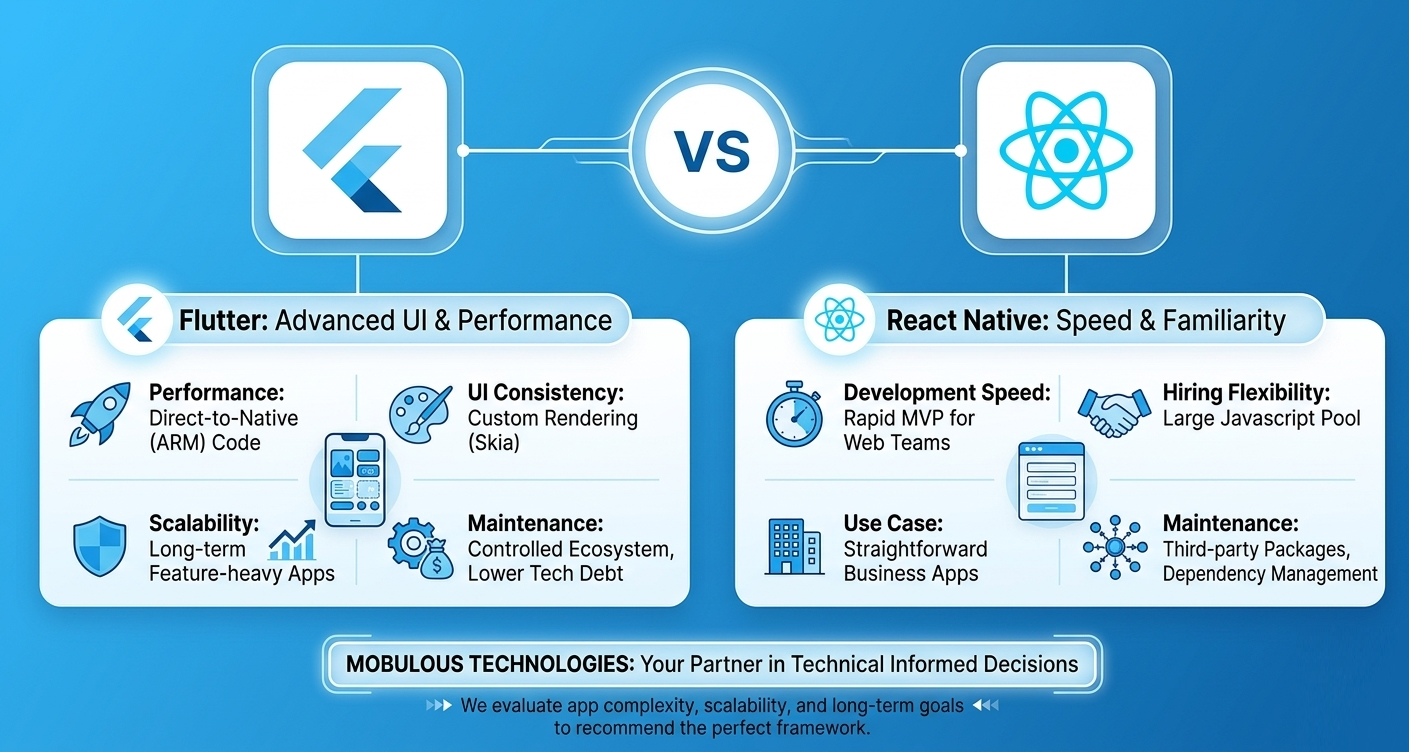
Businesses planning a mobile app usually ask the same question before development starts: should they choose Flutter or React Native?
I’ve seen companies make this decision based only on trends or developer opinions, and that often creates problems later. The right framework depends on app complexity, scalability, UI expectations, developer availability, and long-term maintenance costs.
Both frameworks are strong cross-platform solutions, but they solve problems differently. Understanding those differences helps businesses avoid expensive rebuilds and performance limitations.
Flutter vs React Native: Understanding the Core Difference
The biggest difference between Flutter and React Native is how they render the user interface.
Flutter uses its own rendering engine called Skia. Instead of relying on native UI components, it draws everything directly on the screen. That gives developers more control over animations, layouts, and visual consistency.
React Native works differently. It uses native platform components and connects JavaScript code to native APIs through a bridge architecture. This approach helps apps feel more “platform-native” but can introduce performance bottlenecks in graphics-heavy applications.
This architectural difference is why Flutter often performs better in animation-intensive apps, while React Native is usually faster for teams already experienced with JavaScript.
Performance Comparison
Performance is usually the first thing clients care about once user growth begins.
Flutter compiles directly into native ARM code, which reduces communication overhead and improves rendering speed. In practical terms, I’ve noticed Flutter performs especially well in:
- Real-time dashboards
- Fintech applications
- Video streaming interfaces
- Apps with heavy animations
React Native has improved significantly with the new Fabric architecture, but performance still depends heavily on third-party libraries and native module optimization.
For standard business apps, users may not notice much difference. But once the application scales or introduces advanced UI interactions, Flutter generally provides smoother rendering.
Development Speed and Team Availability
This is where React Native still has a major advantage.
Since React Native uses JavaScript, businesses can hire developers faster and often reduce onboarding costs. Many companies already have React web developers who can transition into mobile development quickly.
Flutter uses Dart, which is easier to learn than many people expect, but the hiring pool is still smaller in comparison.
If I were building an MVP under a tight deadline with an existing React team, I would likely choose React Native.
If I were building a long-term product where UI quality and performance mattered more than initial speed, I would choose Flutter.
UI Consistency and User Experience
Flutter gives developers pixel-level control over the interface. That becomes important when branding and design consistency matter.
For example:
- E-commerce apps
- Fitness platforms
- OTT streaming apps
- Gaming interfaces
These products usually require highly customized UI components and fluid animations. Flutter handles those scenarios exceptionally well because the framework controls rendering directly.
React Native delivers a more native look and feel automatically, which works well for simpler business applications and productivity apps.
Maintenance and Scalability
Many businesses focus only on launch speed and ignore maintenance costs.
That’s a mistake.
React Native applications often depend on multiple third-party packages for advanced functionality. Over time, dependency conflicts and compatibility updates can increase maintenance effort.
Flutter’s ecosystem is more controlled and consistent, which can simplify long-term maintenance for growing applications.
From a scalability perspective, I’ve seen Flutter become a stronger option for businesses planning:
- Multi-region expansion
- Complex UI upgrades
- Cross-platform consistency
- Feature-heavy applications
Which Framework Should Businesses Choose?
The answer depends on business priorities.
Choose Flutter if:
- The app requires advanced UI design
- Performance is critical
- Long-term scalability matters
- Brand consistency is important
Choose React Native if:
- Fast MVP development is the goal
- The business already uses React
- Hiring flexibility matters
- The application is relatively straightforward
This is why an experienced Flutter App Development Company or React Native App Development Company should recommend frameworks based on business requirements rather than personal preference.
Why the Right Development Partner Matters
Framework selection alone does not guarantee success.
Architecture planning, API structure, security implementation, testing strategy, and scalability planning matter just as much as the framework itself.
That’s where companies like Mobulous Technologies stand out. As an experienced App Development Company, they evaluate product goals, technical complexity, future scalability, and user expectations before recommending the right solution.
Instead of forcing a one-size-fits-all approach, they align technology choices with long-term business outcomes.
Source of this blog: CLICK HERE
Conclusion
The debate around Flutter vs React Native is not about finding a universal winner. It’s about choosing the right tool for the right business model.
Flutter offers stronger UI flexibility, consistent rendering, and better performance for visually demanding applications. React Native delivers faster onboarding, wider developer availability, and efficient MVP development.
Businesses that plan carefully before development usually save time, reduce technical debt, and scale more efficiently later.
In the end, successful mobile app development depends less on trends and more on making technically informed decisions with the right development partner.
Also Read Our Latest Blog's:

 English
 Arabic
 French
 Spanish
 Portuguese
 Deutsch
 Turkish
 Dutch
Dutch
 Italiano
 Romaian
 Portuguese (Brazil)
 Greek
Greek
