


 Downloader
 Free FTP
Is Your Blast Valve Actually Doing Its Job?
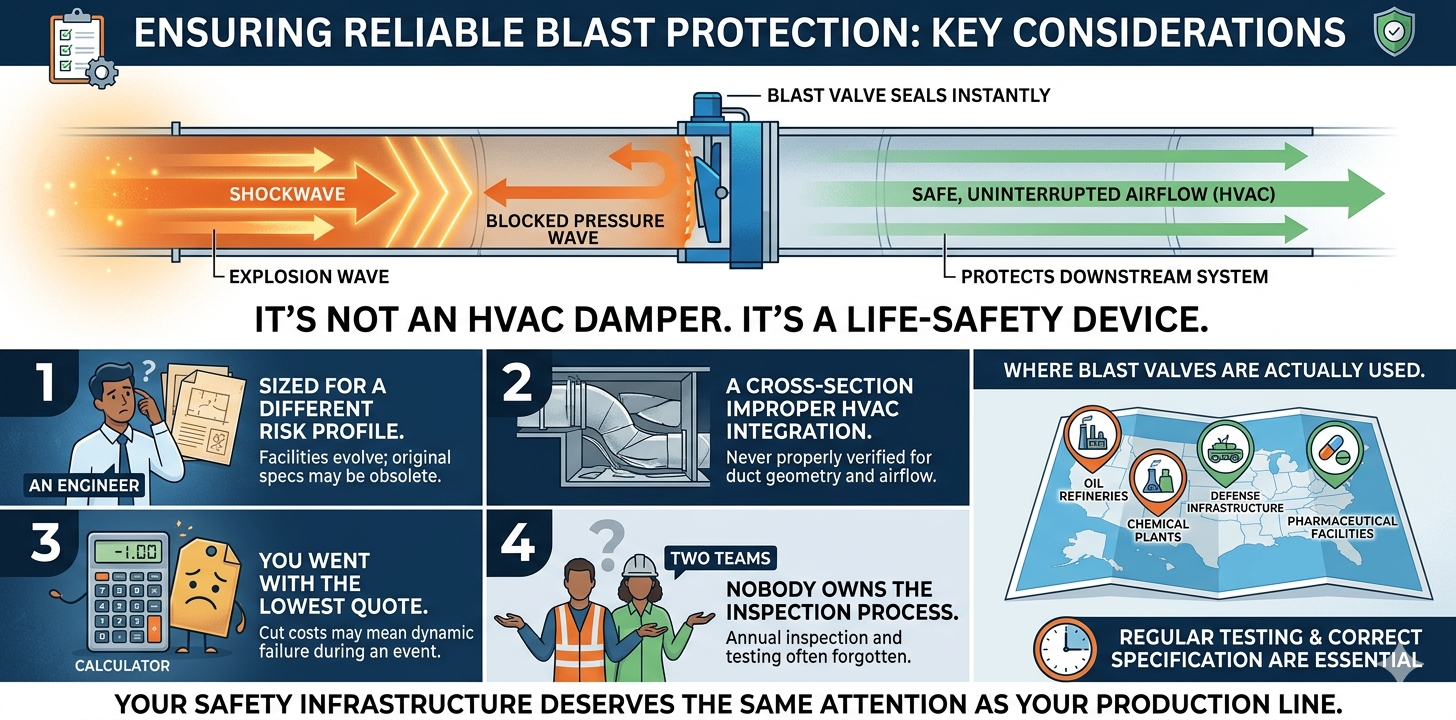
A blast valve is one of those components that sits quietly in your system — until the day it matters most. And on that day, there's no time to check whether it was sized correctly, installed properly, or last inspected two years ago.
The uncomfortable truth? A lot of industrial facilities are running on blast protection that looks compliant on paper but hasn't been genuinely evaluated in years.
What a Blast Valve Actually Does
A blast valve seals instantly when an explosion shockwave hits — stopping the pressure wave from traveling through your ventilation system and destroying everything downstream.
It's not a standard HVAC damper with a fancy name. It's a life-safety device.
And yet, it's often treated like regular ductwork — installed once, forgotten, and only remembered during an audit.
What most engineers don't realize: A blast valve that isn't regularly tested or correctly specified for your pressure load isn't protection. It's a false sense of security.
4 Signs Your Blast Protection May Be Failing You
It was sized for a different risk profile
Facilities evolve. Processes change. New equipment gets added. But the original blast valve spec from ten years ago? Still sitting in the same spot, rated for a load that no longer reflects your actual risk.
If your operational profile has changed and your blast protection hasn't — that's a gap worth closing today.
The HVAC integration was never properly verified
A blast damper installed in an HVAC system needs to be compatible with airflow, duct pressure, and layout — not just bolted in and signed off.
Hidden risk: Improper HVAC integration can cause a blast damper to trigger under normal pressure — or worse, fail when it actually counts.
You went with the lowest quote
Blast valve pricing varies significantly across manufacturers. The temptation to cut costs is real under procurement pressure.
But a valve that saves 20% upfront and fails during an overpressure event doesn't save anything — it costs everything.
Nobody on your team owns the inspection process
Blast valve maintenance falls into a grey zone — too mechanical for the safety team, too safety-critical for the maintenance crew. The result? Nobody checks it seriously.
But that's not the biggest issue...
Most facilities only discover this gap after an incident or external audit. By then, the conversation is very expensive.
Where Blast Valves Are Actually Used
Blast valves aren't just for military bunkers. They're actively used across:
- Oil & gas refineries and chemical processing plants
- Defense infrastructure and government facilities
- Pharmaceutical manufacturing with flammable materials
- Underground tunnels and critical civil infrastructure
If your facility falls into any of these categories, explore blast valve systems engineered for real industrial environments — and review your current setup before an audit does it for you.
The Installation Mistake Nobody Talks About
Most facilities treat blast valve selection as a procurement decision rather than an engineering one.
The spec goes to purchasing. Three quotes come back. The middle option wins. No structural or safety engineer validates whether that valve suits the duct geometry, risk classification, or required response time.
Most facilities miss this: Blast damper placement within an HVAC system directly affects response speed. A valve installed too far from the protected zone may not close fast enough to matter.
It gets worse if the system was designed around a response time the installed unit doesn't actually meet under real conditions.
Don't wait for a failure to fix this. Also explore explosion protection strategies in industrial plants to see how blast valves fit into a broader safety framework.
FAQs
Q. What is a blast valve used for?
Ans. It seals ventilation or HVAC ducts instantly during an explosion, preventing pressure waves from causing further damage downstream.
Q. How is a blast valve different from a blast damper?
Ans. Blast damper is the broader category. A blast valve specifically refers to the rapid-closure mechanism triggered by overpressure conditions.
Q. Where are blast valves required?
Ans. In oil refineries, chemical plants, defense bunkers, underground infrastructure, and pharmaceutical facilities — anywhere explosion risk is a credible operational scenario.
Q. How often should a blast valve be inspected?
Ans. At minimum, annually. More frequently in harsh or high-humidity environments where mechanical components wear faster.
Final Thought
A blast valve doesn't announce when it's no longer fit for purpose. It just sits there — until the moment it's needed.
The facilities that take explosion protection seriously don't wait for that moment to find out if their systems were actually ready.
Your safety infrastructure deserves the same attention as your production line.

 English
 Arabic
 French
 Spanish
 Deutsch
 Turkish
 Dutch
Dutch
 Italiano
 Russian
 Romaian
 Portuguese (Brazil)
 Greek
Greek
