


 Downloader
 Free FTP
Promote Your Product
Got a product, service, or story to share? Promote it directly to our active community and boost your brand today.
Create an Ad
Publish Bulk Blog Posts
Boost Your Reach! 📝
Have articles, guest posts, or bulk stories to publish? Send your content directly to our editorial team and feature on our platform.
Email Us Your PostsHow Does a Metal Punching Machine Manufacturer Like Zjdfjx Measure and Compensate for Frame Deflection Under Eccentric Loading
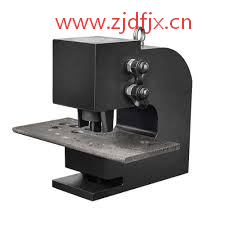
A punching operation that applies force away from the frame's center line creates a twisting moment. This torque rotates the slide and bed relative to each other, changing the angle where the punch meets the die. How does a Metal Punching Machine Manufacturer measure and compensate for frame deflection under eccentric loading at Zjdfjx?
The measurement phase relies on distributed strain sensing. Zjdfjx Defu embeds multiple strain gauge bridges at critical locations along the frame's stress path, including the crown, uprights, and bed. These sensors detect micro-deformations in the steel structure as force applies eccentrically. A data acquisition system samples each gauge at a rate that captures deflection changes between successive punching strokes. The manufacturer uses this real-time strain data to calculate the instantaneous angular displacement between the slide and the bed. Without such distributed sensing, a Metal Punching Machine Manufacturer would have no objective information about how much the frame actually twists during production.
Compensation begins with predictive structural modeling. Before casting any new frame, Zjdfjx Defu runs finite element analysis that simulates eccentric loading conditions at full tonnage. This simulation identifies areas of highest deflection and predicts the slide's tilt angle under specified off-center distances. The manufacturer then machines the slide guide surfaces with a calculated pre-compensation taper that counters the expected deflection. When the frame twists under load, the slide moves into an aligned position rather than shifting out of tolerance. A Metal Punching Machine Manufacturer that skips this predictive step forces the tooling to absorb all misalignment, accelerating die wear.
Active compensation systems handle variable loading conditions. For applications where eccentric distance changes between strokes, Zjdfjx offers servo-controlled wedge systems under the bed or behind the slide. These actuators receive real-time deflection signals from the strain gauge network and adjust their position within each cycle. The control algorithm calculates the required counter-deflection and moves the wedges before the punch contacts the workpiece. This active approach maintains slide-to-bed parallelism even when the operator places a small die in a large press bed without centering it. A passive frame alone cannot correct for such dynamic misalignment.
Validation testing confirms compensation effectiveness. Zjdfjx Defu performs eccentric loading tests on every assembled press, using laser displacement sensors that measure slide tilt at multiple off-center positions. The manufacturer records residual deflection after compensation and compares it to the tolerance required for the press's intended applications. For a detailed look at available stamping equipment, visit . This combination of distributed strain sensing, predictive pre-compensation machining, active wedge control, and laser-validated tilt measurement ensures that a Metal Punching Machine Manufacturer like Zjdfjx delivers presses capable of accurate punching regardless of where the tooling sits on the bed.

 Arabic
 French
 Spanish
 Portuguese
 Deutsch
 Turkish
 Dutch
Dutch
 Italiano
 Russian
 Romaian
 Portuguese (Brazil)
 Greek
Greek
