


 Downloader
 Free FTP
Promote Your Product
Got a product, service, or story to share? Promote it directly to our active community and boost your brand today.
Create an Ad
Publish Bulk Blog Posts
Boost Your Reach! 📝
Have articles, guest posts, or bulk stories to publish? Send your content directly to our editorial team and feature on our platform.
Email Us Your PostsPractical Ways Robotics Is Changing Quality Control and Material Handling
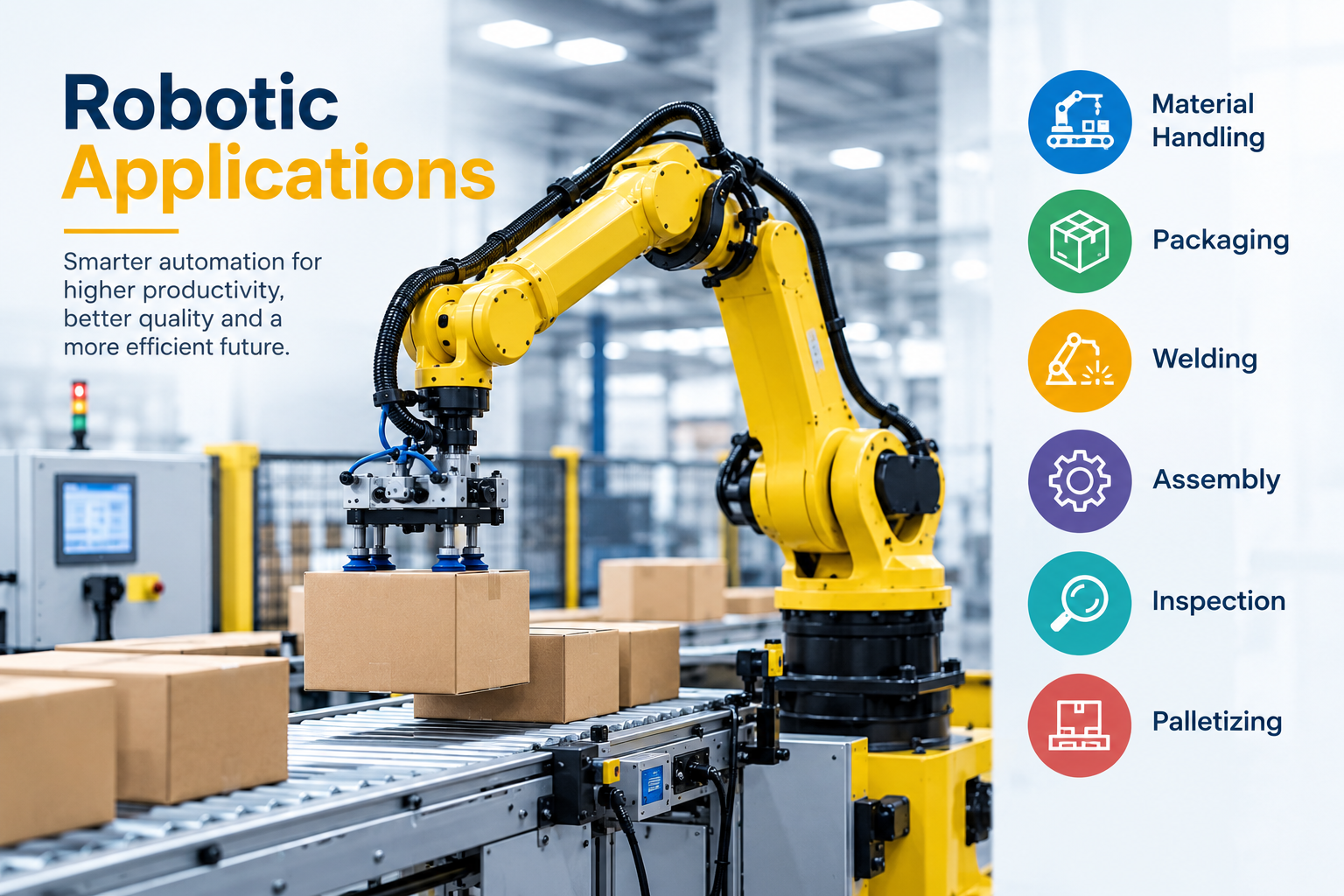
Modern manufacturing requires consistent product quality, efficient material movement, and reliable production processes. As factories handle increasing production demands, businesses are exploring technologies that can improve accuracy and reduce repetitive manual activities.
Robotic Applications are becoming increasingly useful in industrial environments because they allow machines to perform specific tasks with programmed movements and repeatable processes. From inspecting manufactured components to moving materials between workstations, robotics can help companies address operational challenges and improve workflow coordination.
1. Improving Product Inspection
Quality inspection is an important part of manufacturing. Products must meet defined specifications before they are delivered to customers or moved to the next production stage.
Manual inspection can be time-consuming, particularly when businesses need to examine large quantities of similar items. Robotic systems equipped with suitable cameras, sensors, and inspection tools can help automate selected inspection tasks.
For example, a manufacturing facility may use a robotic system to position components for camera-based inspection. The inspection software can then evaluate visible characteristics such as dimensions, surface defects, or component alignment, depending on the system's capabilities.
Automated inspection does not eliminate the need for proper validation. Businesses must ensure that the inspection system can detect the defects relevant to their products.
2. Making Material Handling More Consistent
Moving materials between workstations is a common requirement in manufacturing facilities. Repetitive handling tasks can consume employee time and interrupt production when materials are not available at the right location.
Robotic systems can support activities such as picking, transferring, sorting, and placing items.
For example, a production facility may use a robot to move components from a storage area to an assembly station. When integrated with suitable sensors and control systems, the robot can perform the task according to defined operating instructions.
This can help create more predictable material flow and reduce unnecessary handling steps.
3. Supporting Repetitive Assembly Operations
Some manufacturing processes require the same movement to be repeated across hundreds or thousands of products. These tasks may involve positioning components, inserting parts, fastening items, or applying materials.
Robots can perform suitable repetitive operations with consistent programmed movements.
Before introducing robotic equipment, businesses should evaluate the task's complexity, required accuracy, production volume, and acceptable cycle time.
The design must also account for product variations and any situations requiring human intervention.
When the application is properly selected and configured, robotic assembly can support repeatable production and help manufacturers manage demanding workloads.
4. Improving Workplace Safety
Certain industrial activities involve heavy objects, repetitive movements, or exposure to hazardous operating conditions. Automating suitable tasks can reduce the need for employees to perform some physically demanding activities directly.
For example, robots may handle heavy components or work in areas where heat, dust, or other environmental conditions require additional precautions.
However, introducing robotics also creates new safety considerations. Equipment must be installed with appropriate risk controls, protective devices, operating procedures, and employee training.
Businesses should evaluate the complete work environment rather than assuming that automation automatically makes a process safe.
5. Supporting Flexible Production
Manufacturers often need to accommodate different product models, sizes, or production quantities. Equipment that is difficult to reconfigure can become a limitation when product requirements change.
Some robotic systems can be reprogrammed or equipped with suitable tooling to support different tasks.
For example, a robot used for component handling may be configured for different product positions by updating its movement instructions and adjusting the gripping equipment.
The amount of flexibility depends on the robot, its tooling, the control software, and the application requirements.
Businesses should evaluate the time and technical effort needed to introduce a new product before choosing a system.
6. Connecting Robotics With Existing Equipment
Robotic equipment usually operates as part of a larger production process. It may need to coordinate with conveyors, inspection systems, manufacturing machines, and safety controls.
Successful integration requires careful planning of communication, timing, physical positioning, and operating sequences.
For example, a robot may need a signal confirming that a component is available before beginning a pick-and-place operation. If the connected machine is not ready, the robot may need to wait or follow a predefined recovery procedure.
Testing these interactions helps identify coordination problems before the system enters regular production.
7. Using Production Data to Improve Operations
Robotic systems can generate useful information about task completion, operating cycles, errors, and downtime.
When this information is collected and analyzed appropriately, manufacturers can identify recurring interruptions and evaluate whether production targets are being achieved.
For instance, repeated delays at a particular workstation may indicate that the surrounding process needs improvement.
Data should be interpreted in context. A robot's cycle time alone may not reflect overall productivity if other machines or material supply processes are limiting output.
Combining operational information with practical observation helps businesses identify more meaningful improvements.
8. Evaluating the Business Case for Robotics
Robotic equipment requires investment in hardware, integration, programming, safety measures, and ongoing maintenance.
Businesses should therefore evaluate the expected benefits before committing to a project.
Important considerations include:
- Current production volume and labor requirements
- Task repetition and consistency
- Product variation and changeover frequency
- Installation and integration costs
- Maintenance and employee training
- Expected reduction in errors or production delays
A pilot project can help verify whether the proposed application delivers the expected results before it is introduced across a larger facility.
Conclusion
Robotics is creating new opportunities for manufacturers to improve inspection, material movement, assembly, and production coordination. The most effective implementations begin with a clear understanding of the task and the operational problem that needs to be addressed.
By evaluating equipment capabilities, integration requirements, safety, and long-term costs, businesses can determine where Robotic Applications may provide practical value.

 Arabic
 French
 Spanish
 Portuguese
 Deutsch
 Turkish
 Dutch
 Italiano
 Russian
 Romaian
 Portuguese (Brazil)
 Greek
