


 Downloader
 Free FTP
Promote Your Product
Got a product, service, or story to share? Promote it directly to our active community and boost your brand today.
Create an Ad
Publish Bulk Blog Posts
Boost Your Reach! 📝
Have articles, guest posts, or bulk stories to publish? Send your content directly to our editorial team and feature on our platform.
Email Us Your PostsHow Does a Special Purpose Machine for Drilling Tapping Work?
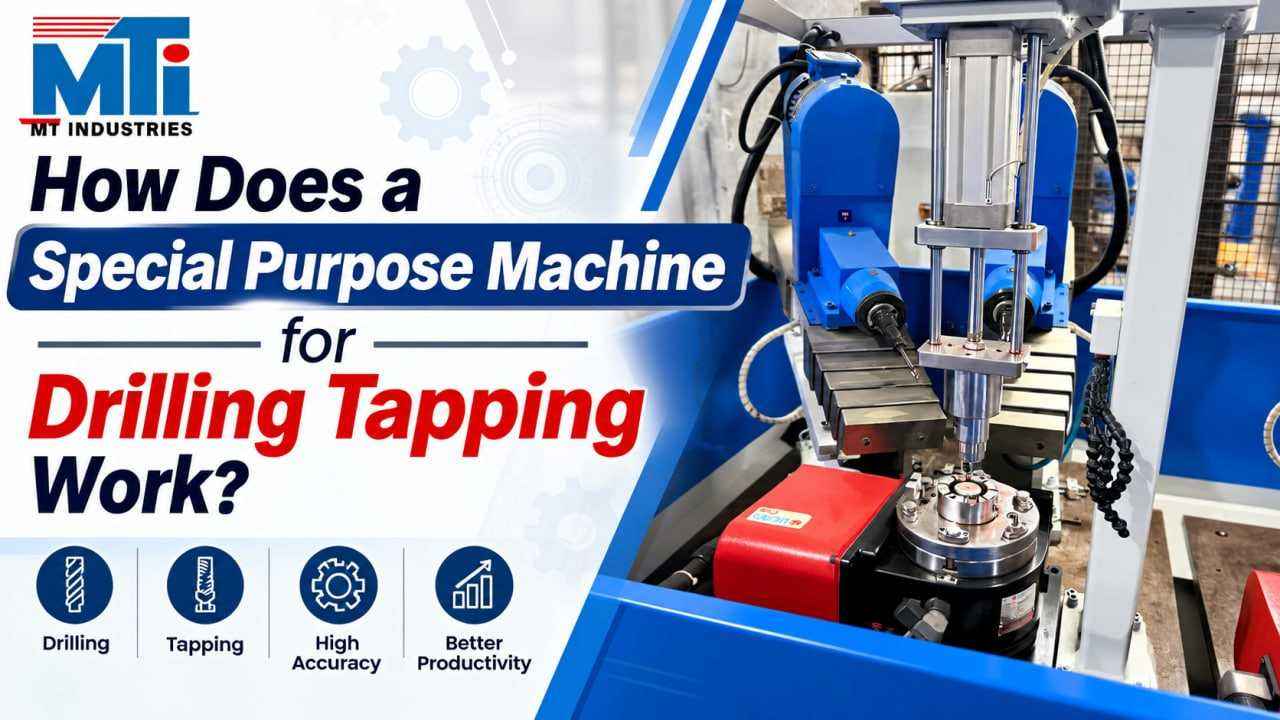
A Special Purpose Machine for Drilling Tapping is designed to perform drilling and thread-cutting operations efficiently, accurately, and consistently. Unlike conventional machines that often require separate setups for different operations, these machines can combine drilling and tapping into a coordinated production process. This makes them useful for manufacturers producing metal components in medium- to high-volume batches.
The working principle involves securing a component in a fixture, positioning the drilling and tapping tools, performing the required machining operations, and checking the finished part against specified quality requirements. Depending on the design, a machine may use multiple spindles, automatic feeding systems, pneumatic or hydraulic clamping, and programmable controls.
For manufacturers looking to improve productivity without compromising component accuracy, understanding how a Special Purpose Machine for Drilling Tapping works helps in selecting the right equipment for their production requirements.
What Is a Special Purpose Machine for Drilling Tapping?
A Special Purpose Machine for Drilling Tapping is a customised industrial machine developed to perform specific drilling, tapping, or combined machining operations on a particular component or family of components.
Drilling creates a hole in a workpiece, while tapping produces internal threads inside a previously drilled or suitably prepared hole. These threads allow fasteners such as bolts and screws to be fitted securely.
Unlike a general-purpose drilling machine, an SPM is engineered around the component's geometry, hole positions, thread specifications, production volume, and cycle-time requirements.
For example, a manufacturer producing automotive brackets may need several holes drilled at precise locations and tapped to specific thread sizes. A dedicated SPM can be designed to complete these operations in one setup, reducing repeated handling and helping maintain consistency.
Common applications include:
-
Automotive brackets, housings, and mounting components
-
Electrical enclosures and electronic hardware
-
Industrial equipment parts and machine components
-
Metal fittings, flanges, and structural components
-
Components requiring multiple drilled and threaded holes
At MT Industries, the design of a suitable machine depends on the component, machining requirements, production targets, and the level of automation needed.
How Does a Special Purpose Machine for Drilling Tapping Work?
The machine operates through a sequence of coordinated steps. Although the exact arrangement varies by design, most systems follow the process below.
1. Component Loading and Positioning
The process begins when the operator or an automated loading system places the workpiece into a dedicated fixture.
The fixture holds the component in the correct position and prevents unwanted movement during machining. Its design depends on the component's dimensions, shape, reference surfaces, and hole locations.
Accurate positioning is essential because even a small alignment error can affect hole spacing, perpendicularity, and thread position.
Depending on the production setup, loading may be manual, semi-automatic, or fully automatic. Sensors and interlocks can also be used to confirm that the component is correctly positioned before the machining cycle starts.
2. Workpiece Clamping
Once the component is positioned, a clamping mechanism secures it firmly.
Clamping systems may use pneumatic cylinders, hydraulic mechanisms, mechanical clamps, or a combination of these methods. The selection depends on the workpiece, machining forces, fixture design, and required production speed.
The purpose is to prevent movement without deforming the component. Excessive clamping force can damage thin-walled parts, while insufficient force can cause vibration, dimensional errors, or tool damage.
A well-designed Special Purpose Machine for Drilling Tapping incorporates suitable locating and clamping arrangements to maintain repeatable positioning throughout production.
3. Drilling the Required Holes
After clamping, the drilling unit moves the cutting tool into the workpiece to create holes at specified locations.
The drilling operation depends on several technical factors, including:
-
Workpiece material and hardness
-
Required hole diameter and depth
-
Drill geometry and tool material
-
Spindle speed and feed rate
-
Coolant or lubrication requirements
-
Component rigidity and fixture stability
For components with multiple holes, the machine may use a single drilling spindle or several spindles arranged according to the hole pattern.
A Multi Drilling Tapping Machine can be designed to process several holes during the same machining cycle. Depending on its configuration, different operations may take place simultaneously or in a controlled sequence.
This arrangement can reduce repeated positioning and improve output when compared with performing every hole individually on a conventional machine.
4. Preparing the Holes for Tapping
After drilling, the holes must be suitable for the required threading operation.
Hole diameter is particularly important. If the hole is too small, tapping forces may increase and the tap may break. If it is too large, the resulting thread may not provide the required engagement.
The correct tapping drill diameter depends on the thread standard, nominal thread size, pitch, material, and specified thread engagement.
Some applications may also require chamfering, deburring, or other preparatory operations before tapping. These requirements should be established during machine planning rather than assumed to be identical for every component.
Proper hole preparation helps reduce tool wear and improves the consistency of the finished threads.
5. Performing the Tapping Operation
Once the holes are ready, the tapping unit cuts internal threads into the workpiece.
A Tapping SPM Machine uses a suitable spindle and tapping arrangement to produce the specified thread profile. The tapping mechanism must coordinate tool rotation and axial movement so that the tap advances according to the thread pitch.
For example, an M6 × 1 thread has a nominal diameter of 6 mm and a pitch of 1 mm. During conventional rigid tapping, the spindle must maintain the correct relationship between rotation and axial feed to produce the intended thread.
Depending on the machine design, tapping may use rigid tapping, a suitable tapping attachment, or a specialised spindle arrangement.
Important parameters include:
-
Thread size and pitch
-
Required thread depth
-
Workpiece material
-
Tap type and tool condition
-
Spindle speed and feed synchronisation
-
Lubrication and chip evacuation
Correct synchronisation is essential. Poor coordination between spindle rotation and feed can damage threads, shorten tool life, or cause tap breakage.
6. Coordinating Drilling and Tapping Operations
In a combined machine, drilling and tapping are arranged to work within one coordinated production cycle.
The machine may drill first and then move the component or tool assembly into the tapping position. Alternatively, separate tool stations may perform different operations as part of an indexed or automated sequence.
The exact arrangement depends on the hole pattern, component design, available space, production target, and tooling requirements.
A Multi Drilling Tapping Machine may use multiple drilling heads and tapping spindles to process several features in a single cycle. However, the number of operations that can occur simultaneously depends on the machine configuration and the component's machining requirements.
Integrating these operations can reduce manual transfers between machines, simplify production flow, and improve repeatability.
7. Unclamping and Component Unloading
After machining is complete, the tools retract and the machine returns to its safe unloading position.
The clamping system releases the workpiece, allowing the operator or an automatic handling system to remove it. The component can then move to inspection, cleaning, or the next manufacturing stage.
Interlocks and suitable guarding help ensure that the machine does not start an unsafe cycle while the workpiece is being loaded or removed.
In automated systems, sensors can verify tool positions, clamping status, and other cycle conditions before the next operation begins.
8. Inspection and Quality Verification
The finished component must be checked against the engineering drawing and quality requirements.
Typical inspection points include:
-
Hole diameter and depth
-
Hole-to-hole spacing and positional accuracy
-
Thread size and pitch
-
Thread depth and engagement
-
Burr formation and surface condition
-
Consistency across repeated production cycles
Depending on the application, manufacturers may use plug gauges, thread gauges, depth gauges, coordinate measuring machines, or other suitable inspection equipment.
Inspection results should be used to identify recurring problems such as tool wear, fixture misalignment, incorrect feed settings, or inconsistent material conditions.
Main Components of a Drilling and Tapping SPM
A machine's performance depends on how its mechanical, tooling, control, and workholding systems function together.
The main components typically include:
-
Machine frame: Supports the machining units and provides structural rigidity.
-
Drilling spindle: Rotates the drill to produce holes.
-
Tapping spindle: Produces internal threads using a suitable tapping arrangement.
-
Fixture and clamping system: Locates and secures the workpiece.
-
Feed mechanism: Controls the movement of the tools or machining heads.
-
Drive system: Supplies the power required for machining operations.
-
Control panel: Coordinates the operating sequence and machine functions.
-
Safety devices: Help protect operators through guarding, interlocks, and emergency-stop provisions.
Not every SPM uses the same components or layout. Machine specifications should reflect the intended operations rather than relying on a standard configuration for every application.
What Are the Benefits of a Special Purpose Machine for Drilling Tapping?
A correctly designed machine can improve manufacturing performance in several ways.
Reduced Production Cycle Time
Combining drilling and tapping in one setup reduces repeated handling and repositioning. Multiple spindles can further improve output when the component and process allow simultaneous machining.
Improved Repeatability
Dedicated fixtures and controlled tool movements help maintain consistent hole positions and thread quality across production batches.
Lower Handling Requirements
An integrated machining sequence can reduce transfers between separate drilling and tapping machines, simplifying material flow.
Better Production Planning
A defined machine cycle makes it easier to estimate output, organise operator responsibilities, and plan tool maintenance.
Application-Specific Machining
Custom tooling, spindle arrangements, and fixtures can be developed around the component's geometry and production requirements.
These benefits are not automatic. Actual performance depends on machine design, tool life, component loading time, downtime, operator practices, and process validation.
How to Choose the Right Drilling and Tapping SPM
Before investing in a Special Purpose Machine for Drilling Tapping, manufacturers should evaluate the following factors.
1. Component specifications: Provide accurate drawings showing dimensions, hole locations, hole depths, thread sizes, and tolerances.
2. Material type: Steel, aluminium, cast iron, and other materials require different cutting conditions and tooling approaches.
3. Production volume: Estimate daily or monthly demand to determine the required cycle time and level of automation.
4. Number of operations: Identify whether the component needs single-hole machining, multi-hole drilling, multiple tapping operations, or additional processes.
5. Quality requirements: Define acceptable tolerances, thread standards, inspection methods, and traceability needs.
6. Tooling and maintenance: Evaluate tool replacement access, spare-part availability, preventive maintenance, and service support.
7. Total operating cost: Consider purchase cost alongside tooling, labour, energy, maintenance, downtime, and expected production output.
MT Industries approaches SPM requirements by considering the relationship between the component, machining sequence, fixture design, and production objective. This helps establish a machine configuration suited to the actual manufacturing process.
Why Machine Design and Process Validation Matter
A machine that completes a drilling and tapping cycle quickly is not necessarily the most productive option. If it produces inconsistent threads, requires frequent adjustments, or experiences repeated tool failures, its effective output can fall significantly.
Before regular production begins, the machining process should be validated using representative components. This includes confirming hole positions, thread quality, cycle time, tool performance, and repeatability over an appropriate trial run.
Manufacturers should also establish maintenance intervals, tool-change criteria, and inspection procedures. MT Industries can use these production requirements as a basis for defining the machine arrangement and evaluating the suitability of a dedicated SPM solution.
Frequently Asked Questions
1. What is a Special Purpose Machine for Drilling Tapping?
A Special Purpose Machine for Drilling Tapping is a customised machine designed to drill holes and produce internal threads in specific components. It can combine operations in one setup to improve repeatability and reduce handling.
2. How does a Tapping SPM Machine work?
A Tapping SPM Machine secures a workpiece, aligns the tapping tool with a prepared hole, and coordinates spindle rotation with axial feed to produce the required internal thread. Correct tooling, lubrication, and feed synchronisation are essential.
3. What is the difference between a drilling machine and a drilling tapping machine?
A conventional drilling machine primarily produces holes. A drilling and tapping machine combines hole-making and internal thread-cutting operations, reducing the need to transfer the component between separate machines.
4. Can a Multi Drilling Tapping Machine drill and tap multiple holes at once?
Yes, depending on its design. A Multi Drilling Tapping Machine can use multiple spindles or machining stations to process several holes and threads in one cycle. The achievable arrangement depends on component geometry, tooling, and production requirements.
5. How do I select the right drilling and tapping SPM manufacturer in India?
Evaluate the manufacturer's engineering experience, understanding of your component, fixture and tooling capabilities, quality-control approach, machine specifications, and after-sales support. Share component drawings, material details, thread requirements, tolerances, and expected production volume before requesting a machine proposal.
Conclusion
A Special Purpose Machine for Drilling Tapping works by combining accurate workpiece positioning, secure clamping, controlled drilling, coordinated tapping, and quality verification into a defined manufacturing process. When designed around the component and production target, it can reduce handling, improve repeatability, and support efficient high-volume manufacturing.
The right solution depends on the number of holes, thread specifications, material, required tolerances, and expected output. Manufacturers should evaluate these factors before deciding between a conventional machine, a dedicated tapping system, or an integrated Multi Drilling Tapping Machine.
With appropriate machine design, tooling, process validation, and maintenance, MT Industries can help manufacturers assess SPM solutions that align with their production requirements and long-term operational goals.

 Arabic
 French
 Spanish
 Portuguese
 Deutsch
 Turkish
 Dutch
 Italiano
 Russian
 Romaian
 Portuguese (Brazil)
 Greek
