


 Downloader
 Free FTP
Promote Your Product
Got a product, service, or story to share? Promote it directly to our active community and boost your brand today.
Create an Ad
Publish Bulk Blog Posts
Boost Your Reach! 📝
Have articles, guest posts, or bulk stories to publish? Send your content directly to our editorial team and feature on our platform.
Email Us Your PostsHow AI Assistant Development Is Transforming Modern Business Workflows
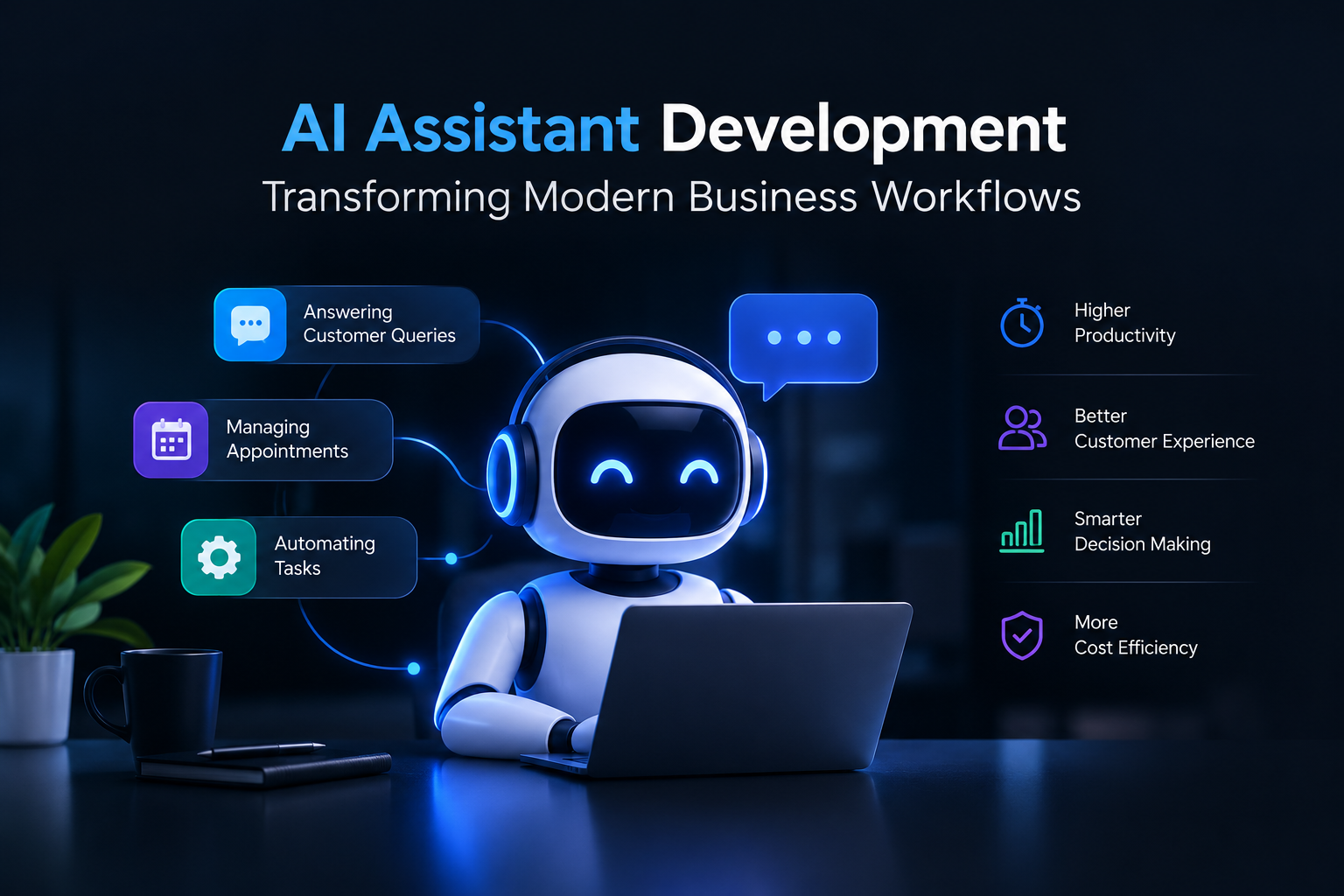
Businesses today are managing more information, customer interactions, and repetitive processes than ever before. As teams look for ways to improve productivity without increasing operational complexity, artificial intelligence is becoming an important part of modern workflows. One area receiving growing attention is AI Assistant Development, which enables businesses to create intelligent systems capable of supporting employees, customers, and internal operations.
Unlike traditional automation tools that follow predefined rules, modern AI assistants can understand natural language, process information, generate responses, and assist with a wide range of tasks. When implemented thoughtfully, they can help businesses reduce repetitive work, improve response times, and make information easier to access.
What Is AI Assistant Development?
AI Assistant Development involves designing and building software assistants that use technologies such as natural language processing, machine learning, large language models, APIs, and business data to perform useful tasks.
An AI assistant can be designed for a specific function or integrated into multiple business processes. For example, it might help employees find information, summarize documents, respond to common customer questions, schedule meetings, or organize data.
The objective is not necessarily to replace human workers. Instead, an assistant can handle repetitive or information-heavy tasks while employees focus on activities requiring creativity, judgment, and human interaction.
How AI Assistants Are Changing Business Workflows
1. Automating Repetitive Tasks
Many employees spend significant amounts of time on routine activities such as data entry, email drafting, document summarization, and information retrieval. An AI assistant can help automate parts of these workflows.
For example, an assistant could summarize incoming customer conversations and prepare a response for an employee to review. This can reduce manual effort while keeping humans involved in important decisions.
2. Improving Access to Business Information
Employees often need to search through documents, knowledge bases, emails, or internal systems to find information. An AI Virtual Assistant can provide a conversational interface for accessing relevant information.
Instead of searching through multiple systems, employees can ask questions using natural language. The assistant can then retrieve relevant information and present it in an easier-to-understand format.
3. Supporting Customer Service
Customer support is another area where AI assistants can contribute to workflow improvements. An AI-Powered Assistant can answer frequently asked questions, guide customers through basic processes, and provide information around the clock.
More complex requests can be transferred to human agents. This creates a workflow in which AI handles straightforward interactions while support teams concentrate on cases requiring deeper investigation or personal attention.
Key Steps in Building an Effective AI Assistant
Define the Business Objective
The first step is identifying the specific problem the assistant should solve. Businesses should avoid implementing AI simply because the technology is available.
A clear objective might be reducing support response times, improving employee knowledge access, automating administrative tasks, or assisting sales teams with customer information.
Identify the Right Data and Integrations
An assistant becomes more useful when it can work with relevant business information. Depending on the use case, this could include CRM platforms, customer support systems, knowledge bases, project management tools, or internal databases.
Proper integrations allow the assistant to work within existing workflows instead of becoming another disconnected software tool.
Design the User Experience
An Intelligent AI Assistant should be easy for people to interact with. Users should understand what the assistant can do, what information it can access, and when human assistance is required.
Clear prompts, conversational interfaces, escalation options, and appropriate error handling can make the overall experience more practical and reliable.
Add Human Oversight
Human involvement remains important, particularly when AI is used for sensitive business decisions or customer interactions. Organizations can establish approval processes where employees review AI-generated content before it is sent or acted upon.
This approach can combine AI efficiency with human judgment.
Why Businesses Are Exploring Custom AI Assistants
Every organization has different workflows, systems, and operational requirements. A generic AI tool may not always fit those needs.
A Custom AI Assistant can be designed around specific business processes, terminology, data sources, and user roles. For example, a healthcare organization may need an assistant focused on administrative workflows, while an e-commerce company may require one for customer support and product information.
Customization can also allow organizations to define access permissions and connect assistants with existing business applications.
Measuring the Impact of AI Assistants
Implementing an AI assistant is only the beginning. Businesses should measure whether it is actually improving workflows.
Useful metrics may include task completion time, customer response time, employee productivity, support resolution rates, user adoption, and the percentage of interactions successfully handled without escalation.
Regular monitoring can also reveal where the assistant needs better data, improved prompts, additional integrations, or human intervention.
The Role of AI Assistant Services
Businesses that do not have extensive internal AI expertise may explore AI Assistant Services to support planning, development, integration, and optimization. The focus should remain on solving a defined business problem rather than adding AI to processes where it provides little practical value.
Similarly, AI Assistant Development Services can help organizations build assistants that connect with existing applications and workflows while considering scalability, security, usability, and ongoing maintenance.
Companies such as CodeCones approach AI product development with a focus on combining AI technologies with software engineering and business requirements. This type of approach can be useful when an organization needs an assistant that goes beyond basic conversational functionality.
What the Future of AI-Assisted Workflows Looks Like
AI assistants are likely to become increasingly integrated into everyday business software. Instead of operating as separate chat interfaces, they can become part of CRM systems, productivity platforms, customer service applications, and internal tools.
Future assistants may also handle more complex multi-step workflows, such as gathering information from several systems, preparing reports, identifying potential issues, and recommending next actions.
However, successful adoption will depend on factors beyond technology. Businesses will need clear governance, reliable data, appropriate security controls, and workflows that define when AI should act and when people should take over.
Conclusion
AI Assistant Development is changing how businesses approach repetitive work, information management, customer service, and employee productivity. By combining conversational AI with business data and existing software systems, organizations can create assistants that support practical day-to-day operations.
The most effective implementations begin with a clear business objective, use appropriate data and integrations, maintain human oversight, and continuously measure results. As AI technology continues to evolve, well-designed assistants can become an increasingly useful component of modern business workflows.
For organizations exploring this technology, starting with one clearly defined workflow can provide a practical way to understand where AI assistance can deliver meaningful value before expanding across the wider business.

 English
 Arabic
 French
 Spanish
 Portuguese
 Deutsch
 Turkish
 Dutch
 Italiano
 Russian
 Portuguese (Brazil)
 Greek
