


 Downloader
 Free FTP
Promote Your Product
Got a product, service, or story to share? Promote it directly to our active community and boost your brand today.
Create an Ad
Publish Bulk Blog Posts
Boost Your Reach! 📝
Have articles, guest posts, or bulk stories to publish? Send your content directly to our editorial team and feature on our platform.
Email Us Your PostsRG217 Coaxial Cable: Construction, Uses & Selection Guide
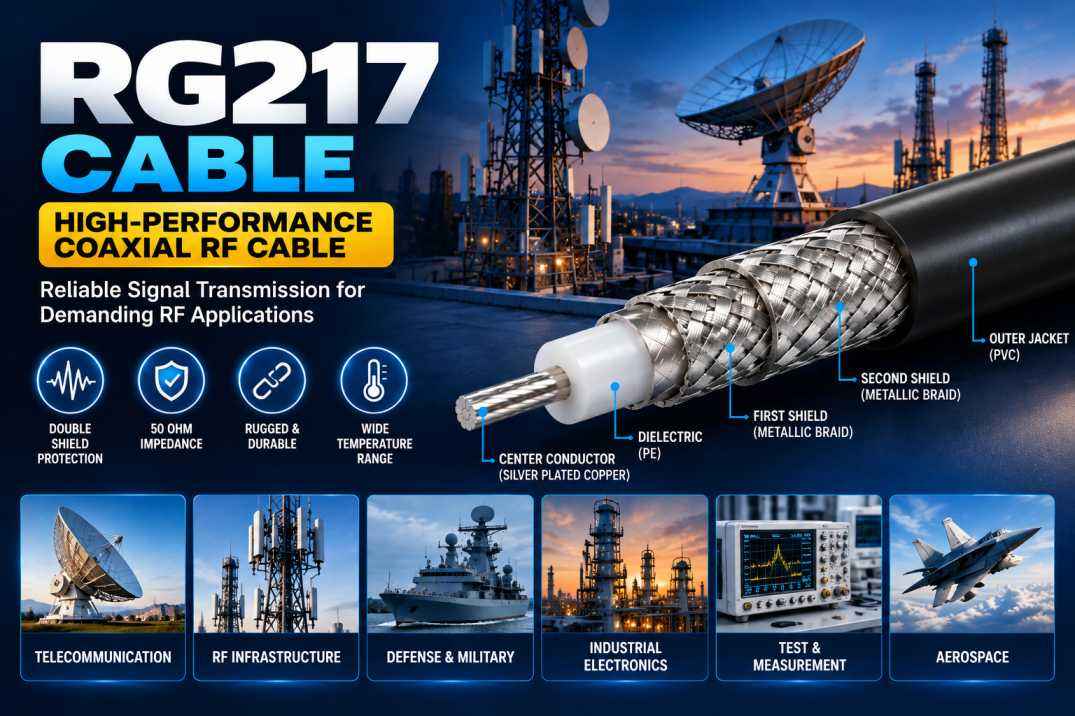
RG217 Cable is a heavy-duty coaxial cable designed for RF and microwave signal transmission where reliable electrical performance, mechanical strength, and effective shielding are important. Its robust construction makes it suitable for demanding communication, test and measurement, broadcast, military, industrial, and high-power RF applications.
The cable uses a coaxial structure consisting of a center conductor, dielectric insulation, metallic shielding, and protective outer jacket. This arrangement helps maintain controlled impedance while reducing electromagnetic interference and protecting the transmitted RF signal from external noise.
What Is RG217 Cable?
RG217 Cable is a 50-ohm coaxial cable commonly used in RF systems requiring dependable signal transmission and relatively high power-handling capability. Compared with smaller flexible coaxial cables, RG217 is physically larger and more robust.
Its larger construction provides mechanical durability and can support lower transmission loss in suitable operating ranges. However, actual electrical specifications such as attenuation, maximum operating frequency, power handling, temperature rating, and dimensions can vary by manufacturer and cable construction.
For critical installations, the manufacturer's datasheet should always be checked before selecting a specific RG217 Cable.
RG217 Cable Construction
The performance of an RG217 Coaxial Cable depends heavily on its layered construction.
Center Conductor
The center conductor carries the RF signal through the cable. Depending on the manufacturer, conductor materials and construction may vary. A properly designed conductor provides the electrical characteristics required for efficient RF transmission.
Dielectric Insulation
The dielectric material separates the center conductor from the outer shielding layer. It maintains the required spacing between conductors and contributes to the cable's impedance, velocity of propagation, capacitance, and overall RF performance.
Shielding Layer
The metallic shield surrounds the dielectric and provides an electrical return path while helping protect the signal from external electromagnetic interference. Effective shielding is particularly important in environments containing motors, transmitters, switching equipment, or other sources of RF noise.
Outer Jacket
The outer jacket protects the internal cable structure against mechanical damage, moisture, abrasion, and environmental exposure. Jacket material and temperature characteristics depend on the specific RG217 Cable version.
Key Features of RG217 Cable
RG217 Cable is selected for applications where a rugged coaxial construction is required. Important characteristics may include:
-
50-ohm impedance for RF systems
-
Robust and durable construction
-
Effective electromagnetic shielding
-
Suitable for RF and microwave applications
-
Higher physical strength than small-diameter coaxial cables
-
Capability for demanding transmission environments
-
Availability in cable assemblies with different RF connectors
-
Suitable for laboratory, industrial, communication, and defense systems
The exact electrical performance should be evaluated from the manufacturer's technical datasheet.
RG217 Cable Specifications
Typical specification categories to consider when evaluating an RG217 Cable include:
|
Parameter |
Typical Consideration |
|
Cable Type |
Coaxial RF Cable |
|
Impedance |
50 Ohms |
|
Construction |
Shielded coaxial design |
|
Conductor |
Manufacturer-specific |
|
Dielectric |
Manufacturer-specific |
|
Shield |
Metallic RF shielding |
|
Application |
RF, microwave and communication systems |
|
Connector Options |
Application dependent |
|
Temperature Rating |
Manufacturer dependent |
|
Frequency Range |
Manufacturer dependent |
Because RG217 products can differ between manufacturers, these values should be treated as selection parameters rather than universal specifications.
Applications of RG217 Coaxial Cable
The rugged construction of RG217 Cable makes it useful across several technical industries.
RF and Microwave Systems
RG217 can be used for connecting RF equipment, transmitters, receivers, antennas, and other components where controlled impedance is required.
Test and Measurement
Laboratories and engineering environments can use suitable RG217 assemblies for connecting RF test equipment, signal sources, measurement instruments, and test fixtures.
Telecommunications
The cable can support connections within communication infrastructure where durable RF interconnection is required.
Defense and Aerospace
RF systems used in demanding environments may require mechanically robust coaxial assemblies. RG217 Cable can be considered for suitable communication, radar, instrumentation, and electronic systems when its verified specifications meet the application requirements.
Broadcast and Industrial Systems
Broadcast equipment, industrial RF systems, and specialized electronic installations can also use appropriately rated RG217 cable assemblies.
How to Select the Right RG217 Cable
Selecting an RG217 Cable should begin with the electrical and mechanical requirements of the system.
First, verify the required impedance, particularly whether the system requires 50-ohm RF interconnection. Next, check the operating frequency and attenuation requirements to ensure the selected cable provides acceptable transmission performance.
Power handling is another important factor. If the cable will carry high RF power, verify the manufacturer's power rating at the actual operating frequency, temperature, and installation conditions.
Environmental requirements should also be considered. For outdoor, industrial, aerospace, or high-temperature applications, examine the jacket material, temperature range, moisture resistance, flexibility, and mechanical protection.
Finally, select compatible connectors and confirm the complete cable assembly's electrical performance rather than evaluating the cable alone.
RG217 Cable Connector Options
RG217 cable assemblies can be configured with RF connectors according to the application. Possible connector families may include N-Type, TNC, SMA, BNC, 7/16 DIN, and other suitable interfaces depending on cable dimensions and system requirements.
Connector selection should consider frequency, impedance, power handling, environmental conditions, mounting configuration, and mating compatibility.
Benefits of Using RG217 Cable
The major benefit of RG217 Cable is its combination of robust construction and reliable RF interconnection. Its larger physical structure can provide mechanical durability and make it suitable for applications where smaller coaxial cables may not provide the required physical characteristics.
When properly selected and terminated, RG217 can provide stable RF transmission, effective shielding, and dependable operation in demanding engineering environments.
Conclusion
RG217 Coaxial Cable is a robust RF interconnection solution for applications requiring dependable 50-ohm coaxial performance and durable construction. Its layered design, shielding, mechanical strength, and availability in different cable assemblies make it useful across RF, telecommunications, test and measurement, defense, aerospace, broadcast, and industrial applications.
For the correct selection, always evaluate frequency, attenuation, power handling, temperature, shielding, cable dimensions, connector compatibility, and installation requirements against the manufacturer's specifications.
FAQs About RG217 Cable
1. What is RG217 Cable?
RG217 Cable is a robust coaxial RF cable commonly designed around a 50-ohm impedance for RF, microwave, communication, and instrumentation applications.
2. Is RG217 Cable suitable for RF applications?
Yes. RG217 Cable is designed for RF signal transmission, provided its verified frequency, attenuation, power, and environmental ratings meet the requirements of the specific application.
3. What is the impedance of RG217 Cable?
RG217 Cable is commonly associated with a 50-ohm impedance, but the exact specification should always be confirmed from the manufacturer's datasheet.
4. Where is RG217 Coaxial Cable used?
It can be used in RF systems, telecommunications, test and measurement equipment, defense, aerospace, broadcast, and industrial electronics.
5. Can RG217 Cable be supplied with connectors?
Yes. RG217 cable assemblies can be terminated with compatible RF connectors based on the equipment and application requirements.
6. How should I select RG217 Cable?
Consider impedance, frequency, attenuation, power handling, temperature range, shielding, cable length, environmental conditions, and connector type before selecting the cable.
7. Is RG217 Cable suitable for high-power RF?
It may be suitable for certain high-power applications, but the actual power rating depends on frequency, construction, installation conditions, and manufacturer specifications. Always verify the datasheet.
8. What makes RG217 Cable different from smaller RF cables?
RG217 generally has a larger and more robust construction, making it appropriate for applications where mechanical strength and specific RF performance requirements are important.

 Arabic
 French
 Spanish
 Portuguese
 Deutsch
 Turkish
 Dutch
 Italiano
 Russian
 Romaian
 Portuguese (Brazil)
 Greek
