


 Downloader
 Free FTP
Promote Your Product
Got a product, service, or story to share? Promote it directly to our active community and boost your brand today.
Create an Ad
Publish Bulk Blog Posts
Boost Your Reach! 📝
Have articles, guest posts, or bulk stories to publish? Send your content directly to our editorial team and feature on our platform.
Email Us Your PostsWhy Is Your Website Traffic Dropping? How to Find the Problem and Recover It

If you run a business website and you have noticed your organic traffic sliding the first instinct is usually panic followed by a scramble to publish new blogs, tweak a few keywords or blame the latest Google algorithm update. In our experience that reaction almost never solves the actual problem.
Website traffic dropping doesn’t always mean something is broken. Sometimes it means your website’s visibility and your website’s clicks have quietly disconnected and until you understand why no amount of new content will fix it.
This article walks through a real diagnostic process we ran on our own website, Digiworld Solution using actual Google Search Console (GSC) data. We’re no longer going to offer you a customary “10 most visitors drops” listicle. Instead we’ll show you precisely what we checked , what we found, what we changed and how you could run the same procedure on your own website.
The Problem We Faced
Digiworld Solution has been continually publishing content, focused on relevant keywords, and doing habitual SEO work. Despite that when we sat down to check our natural performance over the last three months we noticed something worth investigating the numbers weren’t reflecting the effort.
To be clear this wasn’t a dramatic traffic collapse. There was no dramatic red line falling off a cliff. It was something subtler and honestly more common a pattern where organic search traffic was underperforming relative to how much visibility the site was actually getting in search results. That gap is what triggered the deeper investigation you’re about to read about.
If your website traffic decline looks similar a slow erosion rather than a sudden crash this case study is especially relevant to you.
What Google Search Console Revealed
Our first step was to begin in Google Search Console and look at the performance report for the remaining 3 months. Here’s what the topline records confirmed:
| Metric | Value |
|---|---|
| Total Clicks | 631 |
| Total Impressions | 79.6K |
| Average CTR | 0.8% |
| Average Position | 15.6 |
In simple terms:
- Clicks inform you how many humans visited your website online from a Google search result.
- Impressions inform you how often your pages appeared somewhere in search results, whether or not someone clicked.
- • CTR (click-through rate) tells you how many people who noticed your listing clicked on it.
- Average position tells you roughly where your pages tend to rank position 15.6 means many pages had been landing on web page 2 of Google, no longer web page 1.
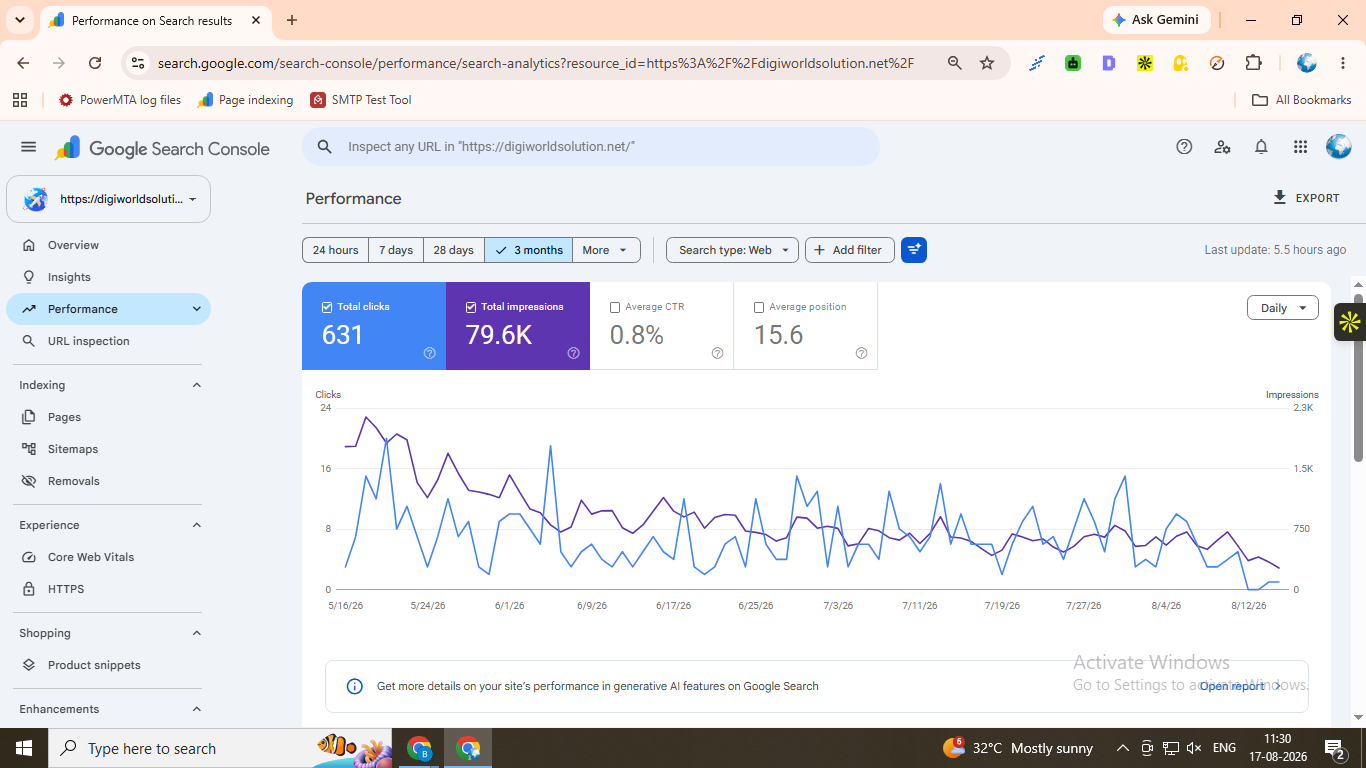
When we checked the Search Console facts one factor right away stood out the website has still been receiving great impressions but the wide variety of clicks turned into surprisingly low. With 79.6K impressions and only 631 clicks, the resulting 0.8% CTR is well beneath what you’ll typically anticipate from a healthy set of ranking pages.
This is a critical distinction. A site that gets almost no impressions has a visibility problem it’s simply not showing up in search. A site that gets strong impressions but weak clicks like Digiworld Solution in this period has a different problem entirely it’s showing up but not convincing searchers to click. Add to that an average position of 15.6 and you get a fuller picture many pages weren’t ranking high enough to earn a click even when they were relevant.
This single observation reframed our entire approach. Instead of assuming we needed more content or more keywords we needed to understand why visibility wasn’t converting into clicks.
Finding the Pages Behind the Problem
Averages hide detail so our next step was drilling into individual page performance inside GSC. We checked the page level and query level data separately because they answer different questions pages tell you where the problem lives queries tell you what people were searching for when they saved it.
A few pages stood out immediately:
- EEAT SEO Guide 2026: Trust Rankings — 24,704 impressions, only 28 clicks
- Best SEO Company in Noida — 3,004 impressions, 28 clicks
- Web Development Company — 5,440 impressions, 19 clicks
- 7 Reasons Your Google Ads Are Wasting Money and How to Fix Them in 2026 — 6,247 impressions, 9 clicks
The EEAT guide is the clearest example. Nearly 25,000 impressions with just 28 clicks is a CTR under 0.2% extraordinarily low for a page with that much visibility.2% extraordinarily low for a page with that much visibility. At first look it is tempting to label this a bad page. In our evaluation we resisted that conclusion because low CTR at deep impressions rarely means the content is nugatory. It usually means one or more of the following:
- The page is ranking too low on the results page for people to bother scrolling to it
- The title tag or meta description isn’t compelling enough to earn a click
- The page is matching the keyword but not the actual intent behind the search
- Competing results in the SERP (featured snippets, other sites, ads) are absorbing the clicks instead
So rather than writing this page off we treated it as a page that needed investigation into ranking position, SERP competition and search intent not a page that needed to be deleted or ignored.
Finding the Queries Behind the Traffic
Pages tell you half the story. Queries tell you the rest. We checked which search terms were actually driving clicks to the site and the pattern here was just as revealing.
| Query | Clicks | Impressions |
|---|---|---|
| digiworld solution | 155 | 921 |
| digital marketing agency noida | 57 | 919 |
| digital marketing agency in noida | 33 | 849 |
| digiworld solutions | 26 | 296 |
| digi world solutions | 17 | 143 |
| digiworld | 14 | 2,629 |
| web development company in noida | 9 | 669 |
| seo company in noida | 8 | 802 |
Look closely and a clean cut up emerges branded queries (human beings searching “digiworld solution,” “digiworld answers,” “digi world solutions”) had been converting at an excessive rate relative to their impressions. Non-branded provider purpose queries like “virtual marketing enterprise in noida,” “web improvement organisation in noida,” and “search engine optimization business enterprise in noida” were generating meaningful impressions but relatively fewer clicks.
This tells us something essential those who already recognise the brand locate us without difficulty. People who are searching for the service without knowing the brand name are seeing us in the results, but not choosing to click as often. That’s a robust sign that our non-branded pages need work on ranking role, title relevance or on-page trust indicators no longer a signal that our search engine marketing is not “running” in any respect.
If you check your personal query facts and see the identical branded vs non branded cut off it is a useful early diagnostic. Strong branded performance with weaker non branded performance usually points to a discoverability and click-appeal issue on your service pages rather than a fundamental content or technical failure.
What We Changed to Improve Organic Performance
Once we understood where the problem was concentrated we moved into the optimization phase. We did not treat any single action here as a silver bullet this was a combined, gradual process. Below is what we actually worked on.
Updating Old Blogs
What it addresses: Content that become accurate or competitive while posted however has when you consider that end up outdated, thin or misaligned with current search intent.
What we changed: We reviewed older blog posts such as a few that had already been ranking with visibility, and updated information, examples and sections that felt outdated. We also expanded areas that were too brief to answer the query fully.
Why it matters: Google tends to prefer content that displays modern, comprehensive coverage of a topic. A web page that hasn’t been touched in 12 months even though it has ranked nicely can lose relevance as competitor content improves.
What to check afterward: Monitor whether or not impressions or common role for that specific web page increase in Search Console over the following weeks not just clicks.
Improving Titles and Meta Descriptions
What it addresses: Pages with decent ratings but low CTR similar to what we saw at the EEAT guide and the Google Ads blog.
What we changed: We rewrote numerous title tags and meta descriptions to more immediately reflect what the searcher is looking for rather than being typical or keyword targeted.
Why it matters: The title and description are the first aspect a person sees within the SERP. Even a properly ranked web page can be skipped if the listing does not appear applicable or compelling.
What to check afterward: CTR for that particular page in GSC, not website wide CTR given that web page wide averages can mask page level development or decline.
Strengthening Internal Linking
What it addresses: Pages that might be isolated inside the website structure with few internal links pointing to them which can weaken both crawlability and topical relevance.
What we changed: We added internal links from relevant blog posts to core pages like our SEO Services page, Digital Marketing Services page and Web Development page using descriptive anchor text instead of generic “click here” links.
Why it matters: Internal hyperlinks assist Google in recognizing which pages are essential and how topics in your site relate to each other. They additionally help distribute authority from nicely acting pages to newer or underperforming ones.
What to check afterward: Whether previously under linked pages’ start appearing more frequently in impressions data over time.
Publishing New Content
What it addresses: Genuine content gaps topics your audience is searching for that your site doesn’t currently cover at all.
What we changed: We diagnosed a small, wide variety of topics and not using the present coverage on the web page created new content material specifically for those gaps in place of duplicating present pages.
Why it matters: New content has to fill a gap not compete with a present page for the same cause. Publishing a new blog on a subject you already have decent coverage for often splits authority in place of building it.
What to check afterward: Whether new pages start earning impressions for their meant queries and whether they cannibalize traffic from current pages a signal the topics had been too similar.
Building Relevant Backlinks
What it addresses: Weak domain and web page level authority relative to competitors ranking for the equal terms.
What we changed: We pursued backlinks from relevant, topically related resources in preference to extent-targeted, low-quality link building.
Why it matters: Backlinks continue to be one of the alerts engines like Google use to gauge relevance and authority but irrelevant or spammy links can do more damage than precise ones.
What to check afterward: Referring domain boom for your back link equipment along not rather than your GSC ranking data.
Optimizing Existing Service Pages
What it addresses: Core commercial pages like our Performance Marketing page that may be technically fine but lack depth, trust signals or clear intent matching.
What we changed: We reviewed web page structure delivered the missing data commercial enterprise proprietors usually search for and improved on page clarity.
Why it matters: Service pages are regularly where non-branded high-rationale site visitors land. If they don’t clearly answer what a visitor wants even excellent scores may not convert into engaged visits.
What to check afterward: Average position and CTR tendencies particularly for industrial, non branded queries tied to that web page.
Why Updating Old Content Matters
One instinct many business owners have when traffic drops is to publish more. Instead of immediately creating another page our first step for many topics was asking does a page targeting this intent already exist.
If it does including a brand new one normally isn’t the solution. It can dilute your existing page’s relevance and cut up visitors between competing pages rather than strengthening one authoritative one.
Signs that an existing page needs updating instead of changing encompass:
- Outdated statistics, examples, screenshots or references
- Sections that feel thin compared to what’s now ranking on page one
- A shift in what searchers actually want when they type that query (search intent changes over time)
- A title or heading structure that no longer matches how people search
- Few or no internal links pointing to the page
- Obvious content gaps questions a reader would have that the page doesn’t answer
Auditing and strengthening what you have already got is frequently greater gain than starting from scratch and it avoids the cannibalization hassle totally.
Why High Impressions Do Not Always Mean High Traffic
It’s worth spending a moment on this because it’s the core insight from this entire case study. Impressions measure visibility. Clicks measure conversion of that visibility into an actual visit. The two don’t move together automatically.
Our EEAT guide’s 24,704 impressions with only 28 clicks illustrates this clearly. The page is visible. People are searching terms related to it. But something in the chain ranking position, title appeal, competing SERP features or intent match is preventing that visibility from converting.
To be transparent improving a title tag does not guarantee CTR will increase. It’s a reasonable, evidence based lever to pull but SERP behavior involves many variables outside a single page’s control including what competitors are doing and how the SERP itself is structured for that query. We treat title and meta description changes as one input into a broader optimization process not a guaranteed fix.
How We Check Whether the Changes Are Working
Search engine marketing recovery isn’t always something you compare the week after making changes. Search engines want time to recrawl, reindex and regulate scores and consumer behavior records take time to stabilize. After making the changes above we set up an ongoing tracking system in place of expecting instantaneous effects.
What we track over time:
- Clicks — both site wide and at the individual page level
- Impressions — to see whether visibility is growing, shrinking or holding steady
- CTR — particularly for pages where we changed titles or meta descriptions
- Average position — to see whether rankings are trending up
- Page-level traffic — comparing specific updated pages against their pre optimization baseline
- Query-level performance — to see whether non branded queries start converting better
We deliberately avoid concluding from a single week of data. SEO changes typically need at least four to eight weeks sometimes longer before a reliable trend emerges and we’re still in that monitoring window for Digiworld Solution itself.
Common Mistakes Businesses Make After Traffic Drops
Having gone through this process ourselves here are the mistakes we see most often and made a point of avoiding:
- Publishing random new blogs without diagnosing the issue — content without a clear gap to fill rarely helps.
- Changing everything at once — if you overhaul titles, content, links and technical SEO simultaneously you won’t know what actually worked.
- Ignoring existing pages in favor of only creating new ones
- Focusing only on keyword rankings while ignoring CTR and actual click behavior
- Ignoring CTR entirely and assuming rank alone determines traffic
- Building low-quality backlinks in bulk which can hurt more than help
- Not checking indexing or technical issues before assuming it’s a content or ranking problem.
- Assuming every traffic drop is caused by a Google algorithm update when often the cause is pagespecific or query specific
A Practical Website Traffic Recovery Process
If you’re facing a similar situation here’s the process we followed laid out as steps you can apply directly to your own site:
- Check Google Search Console for your last three months of performance data
- Compare data against the previous period to spot real trends, not noise
- Identify losing pages which specific URLs have dropped in clicks or impressions
- Identify losing queries which specific search terms have dropped
- Diagnose the reason for each ranking drop, CTR drop, intent mismatch, or indexing issue
- Fix existing pages before creating new ones where a content gap doesn’t actually exist
- Improve content depth, accuracy and structure on underperforming pages
- Strengthen internal links pointing to pages that need more authority and visibility
- Check technical SEO — indexing status, crawl errors, site speed, mobile usability
- Build relevant authority through quality backlinks not volume
- Monitor performance over weeks, not days and adjust based on what the data shows
This is the exact sequence we used for Digiworld Solution and it’s a repeatable framework regardless of your industry or site size.
FAQs
Why is my website traffic dropping?
Traffic can drop for many reasons rating declines, CTR issues, algorithm updates, technical issues, seasonal search behaviour or increased competition. The simplest dependable way to know is to check your Search Console data rather than guessing.
How can I find which pages lost traffic?
In Google Search Console, visit the Performance report, examine date ranges and sort by pages. Look for URLs with the biggest drop in clicks or impressions compared to the previous duration.
Why do my pages get impressions but no clicks?
This commonly means your web page is performing in search results but no longer earning clicks frequently due to a low ranking position an unappealing title or meta description, mismatched search intent or strong competing results inside the SERP.
Can low CTR affect organic traffic?
Yes. A low click-through rate means less traffic even if your impressions are high. Over time persistently low CTR can also be a weak signal to search engines like Google and Yahoo about how relevant users find your listing.
Should I publish new blogs when traffic drops?
Not immediately. First check whether an existing page already targets the same intent. If it does, updating and strengthening that page is usually more effective than creating a competing new one.
How long does SEO traffic recovery take?
It varies, but count on not less than 4 to 8 weeks before significant results appear and frequently longer depending on the scope of the adjustments and how competitive your keywords are. Recovery should be measured over the years not right away after changes.
How can Google Search Console help diagnose a traffic drop?
GSC shows you exactly which pages and queries are gaining or dropping clicks and impressions along with CTR and average position. It’s the most direct source of truth for diagnosing an organic traffic decline before making any changes.
Conclusion
A drop in website traffic doesn’t automatically mean your SEO strategy has failed. In our case with Digiworld Solution, the Search Console data showed strong impressions but a low click through rate and an average position that left many pages just out of reach on page one a visibility to click gap rather than a visibility collapse.
The right response isn’t panic or a scramble of random changes. It’s a structured diagnosis check your data, identify the specific pages and queries behind the problem make targeted and evidence based improvements and then monitor the results patiently over time.
We’re still in that monitoring phase for the changes described in this case study and we’ll be transparent about the results as the data comes in. If you’re seeing a similar pattern on your own site solid impressions, weak clicks the process outlined above is exactly where we’d recommend you start.
Related Blog: If your traffic hasn't dropped so much as flatlined despite months of consistent SEO work that's a related but slightly different problem worth diagnosing on its own. Check out Why Your SEO Results Stopped Growing Even After Months of Optimization for that scenario in detail.

 English
 Arabic
 French
 Spanish
 Portuguese
 Deutsch
 Turkish
 Dutch
Dutch
 Russian
 Romaian
 Portuguese (Brazil)
 Greek
Greek
