


 Downloader
 Free FTP
Promote Your Product
Got a product, service, or story to share? Promote it directly to our active community and boost your brand today.
Create an Ad
Publish Bulk Blog Posts
Boost Your Reach! 📝
Have articles, guest posts, or bulk stories to publish? Send your content directly to our editorial team and feature on our platform.
Email Us Your PostsCKA vs CKAD vs CKS: Kubernetes Certification Roadmap for Beginners in 2026
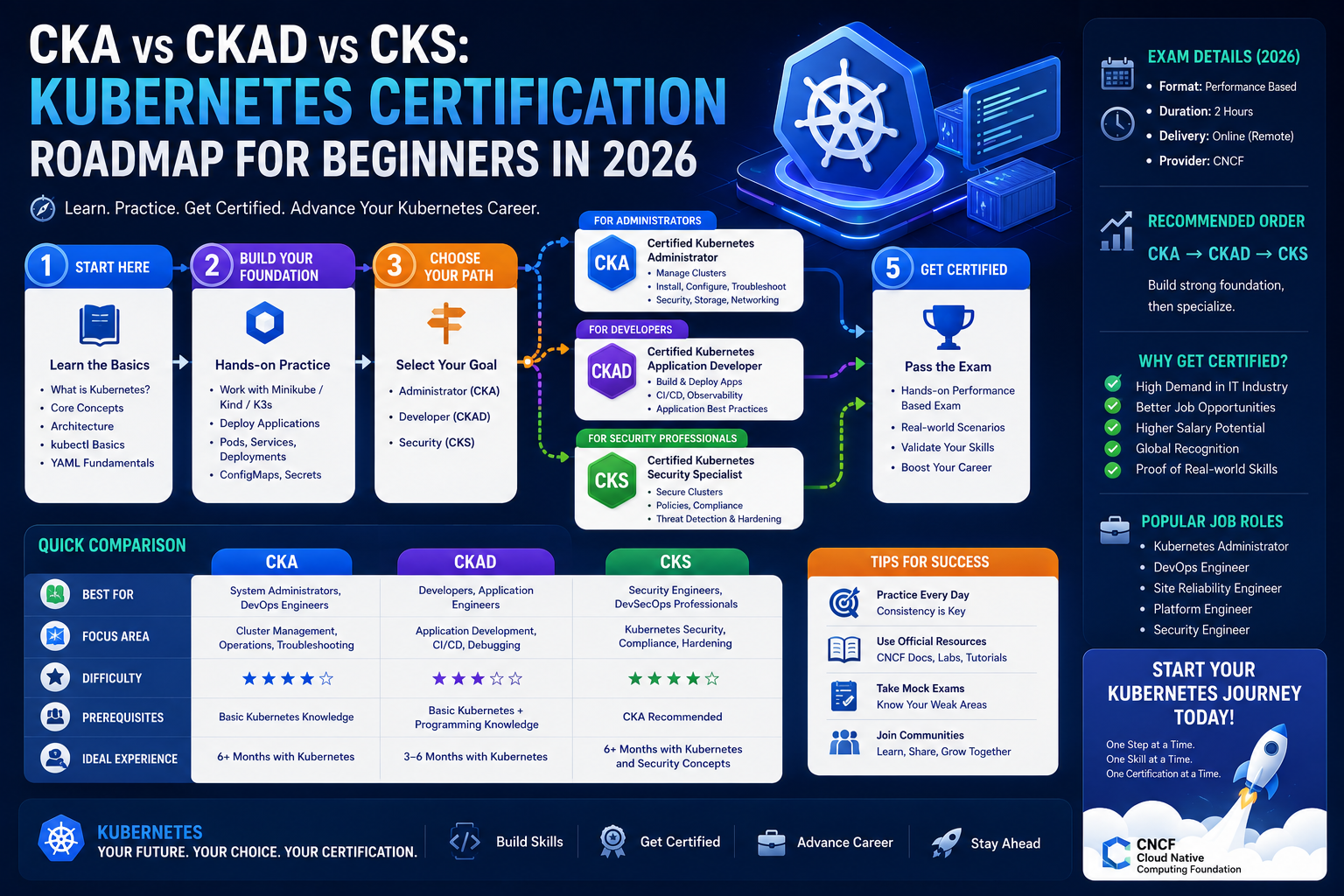
Kubernetes has become an essential skill for modern IT professionals working with cloud-native applications, containers, DevOps, and platform engineering. As organizations continue adopting Kubernetes to deploy and manage scalable applications, certified professionals are increasingly sought after for roles involving cluster administration, application development, and container security.
For beginners, however, the Kubernetes certification ecosystem can seem confusing. Many candidates wonder whether they should start with the Certified Kubernetes Administrator (CKA), the Certified Kubernetes Application Developer (CKAD), or the Certified Kubernetes Security Specialist (CKS). Others discover newer certifications such as the Kubernetes and Cloud Native Associate (KCNA) and wonder where it fits into the learning journey.
This roadmap explains the recommended Kubernetes certification path for beginners in 2026, helping you build practical skills before progressing toward advanced cloud-native roles.
Understanding the Kubernetes Learning Journey
Rather than treating Kubernetes certifications as independent exams, think of them as milestones in a progressive learning path.
Each certification builds a different set of skills:
-
KCNA introduces Kubernetes and cloud-native fundamentals.
-
CKA develops Kubernetes administration expertise.
-
CKAD focuses on deploying and managing cloud-native applications.
-
CKS validates Kubernetes security knowledge.
Choosing the correct sequence allows you to build confidence while gaining practical experience at each stage.
A quick watch on Cert Empire’s channel can clear all your confusion.
Recommended Roadmap for Beginners
|
Learning Stage |
Certification |
Main Focus |
Best For |
|
Stage 1 |
KCNA (Optional) |
Kubernetes fundamentals and cloud-native concepts |
Complete beginners |
|
Stage 2 |
CKA |
Cluster administration and operations |
DevOps and cloud engineers |
|
Stage 3 |
CKAD |
Application deployment and development |
Developers and platform engineers |
|
Stage 4 |
CKS |
Kubernetes security and hardening |
Security and DevSecOps professionals |
The Linux Foundation recommends certification paths that align with different career goals, and KCNA provides a strong introduction for candidates with little Kubernetes experience.
Stage 1: Learn Kubernetes Fundamentals
If you are completely new to Kubernetes, start by understanding the platform before attempting a performance-based certification.
Learn topics such as:
-
Containers
-
Docker basics
-
Kubernetes architecture
-
Pods
-
Deployments
-
Services
-
Namespaces
-
ConfigMaps
-
Basic networking
-
Cloud-native concepts
The Kubernetes and Cloud Native Associate (KCNA) certification validates foundational knowledge and has no prerequisites, making it an excellent starting point for newcomers.
Alongside theory, practice using a local Kubernetes environment such as Minikube or Kind to become comfortable with common commands.
Stage 2: Build Administration Skills with CKA
Once you understand Kubernetes basics, most infrastructure professionals should move toward Certified Kubernetes Administrator (CKA).
CKA teaches how to manage production Kubernetes clusters by covering topics such as:
-
Cluster installation
-
Scheduling workloads
-
Storage
-
Networking
-
Node management
-
Backup and recovery
-
Monitoring
-
Troubleshooting
Because the exam is performance-based, candidates solve real administrative tasks in a live Kubernetes environment rather than answering multiple-choice questions.
Even developers benefit from learning CKA because understanding cluster behavior improves application deployment and troubleshooting.
Stage 3: Learn Cloud-Native Development with CKAD
After becoming comfortable with Kubernetes administration, developers should continue with Certified Kubernetes Application Developer (CKAD).
This certification emphasizes building and maintaining applications inside Kubernetes rather than managing the infrastructure itself.
Topics include:
-
Deployments
-
Pods
-
ConfigMaps
-
Secrets
-
Services
-
Scaling
-
Rolling updates
-
Application debugging
There are no prerequisites for CKAD, but practical experience with containers and Kubernetes resources makes preparation significantly easier.
For software engineers, CKAD often complements CKA by connecting infrastructure knowledge with application development.
Stage 4: Advance into Kubernetes Security
Security becomes increasingly important as organizations deploy production workloads.
The Certified Kubernetes Security Specialist (CKS) certification focuses on:
-
Cluster hardening
-
Runtime security
-
Network policies
-
Secure supply chains
-
Container image security
-
Secrets management
-
Compliance
-
Risk reduction
Unlike CKA and CKAD, CKS requires candidates to hold an active CKA certification before scheduling the exam.
Because it builds directly upon administration skills, CKS is best attempted after gaining practical Kubernetes experience.
Choose a Roadmap Based on Your Career
Not every learner follows exactly the same path.
DevOps Engineer
A practical progression is:
KCNA → CKA → CKAD → CKS
This sequence develops administration, development, and security skills.
Software Developer
Developers often benefit from:
KCNA → CKAD → CKA → CKS
Starting with application deployment can make Kubernetes easier to understand before moving into cluster administration.
Cloud Engineer
Infrastructure-focused professionals typically choose:
KCNA → CKA → CKS
This route prioritizes operations and security.
The Linux Foundation also provides suggested learning paths for candidates pursuing Kubernetes certifications based on different career goals.
How Long Does the Journey Take?
The timeline depends on previous experience.
A complete beginner might follow a schedule like this:
-
Months 1–2: Linux, containers, Docker, Kubernetes fundamentals.
-
Months 3–5: Daily Kubernetes administration practice and CKA preparation.
-
Months 6–7: Application deployment and CKAD preparation.
-
Months 8–10: Production Kubernetes experience and security concepts.
-
Months 11–12: Prepare for and earn CKS.
Candidates with existing DevOps or cloud experience often complete this roadmap much faster.
Practical Preparation Tips
Kubernetes certifications reward practical ability more than memorization.
A successful study plan should include:
-
Official Kubernetes documentation
-
Linux Foundation learning materials
-
Local Kubernetes clusters
-
Daily kubectl practice
-
YAML configuration exercises
-
Troubleshooting scenarios
-
Mock performance exams
Additional resources like www.certempire.com can help candidates reinforce their knowledge through practice and review after completing official training and hands-on exercises. The best preparation strategy combines theory, practical skills, and exam-focused revision.
Conclusion
For beginners in 2026, Kubernetes certifications are most effective when approached as a structured learning journey rather than isolated exams. Start by understanding Kubernetes fundamentals, develop administration skills through CKA, expand into cloud-native application development with CKAD, and finally specialize in Kubernetes security with CKS.
Following this roadmap helps you build practical knowledge gradually while preparing for real-world cloud-native responsibilities. Combined with hands-on projects and continuous learning, these certifications can significantly strengthen your long-term DevOps, cloud, and platform engineering career.
FAQs
Should beginners start with CKA or KCNA?
Complete beginners should consider KCNA to learn Kubernetes fundamentals first, while candidates with Linux, Docker, or cloud experience may begin directly with the Certified Kubernetes Administrator certification.
Is CKA required before CKAD?
No. CKAD has no prerequisites, although understanding Kubernetes fundamentals and basic container concepts makes the certification significantly easier to prepare for successfully.
Why is CKS usually the final certification?
CKS focuses on advanced Kubernetes security topics and requires an active Certified Kubernetes Administrator certification, making it the natural final step in most Kubernetes learning roadmaps.
How much hands-on practice is needed?
Regular hands-on practice is essential because Kubernetes certifications are performance-based. Building clusters, deploying applications, troubleshooting problems, and using kubectl daily greatly improves exam readiness.
Can I skip KCNA and start with CKA?
Yes. Many experienced Linux, cloud, and DevOps professionals begin directly with CKA, while complete beginners often benefit from first learning Kubernetes fundamentals through KCNA.
Learn More: Online IT Exam Practice Tests: Everything You Need Before Your Certification Exam

 English
 Arabic
 French
 Spanish
 Portuguese
 Deutsch
 Turkish
 Dutch
 Italiano
 Romaian
 Portuguese (Brazil)
 Greek
