


 Downloader
 Free FTP
Promote Your Product
Got a product, service, or story to share? Promote it directly to our active community and boost your brand today.
Create an Ad
Publish Bulk Blog Posts
Boost Your Reach! 📝
Have articles, guest posts, or bulk stories to publish? Send your content directly to our editorial team and feature on our platform.
Email Us Your PostsAircraft Fuel Systems Market Forecast to Reach US$ 10.4 Billion by 2034 as Automation Expands
Market Overview and Growth Outlook
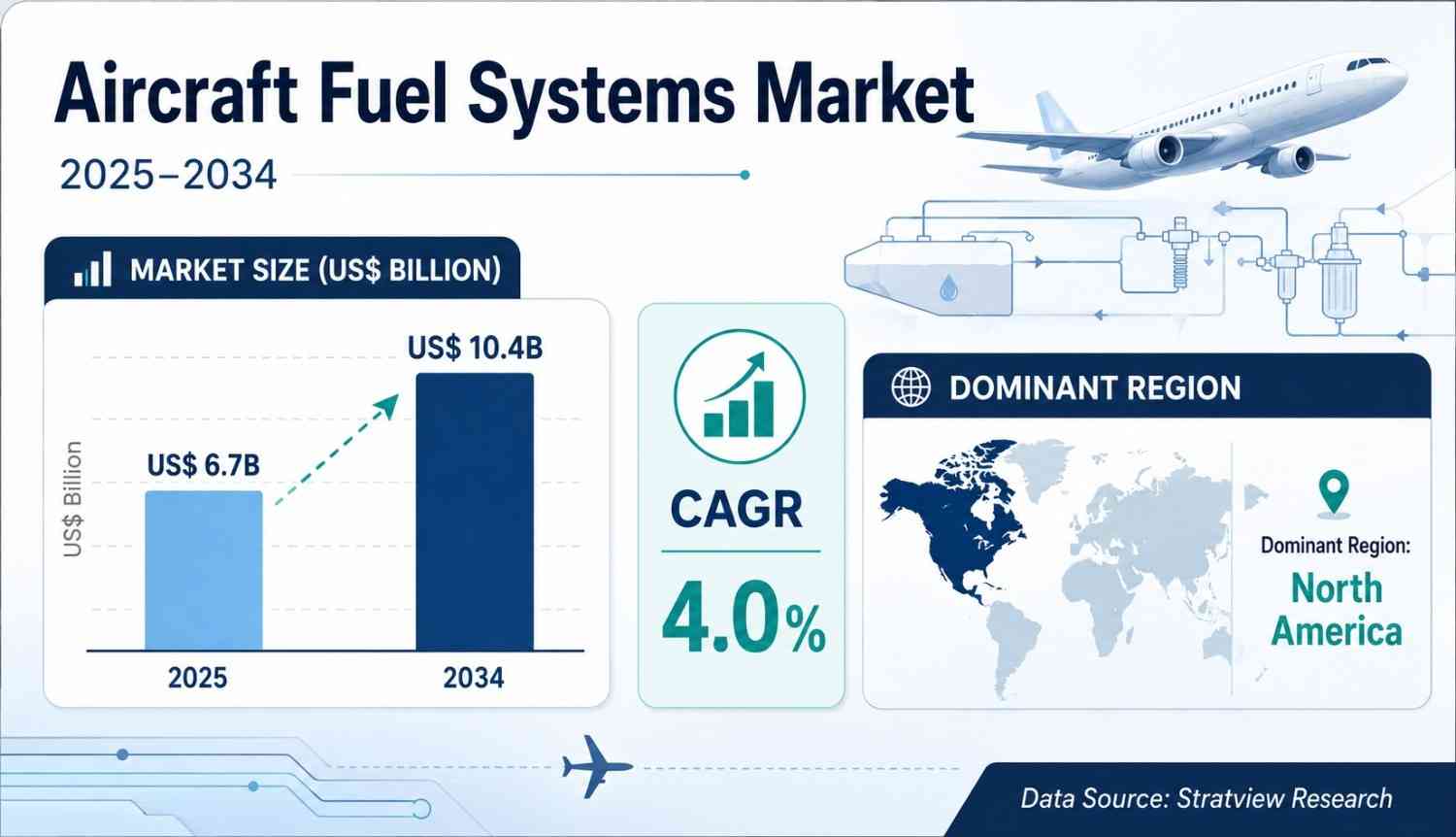
The Aircraft Fuel Systems Market was valued at US$ 6.7 billion in 2025 and is likely to grow to US$ 10.4 billion by 2034. The Aircraft Fuel Systems Market is expected to grow at a CAGR of 4.0% during 2026-2034. The market forecast indicates steady aviation demand for automation, fuel efficiency, and operational safety.
Fuel systems are essential onboard aircraft because they support engine performance, reliability, balance, fuel transfer, monitoring, and emergency handling. Demand is increasing as aircraft OEMs integrate smarter, lighter, and more reliable systems. The Aircraft Fuel Systems Market is also supported by advanced diagnostics, fuel optimization, and next-generation aircraft programs.
Market Segmentation Analysis
Aircraft-Type Analysis includes Commercial Aircraft, Regional Aircraft, Military Aircraft, Helicopter, General Aviation, and UAV. Commercial aircraft are expected to remain the centerpiece of the market because they combine dominant demand and the fastest growth across the study period.
Component-Type Analysis includes Pipe, Pump, Inerting System, Valve, Gauging & Management System, Filters, Tank, Metering, and Other Components. Gauging & Management System led in 2025, while Inerting System is likely to remain the fastest-growing component type by 2034.
Technology-Type Analysis includes Fuel Injection, Pump Feed, and Gravity Feed. Pump Feed is likely to remain the most attractive technology type during the study period. Its use across modern commercial and military aircraft supports reliable fuel movement and system performance.
Engine-Type Analysis includes Turbofan, Turboprop, and Other Engines. Turbofan is expected to remain in the spotlight with the largest share in 2025 and fastest growth by 2034. Its broad aircraft platform use supports sustained demand.
Application-Type Analysis includes Airframe and Engine. Airframe grabbed the larger share because it covers fuel tanks, pumps, valves, vents, gauging systems, and transfer lines. Engine is likely to take the front seat in terms of long-term growth.
End-User-Type Analysis includes OE and Aftermarket. OE is expected to remain the dominant and faster-growing end-user type, propelled by strong aircraft and aeroengine production, order backlogs, and increasing demand for advanced fuel systems in next-generation engines.
Regional Market Insights
North America is expected to remain the largest market for aircraft fuel systems. The USA drives North America’s market, supported by major aircraft OEMs, engine manufacturers, Tier-1 players, MRO providers, airlines, and established aerospace manufacturing capacity.
Asia-Pacific is likely to mark the highest growth during 2026-2034. China and India are expected to impact regional demand, while China’s indigenous aircraft production efforts are creating several opportunity pools for the aircraft fuel systems industry.
Emerging Trends Shaping the Aircraft Fuel Systems Market
The Aircraft Fuel Systems Market is experiencing product development focused on efficiency, safety, environmental performance, lightweight designs, and advanced materials. Composite and corrosion-resistant materials are being used to reduce aircraft weight, enhance fuel economy, and improve durability across demanding aircraft environments.
Digital technologies are being integrated into fuel systems, enabling real-time monitoring, predictive maintenance, and improved operational reliability. Inerting systems, leak detection, and fault-tolerant architectures are also gaining importance. These Aircraft Fuel Systems Market forecast indicators reflect an industry moving toward intelligent fuel management.
Key Growth Drivers of the Market
- Digital fuel quantity indication improves measurement accuracy, creating stronger fuel management capability across modern aircraft platforms.
- Automated fuel transfer and balancing reduce pilot workload while improving aircraft balance, fuel usage, and operational dependability.
- Inerting systems help minimize fire risks, strengthening fuel-system safety and supporting adoption in new-generation aircraft.
- Lightweight composite fuel tanks and components reduce aircraft weight, improving fuel economy and supporting efficiency goals.
- FADEC-integrated adaptive fuel control systems deliver precise fuel under all flight conditions, improving performance and compliance.
Competitive Landscape
Top Companies in the Market
Eaton Corporation Plc
Parker Hannifin Corporation
RTX Corporation
Safran S.A.
Woodward, Inc.
Honeywell International Inc.
Crane Company
Triumph Group, Inc.
PTI Technologies (ESCO Technologies)
Robertson Fuel Systems, LLC (Heico)
Conclusion and Strategic Outlook
The Aircraft Fuel Systems Market is expected to reach US$ 10.4 billion by 2034, advancing at a CAGR of 4.0% from 2026-2034. The industry outlook remains supported by automation, safety technologies, OE production, commercial aircraft demand, turbofan adoption, and North America’s established aerospace ecosystem.
FAQs – Aircraft Fuel Systems Market
What is the Aircraft Fuel Systems Market forecast through 2034?
The Aircraft Fuel Systems Market is likely to grow from US$ 6.7 billion in 2025 to US$ 10.4 billion by 2034. This forecast reflects consistent aviation demand for advanced fuel systems.
What CAGR is projected for the Aircraft Fuel Systems Market?
The Aircraft Fuel Systems Market is expected to grow at a CAGR of 4.0% during 2026-2034. The rate reflects steady growth across OE and aftermarket demand.
What are the main Aircraft Fuel Systems Market growth drivers?
Key drivers include aircraft production, order backlogs, fleet modernization, fuel efficiency requirements, safety systems, and automated fuel management. These factors support demand across both airframe and engine applications.
What does regional analysis show for the Aircraft Fuel Systems Market?
North America is expected to remain the largest market. Asia-Pacific is likely to grow fastest during 2026-2034, supported by China, India, and indigenous aircraft production efforts.
What challenges shape the Aircraft Fuel Systems Market investment outlook?
The market requires strict safety performance, weight optimization, cost efficiency, precision fuel measurement, and advanced control capability. These factors influence supplier competitiveness and long-term investment priorities.

 English
 Arabic
 French
 Spanish
 Portuguese
 Deutsch
 Turkish
 Dutch
Dutch
 Italiano
 Romaian
 Portuguese (Brazil)
 Greek
Greek
