


 Downloader
 Free FTP
Promote Your Product
Got a product, service, or story to share? Promote it directly to our active community and boost your brand today.
Create an Ad
Publish Bulk Blog Posts
Boost Your Reach! 📝
Have articles, guest posts, or bulk stories to publish? Send your content directly to our editorial team and feature on our platform.
Email Us Your PostsHow to Become a Full Stack Developer Without a Computer Science Degree
Introduction
The path to becoming a full stack developer has changed dramatically over the past few years. In the past, a computer science degree was considered the standard qualification for software development jobs. Today, the technology industry is more interested in what you can build than where you studied. Thousands of self-taught developers have successfully entered the IT industry by learning modern web technologies, creating impressive projects, and continuously improving their skills. Whether you are a college student, a graduate from another field, or someone looking for a career change, becoming a full stack developer without a computer science degree is entirely possible. With a clear learning strategy, hands-on practice, and dedication, you can develop the expertise needed to secure rewarding opportunities in web development.
Start with the Right Learning Strategy
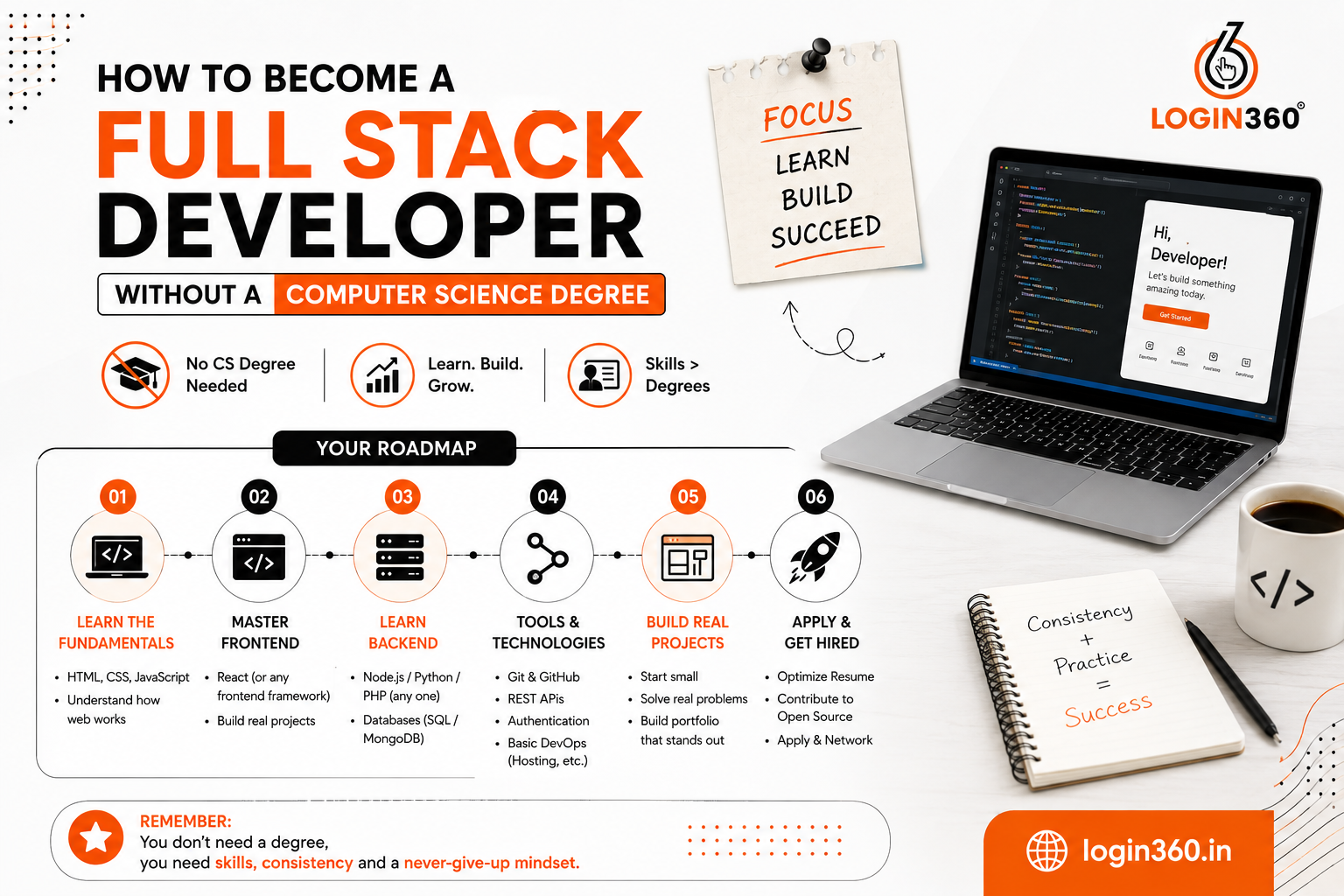
One of the biggest mistakes beginners make is trying to learn multiple programming languages at the same time. Instead, create a step-by-step learning roadmap that focuses on one skill before moving to the next. Begin by understanding how websites work, then gradually progress through front-end development, back-end programming, databases, and deployment. Following a structured learning path helps you stay motivated, reduces confusion, and ensures that every new concept builds upon the previous one. A well-planned roadmap also makes it easier to track your progress and identify areas that need improvement.
Learn Modern Front-End and Back-End Technologies
To become a successful full stack developer, you need to understand both the client side and server side of web applications. Start with HTML and CSS to build the structure and design of web pages, followed by JavaScript to add dynamic functionality. Once you have mastered these basics, learn popular front-end libraries like React or frameworks such as Angular or Vue.js. On the back end, explore technologies like Node.js with Express, Python with Django, or PHP with Laravel. Alongside programming, gain experience working with relational and NoSQL databases such as MySQL and MongoDB. Understanding APIs, authentication, and version control using Git will further strengthen your technical foundation.
Gain Confidence by Building Practical Applications
Learning theory alone will not make you job-ready. The most effective way to improve your development skills is by creating real applications that solve everyday problems. Begin with simple projects like a responsive portfolio website, a notes application, or a calculator. As your knowledge grows, move on to more advanced applications such as online shopping platforms, employee management systems, blogging websites, or chat applications. Every project teaches valuable lessons about debugging, performance optimization, and writing clean code. Practical experience also helps you understand how multiple technologies work together in real-world software development.
Showcase Your Work Through an Outstanding Portfolio
When you do not have a computer science degree, your portfolio becomes your strongest marketing tool. Design a professional portfolio website that highlights your best projects, technical expertise, certifications, and achievements. Include detailed project descriptions explaining the problem you solved, the technologies you used, and the features you implemented. Add links to live demos and GitHub repositories so recruiters can review your work. A consistently updated portfolio reflects your commitment to learning and gives employers confidence in your abilities, often making a greater impact than academic qualifications.
Develop Strong Programming Logic
Professional developers are valued not only for writing code but also for solving complex problems efficiently. Strengthen your logical thinking by practicing coding exercises regularly and learning the fundamentals of algorithms and data structures. Understanding concepts such as arrays, linked lists, sorting techniques, recursion, and object-oriented programming will improve your ability to write optimized and maintainable code. Strong analytical skills also make technical interviews easier and prepare you to work on large-scale software projects with confidence.
Gain Industry Experience Before Applying for Full-Time Roles
Employers appreciate candidates who have practical development experience, even if it comes from freelance work or personal projects. Look for internships, freelance assignments, hackathons, volunteer opportunities, or open-source contributions to gain exposure to professional development environments. Working on real projects helps you improve teamwork, communication, time management, and client interaction skills. It also allows you to understand software development methodologies like Agile and Scrum, making your transition into a full-time developer role much smoother.
Stay Updated with Emerging Technologies
Technology evolves rapidly, and successful developers understand the importance of continuous learning. After mastering the fundamentals, expand your knowledge by exploring cloud computing, containerization with Docker, DevOps practices, TypeScript, testing frameworks, and AI-powered development tools. Follow technology blogs, watch webinars, participate in developer communities, and contribute to technical discussions to stay informed about industry trends. Keeping your skills current ensures you remain competitive in the job market and opens doors to more advanced career opportunities.
Conclusion
Building a career as a full stack developer without a computer science degree is no longer a distant dream. Success depends on your willingness to learn, practice consistently, and build practical solutions rather than relying solely on academic qualifications. By following a structured learning path, mastering essential technologies, developing real-world projects, creating a professional portfolio, and continuously improving your skills, you can confidently compete with graduates from traditional computer science programs. The technology industry rewards talent, creativity, and persistence, making this the perfect time to begin your journey toward becoming a successful full stack developer.

 English
 Arabic
 French
 Spanish
 Portuguese
 Deutsch
 Dutch
Dutch
 Italiano
 Russian
 Romaian
 Portuguese (Brazil)
 Greek
Greek
