


 Downloader
 Free FTP
Promote Your Product
Got a product, service, or story to share? Promote it directly to our active community and boost your brand today.
Create an Ad
Publish Bulk Blog Posts
Boost Your Reach! 📝
Have articles, guest posts, or bulk stories to publish? Send your content directly to our editorial team and feature on our platform.
Email Us Your PostsSPARK Matrix™: Software Asset Management, Q3 2025 – Market Trends and Vendor Analysis
Organizations today rely on hundreds—even thousands—of software applications to power business operations, enable collaboration, and drive innovation. As enterprises embrace hybrid work, cloud computing, and Software-as-a-Service (SaaS), managing software assets has become increasingly complex. Without a centralized strategy, businesses risk overspending on unused licenses, facing costly compliance audits, and losing visibility into their software ecosystem. This growing complexity has elevated Software Asset Management from an administrative function to a strategic business discipline that helps organizations maximize technology investments while reducing financial and operational risks.
Digital transformation has accelerated software adoption across every industry. From enterprise resource planning (ERP) and customer relationship management (CRM) systems to collaboration platforms, cybersecurity solutions, and specialized business applications, organizations are continuously expanding their software portfolios. However, this rapid growth also introduces challenges related to license optimization, vendor management, compliance, software lifecycle governance, and cost control. As a result, enterprises are increasingly adopting intelligent Software Asset Management (SAM) platforms to gain comprehensive visibility and control over their software environments.
QKS Group's Software Asset Management market research provides a comprehensive assessment of the global SAM landscape, examining emerging technology trends, evolving market dynamics, competitive developments, and future opportunities. The research equips technology vendors with valuable market intelligence while helping enterprises evaluate vendor capabilities, competitive differentiation, and long-term strategic value.
Software Asset Management is an intelligent solution designed to manage, monitor, and optimize software assets throughout their entire lifecycle. Modern SAM platforms automate critical activities such as software discovery, license reconciliation, compliance monitoring, contract management, usage analytics, and renewal planning. By eliminating manual processes and improving software visibility, organizations can optimize software investments while reducing operational complexity.
One of the primary drivers behind the rapid adoption of Software Asset Management solutions is the continued growth of SaaS applications. Enterprises often subscribe to numerous cloud-based applications across different departments, creating challenges related to license duplication, shadow IT, and subscription management. Advanced SAM platforms provide centralized visibility into SaaS usage, enabling organizations to eliminate redundant licenses, improve governance, and optimize subscription spending.
Artificial intelligence and automation are reshaping the Software Asset Management market. AI-powered analytics enable organizations to identify underutilized software, predict future licensing requirements, automate compliance reporting, and recommend cost-saving opportunities. Intelligent automation reduces administrative effort while allowing IT teams to focus on higher-value strategic initiatives.
Software compliance continues to be a major concern for enterprises operating in complex IT environments. Software vendors frequently conduct licensing audits, and organizations lacking accurate license records may face unexpected financial penalties. Modern SAM platforms help businesses maintain continuous compliance by automatically tracking software installations, monitoring license consumption, and identifying potential compliance gaps before they become costly issues.
Another significant trend influencing the market is the increasing convergence of Software Asset Management with IT Asset Management (ITAM), IT Service Management (ITSM), and FinOps initiatives. Organizations are seeking unified platforms that provide complete visibility across hardware, software, cloud infrastructure, and digital services. This integrated approach enables better decision-making, streamlined operations, and improved financial governance across enterprise IT environments.
Cloud migration is further driving innovation within the SAM market. As organizations adopt hybrid and multi-cloud strategies, managing software assets across on-premises infrastructure, private clouds, and public cloud environments has become increasingly challenging. Cloud-enabled SAM platforms offer centralized management capabilities that support dynamic software environments while improving scalability and operational efficiency.
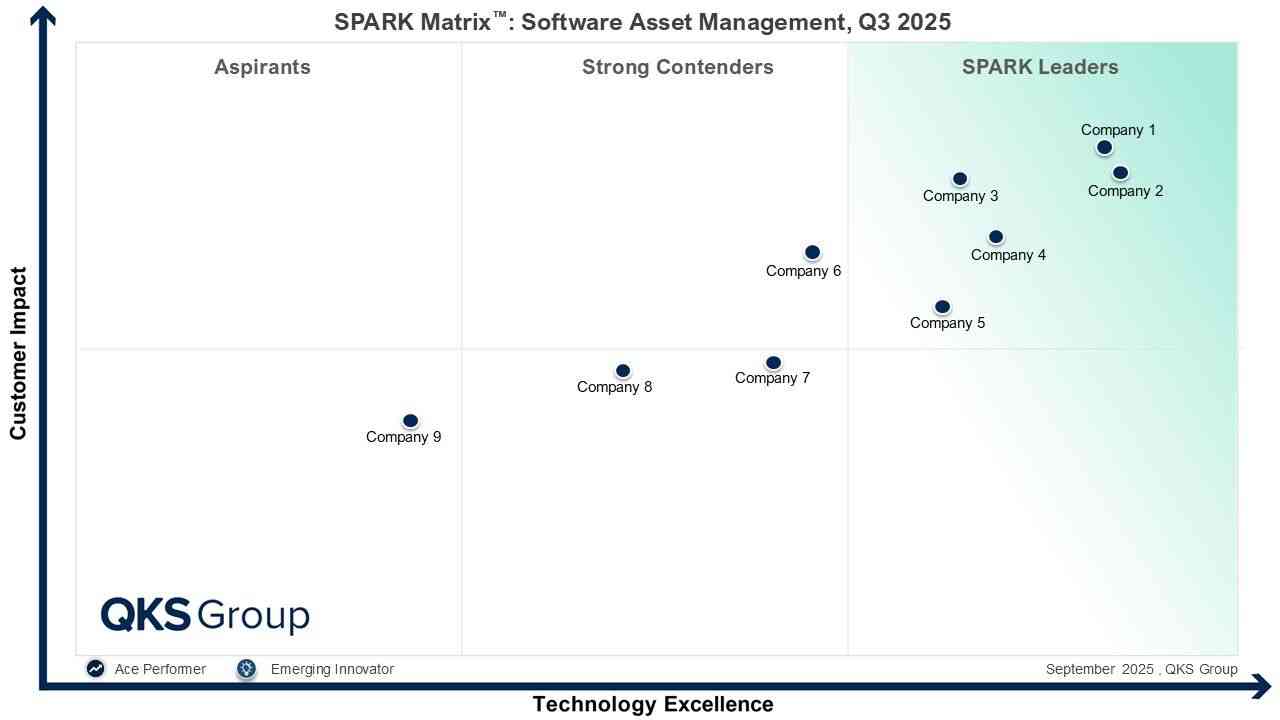
QKS Group's proprietary SPARK Matrix™ provides a detailed evaluation of leading Software Asset Management vendors based on technology excellence and customer impact. The framework enables enterprises to compare vendors across multiple dimensions, helping decision-makers identify solutions that align with their business objectives and digital transformation strategies.
The SPARK Matrix™ evaluates leading vendors including Belarc, BMC Software, Flexera, Ivanti, Matrix42, OpeniT, OpenLM, ServiceNow, and USU Solutions. These organizations continue investing in AI-driven analytics, cloud-native architectures, SaaS optimization, automation capabilities, and advanced reporting to address the evolving requirements of enterprise software management.
The future of Software Asset Management will be defined by intelligent automation, predictive analytics, and greater integration with enterprise technology ecosystems. Organizations will increasingly rely on AI-powered insights to forecast software demand, optimize license utilization, automate procurement decisions, and strengthen software governance across hybrid environments.
Cybersecurity considerations are also expanding the role of SAM. Maintaining an accurate inventory of software assets enables organizations to identify unsupported applications, outdated software versions, and security vulnerabilities that could expose the business to cyber threats. As software supply chain security becomes a strategic priority, SAM solutions will play an increasingly important role in reducing organizational risk.
In addition, sustainability initiatives are encouraging organizations to optimize digital resources and eliminate unnecessary software consumption. Efficient software lifecycle management contributes to improved IT resource utilization while reducing unnecessary operational costs and environmental impact associated with overprovisioned technology assets.
As enterprises continue accelerating digital transformation, Software Asset Management will remain essential for balancing innovation with governance. Organizations that invest in intelligent SAM platforms will be better positioned to optimize technology spending, improve compliance, strengthen cybersecurity, and maximize business value from their software investments.
QKS Group's SPARK Matrix™ serves as a trusted resource for organizations evaluating Software Asset Management vendors and market trends. By delivering comprehensive competitive analysis, technology assessments, and strategic market insights, the research empowers both technology providers and enterprise buyers to make informed decisions in an increasingly dynamic software management landscape. As software ecosystems continue to evolve, Software Asset Management will remain a cornerstone of efficient, secure, and cost-effective enterprise IT operations.

 English
 Arabic
 French
 Portuguese
 Deutsch
 Turkish
 Dutch
Dutch
 Italiano
 Russian
 Romaian
 Portuguese (Brazil)
 Greek
Greek
