


 Downloader
 Free FTP
Promote Your Product
Got a product, service, or story to share? Promote it directly to our active community and boost your brand today.
Create an Ad
Publish Bulk Blog Posts
Boost Your Reach! 📝
Have articles, guest posts, or bulk stories to publish? Send your content directly to our editorial team and feature on our platform.
Email Us Your PostsHow 3D Geo Mat Combines Strength, Flexibility, and Sustainability
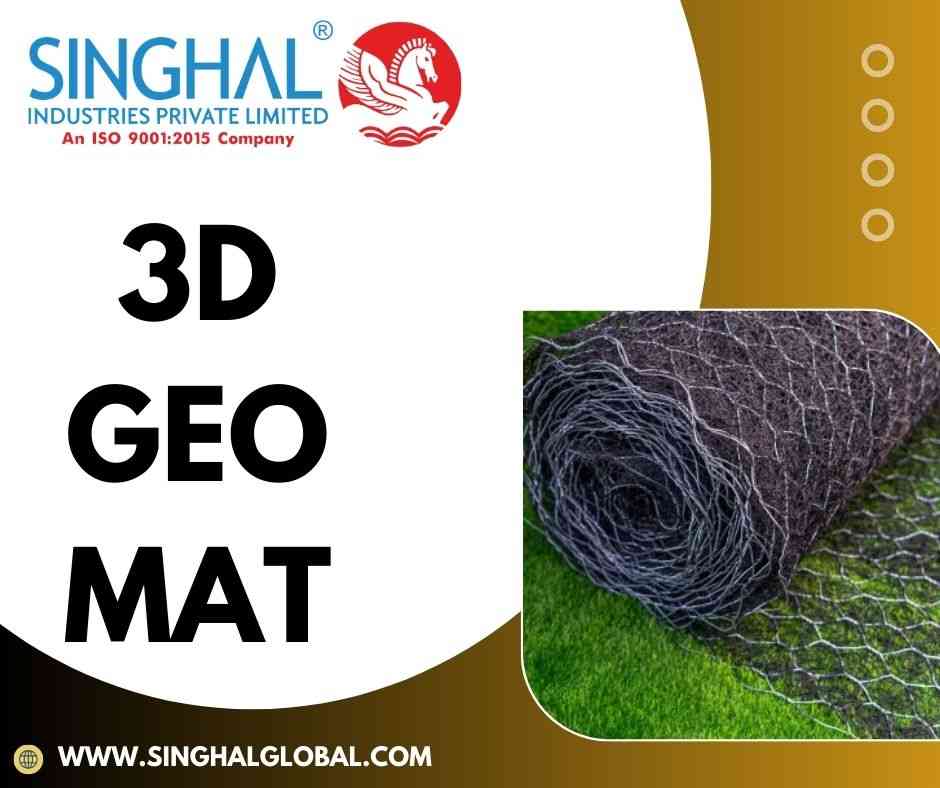
The 3D geomat is not only a plastic membrane, but also a strong three-dimensional net, which will retain soil particles while remaining pliable.-This feature attracts many engineers, who appreciate the ability to combine strength and lightness, unlike in concrete materials. Soil particles are held together with the help of 3D geomat, thus, rainwater cannot move soil particles from their positions. Isn’t strength sufficient enough in this case? No, because excessive rigidity may result in cracking under the pressure of irregularities of the surface. 3D geomat overcomes this problem through its flexibility.
A Flexible Material Designed for Real, Imperfect Terrain
Real slopes are never perfectly smooth. They are always irregular in shape, full of obstructions, and even prone to movement in some cases. Rigid materials would easily break under such stress, whereas the 3D geomat can adapt to terrain changes because of its flexible nature. Just imagine that it can stretch somewhat, bend over obstacles, and yet hold the soil inside. It is often claimed that "won't the mat sag?" Of course not, if proper fasteners are used to secure it properly both at its top and bottom.
Sustainability: Less Concrete, More Green, Less Carbon Emissions
And this is the green side: 3D geomat is used to reduce the amount of concrete, and this means carbon reduction, too. Concrete production requires energy resources. Geomat is made of polymers, it is UV stabilized, and it is durable. And then plants start growing on top of it. Roots start forming on it, and the slope turns into a protective green cover. Gradually, geomat becomes passive while plants become active. Doesn’t it sound much better than a bare rock? Yes, of course, since there is erosion control, higher biodiversity, improved appearance, reduced temperature of runoff water, pollution reduction, and sometimes geomat is used to comply with environmental regulations. But wait—isn’t it decomposed under the sun? No, not most modern geomats.
How It Works: Soil Entrapment, Water Permeability, and Root Entrenchment
The three-dimensional framework forms pockets, which are filled with soil, water moves through them, and the roots grow within. The effect is minimal erosion and decreased pore pressure, which could result in landslides. Upon rainfall, there isn’t going to be water accumulation under an impenetrable layer, but its free movement. That is critical for slopes, where the water accumulation might otherwise lead to slope movement and sliding. Besides, the mat prevents small soil particles from being washed away by rain, providing stability at the surface level. With time, vegetation grows right into the pockets, thus increasing their stability through root entrenchment and holding back the upper soil layer with the mat’s help.
Where to See it: Roads, Channels, Slopes, and Industrial Sites
It can be found in highways, railway cuts, slope channels and stormwater channels. Geomat is applied in cities for park terraces, golf course berms, and hillsides. For industrial use, it is applied at stockpiles and buffer areas. Can geomat replace concrete in channels? Occasionally, especially when water does not flow too rapidly. However, when the flow is rapid, geomat is usually combined with stones and sometimes concrete. Why combine the two? Geomat will protect the soil while stones deal with the rapidity of the water. This method is efficient and economical.
Market in India: Exporters, Manufacturers, Local Supplies
There is an emerging market for 3D geomat in India. When buying goods, look out for “3D geomat exporter India” or “3D geomat manufacturer India.” Local suppliers will make prompt deliveries and give you proper guidance. The exporters will attend to bulk orders that will be sent abroad. However, there are distinctions in the quality of the products, some being low-priced and flimsy while others strong and UV resistant. Ensure that the products tested have excellent tensile strength, UV resistance, and stability. There are some suppliers that offer assistance in designing materials for steep surfaces and high erosion areas. It’s best to go with a trusted brand to avoid further delays and redesigning.
Singhal Industries Pvt Ltd and Trusted Brands in the Industry
From the companies mentioned above, Singhal Industries Pvt Ltd is notable for geomat and geosynthetic solutions in earthworks and drainage projects. Consider the specifications, warranty, and installation instructions while selecting the right brand. Does larger mean better all the time? Not necessarily. In some cases, small firms might be more accommodating. What you should do is verify performance records by consulting clients that use the same product. In India, there are many mid to large manufacturers competing, and Singhal Industries Pvt Ltd is one such manufacturer in the category.
Conclusion
3D Geomat has features that make it stronger, flexible and sustainable than concrete. This includes being capable of retaining soils, working on realistic slopes, and enabling vegetation to grow. In case of projects located in India, you will be able to find reliable suppliers by using terms like "3D geomat exporter India" and "3D geomat factory India." Singhal Industries Pvt Ltd is one of such companies. The outcome will be safe embankments, clear channels, and improved aesthetics. Doesn’t it sound good.
FAQs
Question No. 1 - For how long will the 3D geomat take before vegetation starts covering it up entirely?
Most geomats start showing visible coverage after six months and achieve full root development within 12 to 24 months. These mats will continue to survive for 20 years or more when treated with UV stabilizers.
Question No. 2 - Can 3D geomats be used on slopes that exceed 45 degrees?
Yes, but only with proper anchorage and even an underlay geotextile layer in some cases. Extreme angles might require slope terrace construction or improved drainage to relieve water pressure.
Q3. Does 3D geomat restrict water passage?
No, because it allows water movement with soil retention which reduces pore pressures and avoids slippery layers of soil.
Q4. How long does it take to install 1000 sq.m. of 3D Geomat on a slope?
An expert team can install 1000 square meters in 1 to 2 days based on access of slopes and soil type. Anchorages and backfilling will be the major time-consuming processes.
Q5. Who is the largest manufacture of 3D Geomat ?
There is no named company that manufactures the largest amount of 3D geosynthetic mats globally. Several large companies manufacture the material in Asia, Europe, and North America. But in India, it cannot be named because there is a competition between many medium-to-large-scale manufacturers who manufacture it. Singhal Industries Pvt Ltd is one of them.

 English
 Arabic
 French
 Spanish
 Portuguese
 Deutsch
 Dutch
Dutch
 Italiano
 Russian
 Romaian
 Portuguese (Brazil)
 Greek
Greek
