


 Downloader
 Free FTP
Promote Your Product
Got a product, service, or story to share? Promote it directly to our active community and boost your brand today.
Create an Ad
Publish Bulk Blog Posts
Boost Your Reach! 📝
Have articles, guest posts, or bulk stories to publish? Send your content directly to our editorial team and feature on our platform.
Email Us Your PostsHow Technical Debt Is Quietly Slowing SaaS Growth in Modern AI Products
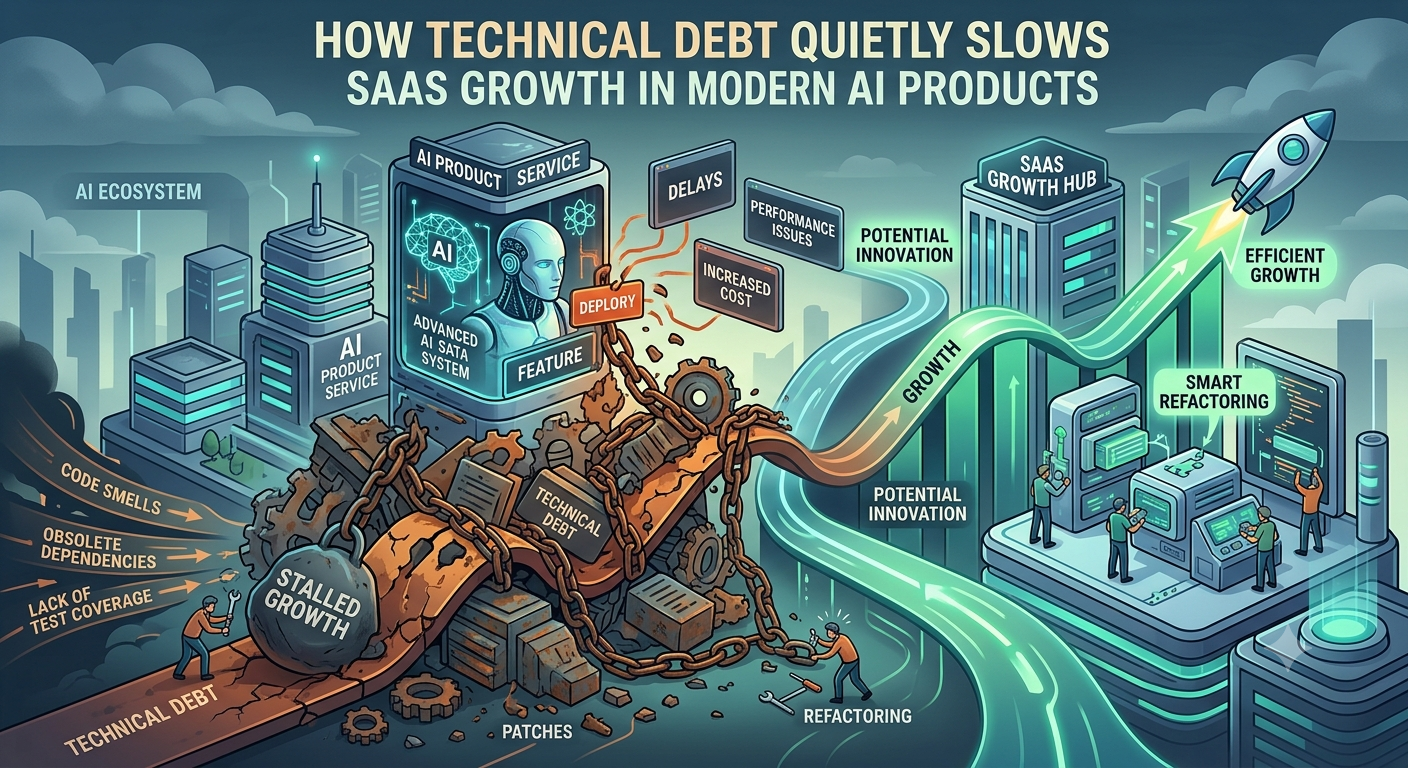
The SaaS industry is evolving rapidly as artificial intelligence becomes deeply integrated into modern digital products. Businesses across industries are embedding AI capabilities into customer support platforms, workflow automation systems, enterprise analytics products, cybersecurity tools, marketing platforms, fintech ecosystems, and operational software environments.
For many SaaS companies, AI adoption creates significant opportunities for innovation and competitive differentiation. However, it also introduces a growing challenge that many businesses underestimate during rapid growth phases: technical debt.
At Triple Minds, we frequently work with SaaS businesses that scaled quickly after integrating AI capabilities into their products. In many cases, the companies achieved strong market traction, growing customer adoption, and increasing infrastructure expansion. Yet internally, engineering teams often struggled with fragmented workflows, backend inefficiencies, unstable deployments, and increasingly difficult software maintenance cycles.
This problem rarely appears suddenly.
Instead, technical debt accumulates gradually as products evolve faster than the architecture supporting them.
Initially, businesses may continue growing successfully despite these inefficiencies. However, over time, fragmented systems begin slowing development velocity, increasing cloud costs, reducing operational flexibility, and limiting the company’s ability to scale efficiently.
This is exactly why Vibe Coding Cleanup Services are becoming increasingly important for SaaS businesses operating inside modern AI ecosystems.
At Triple Minds, we believe sustainable growth depends heavily on whether software systems can continue evolving without generating excessive operational complexity.
Why AI-Powered SaaS Products Accumulate Complexity Faster
Traditional SaaS products already involve substantial backend coordination. Most platforms today rely on:
- distributed APIs
- cloud-native infrastructure
- authentication systems
- real-time data workflows
- deployment automation
- third-party integrations
AI-powered ecosystems significantly increase this complexity.
Modern AI-driven SaaS products often require:
- real-time inference systems
- dynamic orchestration workflows
- contextual processing pipelines
- intelligent automation layers
- continuous data synchronization
- distributed infrastructure coordination
At Triple Minds, we’ve observed that engineering teams often prioritize feature velocity during early scaling phases. This is understandable because SaaS businesses operate in highly competitive markets where rapid iteration directly impacts growth.
However, speed-focused development frequently creates:
- duplicate backend logic
- temporary integrations becoming permanent systems
- inconsistent infrastructure patterns
- tightly coupled services
- inefficient orchestration environments
Over time, these architectural inefficiencies compound across the ecosystem and begin reducing operational scalability significantly.
This is why many SaaS companies are increasingly investing in AI consulting services earlier in their growth cycles to improve long-term infrastructure sustainability before technical debt becomes deeply embedded.
Why Technical Debt Becomes a Business-Level Problem
Technical debt is often viewed purely as an engineering concern. At Triple Minds, we believe this perspective is outdated for modern AI-driven SaaS businesses.
As products scale, technical debt begins affecting:
- product release velocity
- infrastructure spending
- deployment reliability
- engineering productivity
- AI experimentation speed
- customer experience stability
One of the biggest problems is that technical debt accumulates invisibly during periods of rapid growth.
Externally, products may appear highly successful. Internally, however, engineering teams gradually spend increasing amounts of time:
- troubleshooting unstable workflows
- managing deployment regressions
- coordinating fragmented services
- debugging orchestration inconsistencies
- maintaining legacy dependencies
Eventually, operational complexity slows innovation significantly.
At Triple Minds, we’ve seen SaaS businesses where engineering teams became hesitant to modify systems because even relatively small infrastructure changes introduced major deployment risks.
This creates long-term scalability limitations that become increasingly expensive to resolve over time.
Why AI Infrastructure Costs Increase So Quickly
One of the most common challenges modern SaaS businesses face after integrating AI capabilities is rapidly increasing infrastructure costs.
Many organizations initially assume rising cloud expenses are simply a natural consequence of AI scaling. In reality, fragmented architecture often amplifies infrastructure consumption substantially.
At Triple Minds, we frequently identify inefficiencies involving:
- redundant processing pipelines
- excessive API communication
- duplicate orchestration workflows
- inefficient compute allocation
- poorly optimized backend coordination
As operational complexity grows, these inefficiencies consume increasing infrastructure resources continuously.
Many SaaS businesses respond by:
- scaling cloud infrastructure
- expanding distributed environments
- increasing compute capacity
- adding orchestration layers
While this may improve short-term performance, fragmented systems continue generating operational waste underneath the surface.
Without architectural optimization, infrastructure spending frequently increases faster than product scalability itself.
This is one of the primary reasons businesses are increasingly combining:
- Vibe Coding Cleanup Services
- AI consulting services
- AI development services
to improve both scalability and infrastructure sustainability simultaneously.
Why Developer Productivity Declines in Fragmented SaaS Ecosystems
At Triple Minds, one of the most overlooked patterns we observe is how technical debt gradually reduces engineering productivity.
As systems become increasingly fragmented, developers spend more time:
- understanding legacy workflows
- debugging unstable infrastructure
- managing deployment failures
- coordinating across disconnected services
- maintaining orchestration dependencies
Eventually, engineering environments become reactive rather than innovative.
Instead of building scalable new capabilities, teams spend growing amounts of time maintaining operational stability.
This creates major business-level consequences:
- delayed product releases
- slower customer feature delivery
- reduced experimentation speed
- increased QA overhead
- declining engineering efficiency
Many SaaS businesses incorrectly assume scaling requires simply hiring larger engineering teams. In reality, fragmented architecture often reduces productivity regardless of team size.
This is exactly why maintainable software ecosystems are becoming a major competitive advantage for modern SaaS businesses.
Why AI Systems Expose Architectural Weaknesses Faster
AI ecosystems place continuous pressure on software architecture.
Modern AI-driven products require:
- real-time orchestration
- intelligent automation workflows
- continuous backend communication
- contextual data processing
- distributed operational scalability
At Triple Minds, we’ve observed that AI systems expose architectural weaknesses much faster than traditional applications.
For example:
- fragmented APIs increase inference latency
- tightly coupled systems reduce deployment flexibility
- inefficient orchestration slows automation workflows
- legacy dependencies create infrastructure instability
- redundant backend operations increase cloud consumption
Many businesses initially assume AI scalability problems originate from the models themselves. However, the surrounding software ecosystem is often the primary operational bottleneck.
This is why scalable AI adoption depends heavily on scalable backend infrastructure.
Why Full Rebuilds Are Becoming Increasingly Unsustainable
Historically, many SaaS businesses delayed optimization efforts until systems became extremely difficult to maintain. Eventually, organizations attempted complete platform rebuilds.
At Triple Minds, we’ve seen that full rebuilds frequently create significant operational risks:
- long redevelopment timelines
- infrastructure instability during migration
- product stagnation
- increased operational expenses
- delayed growth initiatives
More importantly, rebuilding systems without improving architectural discipline often recreates similar problems later.
This is why modern SaaS businesses increasingly prefer incremental optimization strategies through Vibe Coding Cleanup Services.
Instead of replacing entire ecosystems from zero, organizations can:
- optimize infrastructure progressively
- reduce technical debt incrementally
- improve workflows continuously
- maintain operational continuity
- continue scaling products during modernization
This approach is significantly more sustainable for fast-growing SaaS ecosystems.
How Triple Minds Approaches Vibe Coding Cleanup Services
At Triple Minds, we approach Vibe Coding Cleanup Services as a long-term scalability framework designed to improve software sustainability.
Our objective is not simply improving code organization. We focus on improving how software ecosystems operate internally as operational demands continue growing.
This often includes:
- simplifying backend workflows
- optimizing orchestration systems
- reducing redundant infrastructure dependencies
- improving deployment consistency
- enhancing modular architecture
- improving API communication efficiency
- reducing operational complexity across services
We believe scalable SaaS businesses require maintainable engineering environments capable of supporting continuous product evolution without excessive operational friction.
Why Sustainable Architecture Will Define Future SaaS Growth
The future SaaS market will become increasingly AI-driven, automated, and operationally complex.
Businesses operating on fragmented systems may increasingly struggle with:
- rising infrastructure expenses
- slower innovation cycles
- declining engineering productivity
- deployment instability
- difficulty integrating future AI technologies
Meanwhile, companies investing early in maintainable architecture and scalable software ecosystems will gain major long-term advantages involving:
- operational agility
- infrastructure efficiency
- engineering velocity
- deployment reliability
- sustainable scalability
This is exactly why:
- Vibe Coding Cleanup Services
- AI consulting services
- AI development services
are becoming foundational modernization strategies for future-ready SaaS businesses leveraging technologies such as Claude AI solutions.
Conclusion
At Triple Minds, we believe technical debt is becoming one of the most important hidden barriers affecting scalability across modern AI-driven SaaS products.
As software ecosystems become increasingly interconnected and operationally demanding, fragmented workflows, backend inefficiencies, and unstable infrastructure patterns gradually reduce engineering efficiency, deployment reliability, and long-term scalability.
This is exactly why Vibe Coding Cleanup Services are becoming essential for SaaS businesses trying to scale AI-driven products sustainably.
In modern software ecosystems, long-term growth no longer depends only on rapid product development. It depends on whether infrastructure and architecture can continue evolving efficiently as operational complexity increases.

 English
 Arabic
 French
 Spanish
 Portuguese
 Deutsch
 Turkish
 Dutch
Dutch
 Italiano
 Russian
 Romaian
 Greek
Greek
